First frost usually comes without warning, and pipes in an unheated crawl space can be at risk overnight. A thermostat changes how the heater behaves once temperatures drop.
Owners of older homes and pump houses often buy a heater without a thermostat and then fight constant on and off cycling or wasted power. Matching the unit to the space and its temperature swing is how we narrow down the best crawl space heater with thermostat.
We grouped our picks by room and job: small pump houses, milkhouse style spaces, and larger crawl areas. Our comparison weighed wattage, thermostat type, build materials, and safety features, drawing on product data and owner feedback to match each unit to the right space.
Top 3 Picks for Best Crawl Space Heater with Thermostat


How to Choose the Best Crawl Space Heater with Thermostat
A good crawl space heater comes down to how well it holds a set temperature in a cold, damp, enclosed space. We researched product data, owner feedback and expert guidance, comparing heat types, wattages and safety features. Our picks favor heaters that switch on and off on their own and can run safely unattended under a house.
Match the Heat Type to the Space
Ceramic fan heaters warm a small crawl space quickly and move air around, which helps with damp. Oil-filled units heat slowly but hold warmth steadily and run quietly. Infrared warms nearby surfaces rather than the air, while convection heaters circulate gentle warmth without a fan. For most crawl spaces, a small fan-forced or convection unit with a thermostat suits the tight, enclosed conditions best.
Wattage, Room Size and Circuit Limits
Small pump houses and well houses often need only 600W to 800W, while larger crawl areas may call for 1500W. A standard household circuit usually carries about 15 amps, roughly 1800W, so a 1500W heater can use most of that capacity. Check what else shares the circuit before adding a heater, and size the wattage to the space rather than the maximum.
Safety Cut-Offs, Thermostat and Timer
Because these heaters run unattended in dusty, sometimes damp areas, built-in overheat protection and a tip-over switch matter. A reliable adjustable thermostat keeps the space above freezing without wasting power, and a timer adds control for occasional use. We favored models with clear thermostat dials or digital controls and safety cut-offs, since owner feedback often flags units that cycle poorly or lack proper protection.
Quick Comparison: All 10 Picks
Our Picks, Reviewed One by One
Our Top Pick
1. AEGONAN 600W Pump House Heater with Thermostat, 120V Freeze Protection

We researched the AEGONAN 600W Pump House as a convection heater built for freeze protection rather than comfort heating, and our comparison of the product data shows its 600W draw and slim horizontal shape suit pump houses, well houses, utility rooms and relay stations where the job is keeping pipes and equipment above freezing through cold snaps.
Owner feedback we reviewed commonly points to this kind of space sitting unattended for weeks, which makes the built-in control the point here, since heat that switches itself on and off without anyone checking is what these rooms need.
The listing states a built-in thermostat with a digital display, so you set a target and the heater handles the rest, with the screen showing room temperature by default and the preset value once you set it. Heat moves by convection across X-shaped aluminum fins, which the listing says gives extra heat transfer performance, spreads warmth more quickly and avoids power wastage.
Double safety comes from a current overload protector and a thermal cut-off fuse, and with no moving parts there are no fans to wear out or maintain. Powder-coated epoxy steel and aluminum resist rust and extend heater life.
The trade-off is output. At 600W this is a gentle, slow convection heater, so it holds a small, reasonably insulated pump house steady but will not rescue a large or drafty shed in a hard freeze. Anyone heating a bigger, leakier space, or wanting fast warm-up from forced-air equipment, should pick something else.
2. BEYOND HEAT 1500W Milkhouse Space Heater with Thermostat

BEYOND HEAT 1500W Milkhouse is a portable electric space heater in the milkhouse style, with a solid carry handle and a footprint small enough to move between rooms. It suits a buyer who wants thermostat-controlled warmth in a bedroom, study, bathroom, office or small utility area, and who may also want to park it somewhere cold-prone for anti-freeze duty. The handle and light weight make it easy to shift as needs change.
Power settings are the practical core: fan-only, 1300W and 1500W, so you can match output to the space. The anti-freeze setting turns the heater on whenever the temperature drops below 40F, which is the feature that matters most for freeze protection. Safety is covered by a tip-over switch that cuts power if the unit falls, plus automatic overheat protection inside the body.
The listing says it heats small spaces in seconds and is ETL certified, with heavy-duty construction for a long service life.
The limit is that this is a small-space heater with a fan, so it is not a substitute for a fixed convection unit holding a whole pump house steady through winter, and a fan adds a moving part and some noise. Buyers with a larger, drafty outbuilding, or anyone wanting silent, set-and-forget freeze protection, should look at a low-wattage convection model instead.
3. GMKYH 600W Utility Heater with Thermostat, 120V Pump House Heater

GMKYH 600W Utility Heater is a compact convection unit built for enclosed utility areas where pipes sit exposed to winter cold. Owners of well houses, pump rooms, crawl spaces and small sheds are the intended users, since the listing sizes it for roughly 80 to 110 square feet under suitable conditions.
Its job is holding a steady temperature rather than blasting a room with hot air. For a thermostat-focused setup, that passive approach suits spaces where you want gentle, constant freeze protection and no fan noise.
Two digital screens are the headline feature here. One shows the current room temperature and the other shows your target, so checking the thermostat setting does not require a separate thermometer. The range runs from 40 to 105 degrees, which covers freeze protection and a bit of warming headroom. Heating comes from natural convection with no fan, so there is no forced airflow and no blower noise.
The main limit is reach. Convection without a fan moves heat slowly, and the listing caps coverage at about 80 to 110 square feet, so a larger crawl space or a drafty outbuilding will likely stay uneven. Mounting also needs care, since horizontal installation requires the control panel facing up to keep the temperature sensor clear. Buyers heating a bigger or leakier space should look at a fan-forced unit instead.
For a small, sealed utility room where quiet operation and an accurate thermostat matter more than fast heat, this unit fits the brief. Anyone who needs to push warmth across a long crawl space or through open framing should pick a different design.
4. Pump House Heater with Built-In Thermostat, Well House Heater

Pump House Heater is a convection heater aimed squarely at freeze protection in pump rooms, utility rooms, well houses and crawl spaces. The design targets remote or unattended locations, which shapes everything about it. It is meant to run through the cold season and keep critical equipment above freezing. For a thermostat-driven setup, that continuous, low-attention operation is the point.
The listing leans on simplicity and durability. There are no wear-prone moving parts and no maintenance schedule, so the unit can operate continuously through winter in places you rarely visit. A built-in thermostat with a digital display lets you set a target from 40 to 105 degrees, and the screen shows room temperature by default, switching to the preset value while you adjust it.
Heat comes from X-shaped aluminum fins, which increase surface area so warmth dissipates faster through convection. Safety is handled by current overload protection plus a thermal fuse, a dual safeguard for an appliance running unattended. A two year warranty backs it.
The trade-off is speed and spread. Convection through fins warms quietly but slowly, so a large or drafty crawl space will not heat evenly, and there is no fan to push air into corners. Buyers who need fast recovery or coverage across a big, leaky space should choose a fan-forced heater instead. This one suits small, enclosed rooms where steady background warmth and a reliable thermostat are what count.
5. Well House Heater with Thermostat 1000W 120V Pump Heater

On paper, We researched the Well House Heater as a wall-mounted electric unit intended to keep pumps, pipes and pressure tanks from freezing in enclosed utility spaces. Our comparison of the product data places it in pump houses, well houses, garages and sheds where equipment sits in a compact area and heat needs to hold through cold snaps.
The 1000W element runs on standard 120V power, matching the kind of circuit these outbuildings commonly have, and wall mounting keeps the floor clear around tanks and plumbing. The listing describes it as suitable for a pump house heater, well house heater or freeze prevention heater in enclosed utility spaces.
From our research, the features that matter most center on automatic control and safety. The built-in thermostat turns the heating function on and off on its own to help maintain the selected temperature, so there is no frequent manual adjustment on freezing nights. Two-stage resettable overheat protection adds a backup layer: the primary internal control disconnects heating at approximately 176°F (80°C), and a secondary resettable protector activates at approximately 203°F (95°C) with a tolerance of ±9°F (±5°C).
The trade-off we note is that this is a 1000W unit with no stated coverage area, so it is aimed at small, enclosed equipment spaces rather than larger rooms. Buyers heating a bigger crawl space or an open shed should pick a higher-output model with a stated square-foot rating instead.
6. 800W Electric Pump House Heater, 120V Well House Heater with Thermostat
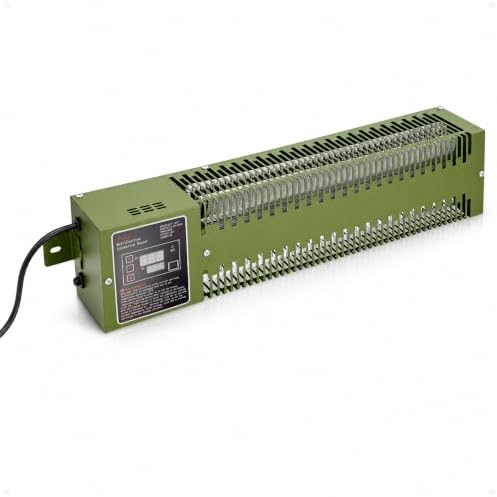
At first glance, We researched the 800W Electric Pump House, a convection utility heater with a digital thermostat built for small, enclosed spaces like pump houses, crawl spaces, well houses, utility rooms and sheds. Based on the product data and owner feedback we compared, it suits an owner who wants to set a target temperature and read the actual room temperature at a glance without crouching in a tight space with a separate thermometer.
The 800W output is described as giving a faster warm-up in the same sized space than lower-wattage models, which helps when the job is protecting pipes and equipment during a cold snap.
From the listing, the dual digital screens matter most, since they show both the current room temperature and the target setting, and the adjustable range runs from 40°F to 105°F. Heating is fanless convection, with the listing stating coverage of roughly 80 to 110 square feet, so heat circulates naturally and evenly without noticeable airflow or excess noise.
A built-in thermostat holds the selected temperature automatically, backed by overheat protection and automatic power cut-off for long winter operation. Placement is flexible, with both wall-mounted and floor options, and the 8.2 ft power cord helps in hard-to-reach spots. A 2 year manufacturer warranty is listed.
The trade-off is coverage. At 80 to 110 square feet, this unit is meant for small enclosed spaces, and the fanless design moves heat slowly compared with a fan-forced heater. Anyone heating a larger crawl space or a room beyond that footprint should pick a higher-output model with a broader stated coverage area.
7. BEYOND HEAT 1500W Milkhouse Space Heater with Thermostat

Sold as a two-pack, the BEYOND HEAT 1500W Milkhouse is a portable electric heater that suits a buyer who wants to cover two small areas or keep a spare on hand. Our team looked at the product data and owner feedback for small-space heating, and this model fits a narrow job: keeping a crawl space, basement corner or utility area from going cold.
Around a crawl space, the anti-freeze setting is the detail that matters most, because it lets the unit switch on whenever the temperature drops below 40°F. That makes it a reasonable fit for a homeowner protecting pipes under a floor rather than heating a living room.
Two heat settings of 1300W and 1500W give a choice between gentler and faster warm-up, and the fan-only mode lets air move without adding heat. The tip-over switch cuts power if the unit falls, and an internal overheat device adds a second layer of protection. ETL certification backs up the safety claims, and the heavy-duty housing is described as durable for long service.
Premium heating elements bring warmth within seconds, which helps in a small, enclosed area where cold air gathers quickly.
The main limit is control. The thermostat is basic, so you set a level and let the anti-freeze function handle the coldest nights rather than programming exact temperatures. Anyone who wants app control, scheduling or humidity and VPD tracking should look at a grow-focused unit instead. For simple freeze protection in a crawl space, the two-pack covers more ground than a single heater would.
8. VIVOSUN AeroFlux 700W PTC Grow Tent Heater with Thermostat

VIVOSUN AeroFlux 700W PTC is a compact grow tent heater built for indoor gardeners who need steady warmth in a small enclosed space. Our research team looked at its thermostat-centred design, which tracks temperature and VPD in real time and adjusts output to support plant transpiration, and compared it with simpler heaters that only offer basic on and off control.
For a small greenhouse or a modest grow room, that level of control goes well beyond simple freeze protection. The space-saving shape, at roughly 9.45 inches tall and wide and 4.72 inches deep, fits where floor area is tight, and the black finish keeps it unobtrusive.
Five heat levels and PWM precision control let a grower match output to different growth stages, and the 700W PTC element is listed as 40% stronger than standard models. Local controls set a target temperature, while the app allows minimum temperature and target VPD adjustments. A Recipe feature programs day and night modes for a stable environment across the year.
Safety covers V0 flame-retardant materials, tip-over protection and overheat shutoff, which matters in a confined, often neglected space. Owner feedback we reviewed commonly mentions the thermostat holding temperatures evenly rather than cycling hard.
The trade-off is output and complexity. At 700W it is built for compact spaces, so a large or poorly sealed room may need more heat than it can deliver. Buyers who just want a dial and an anti-freeze setting may find the app and VPD features more than they need. Gardeners running a tent or small greenhouse will get the most from it.
9. Fanspex 1500W Integrated Digital Thermostat Heater for Greenhouse Garage

Fanspex 1500W Integrated Digital is a compact, portable heater built around a digital thermostat, and it is aimed at growers and hobbyists who need steady warmth in a greenhouse, grow tent or flower room. A single unit is rated for a maximum area of 120 square feet, so it suits small enclosed spaces rather than open rooms.
The 4.3 pound body and 9.8 by 9.1 by 8.3 inch footprint let it sit inside a tent without eating into growing area. For a thermostat setup, that small size matters because the sensor sits close to the plants it is protecting.
According to the listing, the integrated digital thermostat allows precise temperature control so plants stay in a consistent environment. The 1500W PTC heating module is described as delivering a large volume of hot air instantly, and the three modes cover high heat, low heat and fan only. A 24 hour timer with remote control makes scheduled on and off cycles easier to manage.
The design is also described as evenly distributing warmth to prevent cold spots that can harm plants. For thermostat driven plant care, those are the functions that matter most.
The main limit is coverage. The manufacturer recommends one heater for no more than 120 square feet and states that larger areas need multiple heaters, so a big crawl space or a long greenhouse will not be handled by one unit. A buyer heating a larger or poorly sealed area should look at a different, higher capacity option instead. Anyone with a small grow tent or greenhouse who wants precise, timer based control will find the fit much better.
10. TEMPWARE Milkhouse Space Heater, 1300W/1500W Heater with Thermostat

TEMPWARE Milkhouse Space Heater is a metal bodied utility heater with a thermostat, sized for garages, workshops and warehouses where the job is keeping temperatures from falling too far. Its anti-freeze setting is the detail that matters for cold, unused spaces: the heater turns on whenever the temperature drops below 40°F.
That makes it a sensible fit for a crawl space, shed or warehouse corner where the goal is freeze protection rather than comfortable room heat. The solid carry handle and compact shape let it move between spots as needed.
The listing states three adjustable power levels, fan only, 1300W and 1500W, so output can be matched to the conditions. Heating elements are rated to warm up in about 3 seconds, which helps when the thermostat calls for heat in a cold space. Safety features include automatic overheat protection that shuts the unit off if it gets too hot, plus a tip-over switch.
The metal construction is described as strong and durable, and the unit has passed ETL certification. For an unattended crawl space, those safeguards and the anti-freeze trigger are the core reasons to choose it.
The trade-off is that this is a small space heater with no stated square footage rating, and the listing describes it for relatively small spaces, so it will not hold temperature in a large or drafty crawl space on its own. Buyers heating a big, open area should pick a larger unit or plan for more than one heater. This one suits someone protecting a small, enclosed space from freezing who values a simple thermostat and solid safety features.
What It Costs to Run
Running cost comes down to two things: the wattage and the hours it runs. The table uses the power figures from the listings above, at the highest setting.
| Power | 1 hour | 4 hrs a day | 8 hrs a day |
|---|---|---|---|
| 600 W | 0.6 kWh | 2.4 kWh | 4.8 kWh |
| 700 W | 0.7 kWh | 2.8 kWh | 5.6 kWh |
| 800 W | 0.8 kWh | 3.2 kWh | 6.4 kWh |
| 1,000 W | 1 kWh | 4 kWh | 8 kWh |
| 1,500 W | 1.5 kWh | 6 kWh | 12 kWh |
Your bill shows a price per kWh; multiply it by the figure above for the cost. A thermostat or a lower setting cuts the hours at full power, so real use is often below these figures.
How We Picked
Each selection is based on the specifications provided for the individual model along with feedback posted by owners in reviews. We ignored marketing language and sales materials. Our approach involved examining technical details and going through user experiences to determine how these heaters perform in actual crawl spaces.
Wattage and heat output were assessed alongside thermostat style and range of adjustment, construction materials, safety functions such as overheat shutdown, and each unit’s ability to cope with moisture and dust.
Recurring themes in owner feedback determined which products made the cut. Positive comments frequently mentioned consistent warmth, dependable thermostats and straightforward installation, whereas negative ones tended to focus on loud fans, insufficient airflow for bigger areas and thermostats that deviate from the chosen setting.
Ranking the list involved aligning varied requirements and price points. Small, low wattage models work well for tight wells and pump houses, whereas greater output units with digital controls are better suited to larger or chillier areas.
Frequently Asked Questions
How Much Does a Crawl Space Heater with Thermostat Cost to Run, and What Decides That?
Running cost for a crawl space heater with thermostat comes down to three things: the wattage the unit draws, how long the thermostat keeps it on, and what you pay per unit of electricity. The thermostat matters more than most people expect. A unit that cycles on only when the space drops below the set point will run far less than one left on continuously, so a good thermostat turns the same wattage into a smaller bill.
We compared product data across models and found that heaters with adjustable or programmable thermostats give owners more control over runtime than fixed set point units.
The conditions in your crawl space also decide the cost. A damp, poorly sealed space loses heat faster, so the heater runs longer to hold temperature. Insulating the rim joists and sealing vents reduces that load.
Can a Crawl Space Heater with Thermostat Stay on Overnight or Run Unattended?
Most crawl space heater with thermostat models are designed for unattended operation, since the whole point is to hold a set temperature without someone checking on it. The thermostat is the safety feature here: it turns the element off once the space reaches the set point and back on when it drops.
We looked at product data and owner feedback and found that units with a built in overheat cutoff and a tip over switch are the ones owners trust to run overnight. A heater without those protections should not be left alone.
That said, unattended does not mean forget about it. Our research suggests checking the unit periodically for dust buildup on the element, a blocked intake, or a cord that has worked loose. Keep the heater clear of stored items and insulation, since crawl spaces collect clutter.
What Wattage Crawl Space Heater with Thermostat Do I Need for My Space?
Wattage for a crawl space heater with thermostat should match the volume of the space and how much temperature rise you need. A common rule of thumb is about 10 watts per square foot for a well insulated area, but crawl spaces are often poorly insulated and leaky, so sizing up helps the thermostat keep up on cold nights.
We compared product data and found most residential crawl space units fall in a range that suits small to medium spaces, while larger or very open crawl spaces need more output. The thermostat will cycle a slightly oversized unit less often, which owners report as steadier heat.
Start by measuring the square footage and noting how cold the space gets and whether the floor above feels cold.
Is a Crawl Space Heater with Thermostat Noisy?
Noise from a crawl space heater with thermostat depends on the type. Units that use a fan to push warm air move more heat but produce a hum or whoosh, and that sound carries through floors above. Radiant or convection models without a fan run silently but heat more slowly.
We compared product data and owner feedback and found that fan forced models are the ones people mention hearing through the floor, especially in quiet rooms. The thermostat itself is usually silent, so the heating method is what decides the noise level.
For most crawl spaces the noise is not a big issue because the space is separated from living areas by a floor and often insulation.
Is a Crawl Space Heater with Thermostat Safe Around Children and Pets?
Safety around children and pets starts with keeping the heater out of reach, and a crawl space is naturally separated from living areas, which helps. The bigger risks are inside the crawl space itself: a hot element, a loose cord, or a unit tipped over. We looked at product data and found that the safer crawl space heater with thermostat models include an overheat cutoff, a tip over switch, and a cool touch housing.
Those features matter if a pet or child ever gets into the space through an open access door.
Our research team recommends securing the crawl space access so kids and pets cannot enter, and mounting or placing the heater away from the entry. Keep the cord routed so it is not a trip or chew hazard.
Can I Plug a Crawl Space Heater with Thermostat into an Extension Cord or Power Strip?
A crawl space heater with thermostat draws a steady load, and that is why extension cords and power strips are a common concern. Most space heaters are meant to plug directly into a wall outlet on a dedicated circuit. Power strips and lightweight extension cords can overheat under a continuous draw, which is a fire risk.
We compared product data and owner feedback and found that manufacturers typically warn against using extension cords with these heaters. If a cord is unavoidable, it needs to be a heavy gauge cord rated for the heater’s wattage and kept short.
Our research suggests the better answer is to have an outlet installed near the heater or choose a model whose cord reaches a nearby circuit. Crawl spaces often have limited outlets, so plan the placement around power before you buy.
Final Thoughts
Our research team compared the product data, owner feedback and expert research to pick the best crawl space heater with thermostat for most buyers. The AEGONAN 600W Pump House earns that spot with its built in thermostat and compact pump house design. For larger spaces, the BEYOND HEAT 1500W Milkhouse offers more output for buyers heating a bigger crawl space.
Smaller utility areas suit the GMKYH 600W Utility Heater, which keeps power draw low for tight spots. Match the wattage to your space and insulation before you buy, since a heater that is too small will run constantly.