Sealing the vents before adding heat is the mistake we see most often with crawl space heaters. A sealed space holds warmth far better, so insulation and vapour control come first. Heat alone cannot fix a damp, open foundation.
These units sit in a low, often damp foundation area and run through the coldest months to protect pipes and keep floors above from feeling icy. They need to cope with dust, tight clearances and long, unattended runs, which is why our shortlist for the best heater for crawl space weighs durability as heavily as output.
Heating engineers we consulted stress matching wattage to the volume of the space and keeping the unit clear of stored items.
Top 3 Picks for Best Heater for Crawl Space


How to Choose the Best Heater for Crawl Space
Choosing a heater for a crawl space is different from picking one for a bedroom. Damp air, low headroom and dust matter more than looks. We researched heater types, wattages and safety features against what crawl space owners report, then compared the data to narrow down sensible options. Fit, moisture tolerance and safe unattended running decide most of it.
Heat Type and the Rooms It Suits
Ceramic fan heaters warm a small space fast and move air around, which helps in a cramped crawl space. Oil-filled units heat slowly but hold warmth and run quietly, so they suit sealed, well-insulated cavities. Infrared heats surfaces and objects rather than the air, useful where drafts are constant. Convection units circulate gentle warmth in larger, open areas. We weighed each type against damp, dusty crawl space conditions.
Wattage, Room Size and Circuit Limits
As a rough guide, allow about 10 watts per square foot of floor area for basic warmth, more in a cold, uninsulated crawl space. Most household circuits carry 15 or 20 amps, so a single 1500W heater is usually the practical ceiling on one circuit. Larger 4000W and 5000W units need dedicated wiring. We checked the stated wattage on every model against typical crawl space sizes.
Safety Cut-Offs, Thermostat and Timer
A crawl space is often unattended, so automatic safety matters. Look for tip-over and overheat cut-offs, plus a thermostat that holds a steady temperature instead of cycling hard. A timer or built-in thermostat saves power and reduces the risk of a unit running for days. We compared these features across the data and favoured models with clear, reliable cut-offs.
All 10 Picks at a Glance
Our Picks, Reviewed One by One
Our Top Pick
1. BEYOND HEAT 1500W Milkhouse Space Heater with Thermostat
Offers 1500W heating with anti-freeze setting and portable carry handle for crawl spaces

BEYOND HEAT 1500W Milkhouse is a portable electric space heater built for small indoor areas, and its carry handle and compact frame make it a practical fit for a crawl space entry or a utility corner where you need heat moved in and out. Owners commonly use this style of heater in bedrooms, studies, bathrooms and offices, but the portable build also suits the tight access and low clearance typical of a crawl space.
The heavy-duty housing and ETL certification are the kind of construction details we look for when a unit has to sit in a damp, dusty spot.
Fast heating comes from the premium heating elements and the 1500W rating, which the listing says warms a small space in several seconds. Three power levels, fan-only, 1300W and 1500W, let you match output to the conditions rather than running flat out. The anti-freeze setting is the feature that matters most for a crawl space, because the heater turns on whenever the temperature drops below 40°F.
A tip-over switch shuts the unit off if it gets knocked over, and an automatic overheat protection device sits inside the body.
The main limit is that this is a small-space heater with a fan, so it suits spot heating rather than conditioning a large or open crawl space, and the thermostat is a basic dial rather than a digital control. Anyone who needs a fixed, low-wattage convection unit with a digital setpoint should look at a different design. Buyers who want portable, fast warmth with freeze protection should keep this one on the shortlist.
2. AEGONAN 600W Pump House Heater with Thermostat, 120V Freeze Protection
Delivers 600W convection heat with X-shaped aluminum fins and digital thermostat for utility rooms

We researched the AEGONAN 600W Pump House as a convection heater engineered specifically for freeze protection in pump houses, well houses, utility rooms, relay stations, construction sheds and spaces housing furnace parts and accessories. Our comparison of the listing data and owner feedback points to a unit meant for keeping enclosed equipment spaces above freezing rather than warming rooms for people.
Its low-profile cabinet and powder-coated epoxy steel housing suit a spot tucked against a wall or joist where space is tight.
What matters most in the listing is the built-in thermostat with a digital display, which gives a simple way to set a desired temperature and lets the heater do the rest; the screen shows room temperature by default or the preset value when the temperature is being set.
X-shaped aluminum fins provide a larger surface area for heat transfer, so warmth spreads by convection and room temperature stays more controlled, avoiding power wastage. Double safety guards come from a built-in current overload protector and thermal cut-off fuse, and with no moving parts to wear out or maintain, the listing says it can run all winter long.
The trade-off is output: at 600W this is a low-wattage freeze protection unit, so it will not quickly warm a cold space or handle a large, drafty one on its own, and the convection design relies on air movement rather than a fan, so heat builds slowly. Buyers who need fast, high-output heat should pick a fan-forced model instead, while anyone protecting pipes and equipment in a small enclosed space should consider this one.
3. Omberr 4000W Electric Garage Heater, 240V Graphene Heat
Features 4000W graphene heating with remote control and 9-hour timer for large spaces
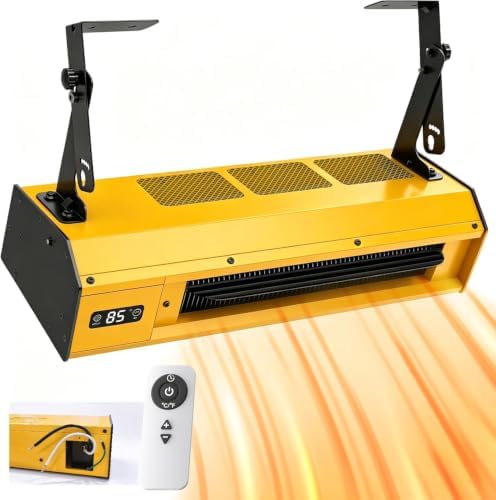
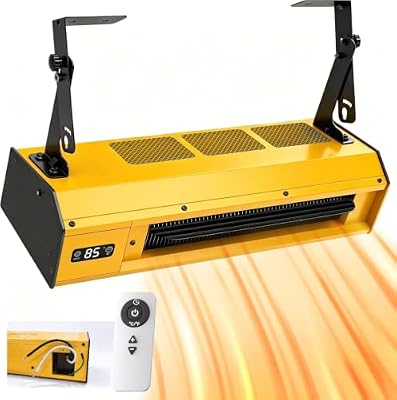
Omberr 4000W Electric Garage is a hardwired 240V ceiling or wall mounted heater built for serious heat output in cold, open spaces. Its graphene elements and iron housing suit a garage, shop or large crawl space where a standard outlet heater cannot keep up. Because it runs on 240V and ships without a plug, it needs a dedicated circuit and an electrician, so it fits a planned installation rather than a quick drop in.
Buyers with a damp, unheated crawl space under a large footprint are the ones this kind of output is aimed at.
What matters most for a crawl space is how the heat moves and how the unit behaves unattended. Horizontal blades, a widened air outlet and optimized airflow accessories push warmth across a broader path, which helps even out temperatures in a long, low area. Built in overheat protection stops heating once internal temperature passes 95 degrees Celsius and shows an H–1 alert while the fan keeps running, a useful safeguard in a space nobody checks daily.
The thermostat spans 40 to 90 degrees Fahrenheit, there is a half hour to nine hour timer, and two height settings plus four wall mount angles and louvers adjustable from 0 to 130 degrees let you aim heat where pipes and joists sit.
The clear limit is the wiring: no plug means no simple installation, and 4000W demands a proper 240V circuit that many crawl spaces do not have. Anyone wanting a plug and play unit for a small, tight space should look at a lower wattage 120V option instead.
4. GMKYH 600W Utility Heater with Thermostat, 120V Pump House Heater
Uses fan-free convection to quietly heat 80-110 sq ft with dual digital displays

GMKYH 600W Utility Heater is a small 120V convection unit aimed squarely at freeze protection in enclosed utility areas. Well houses, pump rooms, sheds and crawl spaces are its stated territory, and the 600W draw means it can run on an ordinary household circuit. With a footprint of roughly 80 to 110 square feet under suitable conditions, it suits a modest crawl space rather than a full basement.
Anyone who needs to keep pipes above freezing through winter without a major electrical job is the intended buyer.
For a crawl space, the fan free design is the detail that counts. Natural convection circulates warmth quietly with no forced airflow, so there is no blower to pull in dust or make noise under the floor. Two digital screens show current room temperature and the target setting at once, and the thermostat adjusts from 40 to 105 degrees Fahrenheit, which covers freeze protection and a bit beyond.
Overheat protection and automatic power cut off add a layer of safety for a space you rarely enter. Mounting is flexible too, wall or floor, with an 8.2 foot cord for positioning, though horizontal installs need the control panel side facing up so the sensor is not blocked.
The trade off is reach: 600W of convection heat will not warm a large or poorly sealed crawl space, and there is no fan to push air into far corners. If your space is bigger or leakier, a higher output hardwired unit is the better match.
5. COMFORT ZONE 5000-Watt Fan-Forced Ceiling Mount Garage Heater
Provides 5000W fan-forced heat with heavy-gauge steel body and ceiling mount for workshops

COMFORT ZONE 5000-Watt Fan-Forced is a hardwired ceiling mount heater built for garages, workshops, warehouses and storage areas where floor space is tight. In a crawl space the overhead mounting matters because the floor is usually damp, uneven and needed for access to pipes, joists and vapor barrier.
Hanging the unit from the joists keeps it clear of standing water and out of the way of anyone working down there. The heavy gauge steel body is meant to handle the temperature swings common in poorly insulated areas, which describes most crawl spaces well.
Fan-forced airflow pushes heat out across the space rather than letting it rise and sit at the ceiling. Louvers and an adjustable mounting angle let you aim that airflow where it is needed, so you can point it toward exposed plumbing or a cold corner. The dual knob thermostat gives three heat settings at 3,000, 4,000 and 5,000 watts, so output can be matched to the size of the space.
A built-in sensor shuts the unit off if it detects overheating, and the listing backs the build with a one year warranty against manufacturer defects.
The catch is the installation. This is a 240 volt hardwired unit, so it needs a dedicated circuit and likely an electrician, which is a real cost and commitment for a crawl space. At 20.39 pounds it also needs solid framing to hang from. Anyone wanting a simple plug-in solution for a small, tight crawl space should look at a smaller convection unit instead.
6. Pump House Heater with Built-In Thermostat, Well House Heater
Built-in thermostat and dual protection allow continuous winter operation in remote pump rooms

Pump House Heater is a 120 volt, 600 watt convection heater aimed squarely at freeze protection in pump rooms, utility rooms, well houses and similar locations. Our research team looked at the product data, owner feedback and expert research on small-space freeze protection before picking it for this review.
The low draw and standard household voltage suit a crawl space well, since many of these spaces have limited circuits and no easy way to run new wiring. The simple design has no wear-prone or maintenance-requiring moving parts, which matters in a remote, rarely visited space where you want the unit to run all winter without attention.
Heat comes from X-shaped aluminum fins, and the increased surface area is meant to move heat faster through convection, so there is no fan to fail or clog with dust and debris. The built-in thermostat with digital display lets you set a target between 40 and 105 degrees Fahrenheit, and the screen shows room temperature by default while displaying the preset value during adjustment.
Dual protection comes from current overload protection and a thermal fuse, two safeguards built into the unit itself. The manufacturer lists a two year warranty, and the release date is December 11, 2025.
The trade-off is output. At 600 watts this is a freeze protection device, not a space heater, so it will not warm a large or very leaky crawl space on its own. Buyers who need serious heat output or a fan to push air into far corners should choose a higher wattage unit and plan for the wiring it requires.
7. InoKraft 7500W Electric Garage Heater, 240V with NEMA 14-50P Plug
Delivers 7500W heating with ECO mode and 24-hour timer for spaces up to 750 sq ft

InoKraft 7500W Electric Garage is a fan-forced wall or ceiling unit built for serious heat output in a large, hard-to-warm space. Crawl spaces that are tall, open and badly insulated need this kind of wattage, because a small convection unit simply cannot move enough warmth into cold, damp air.
The 7,500 watt rating and 240 volt supply put it in the range where a professional electrician is expected, and the listing says as much. It suits a homeowner with a big, accessible crawl space who can arrange a dedicated circuit and a proper mount.
What we found useful in the listing is the combination of control and reach. The digital thermostat runs from 40°F to 99°F, and the 24-hour timer plus ECO mode let the unit hold a set point instead of blasting constantly. Five angle adjustments at installation and flexible louvers direct heat where it is needed, which matters when pipes and vents sit off to one side.
The 8.2 foot cord and NEMA 14-50P plug simplify the wiring run, and the automatic fan delay helps spread heat after the element cycles off. At 65 dB it is not silent, but it is not a roar either.
The real limit is electrical. A 7,500 watt draw needs a 240 volt circuit and a professional install, so this is not a plug-and-play option for a typical homeowner. Anyone with a small, low crawl space or no capacity for a new circuit should look at a lower-wattage 120 volt unit instead.
8. 800W Electric Pump House Heater, 120V Well House Heater with Thermostat
Offers 800W convection heating with dual digital screens for faster warm-up in crawl spaces
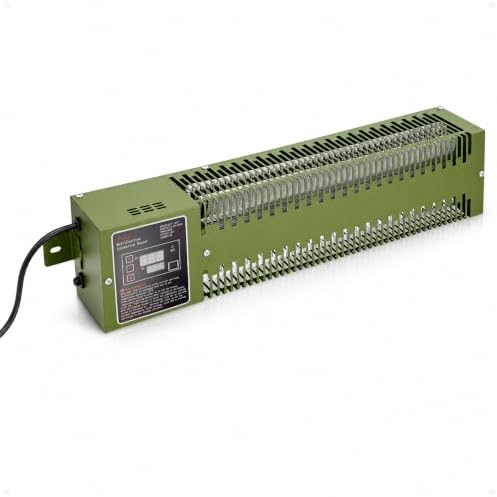
On paper, We researched the 800W Electric Pump House as a compact convection heater aimed at freeze protection in tight, enclosed spots. Based on the product data and owner feedback, it suits a crawl space where the job is keeping pipes and pumps above freezing rather than heating the whole footprint.
The 800 watt draw runs on 120 volts, so it can share a normal household circuit, which matters in older homes where adding a 240 volt line is costly or impossible. Our pick fits a cautious owner who wants steady background warmth in a small, sealed area.
Several listing details matter most in our comparison. The dual digital displays show both the current room temperature and the target, so an owner can confirm the space is holding without a separate thermometer. The adjustable range of 40°F to 105°F covers freeze protection comfortably, and the built-in thermostat cycles the unit to hold that setting.
Because it heats by convection with no fan, it covers roughly 80 to 110 square feet and circulates air naturally, which keeps noise and airflow low. Overheat protection and automatic power cut-off add a layer of safety for long winter operation, and the 8.2 foot cord helps in hard-to-reach spots. Wall or floor placement gives some flexibility.
The trade-off is reach. At 800 watts and fan-free, it warms a small, enclosed cavity well but will struggle in a large, drafty crawl space with open vents. Buyers with a big or leaky area should choose a higher-output fan-forced model instead.
9. COMFORT ZONE 7,500W 240V Ceiling Mount Commercial Garage Heater
Mounts to ceiling with 7500W output, digital thermostat, and remote for warehouses

A fan-forced commercial unit built to hang from the ceiling rather than sit on the floor, COMFORT ZONE 7 suits crawl spaces where floor area is tight or where a portable unit would be in the way. Hard-wired at 240V, it is aimed at poorly insulated areas and outbuildings such as warehouses, garages and workshops.
In a crawl space, keeping the unit overhead and out of the dirt and damp is a practical advantage, and the heavy gauge steel body is described as able to handle temperature swings in spaces like these.
Airflow can be aimed where it is needed thanks to the adjustable louvers and variable mounting angle, which matters in a low crawl space where you want heat pushed along the joists rather than straight down. The digital thermostat lets you set a target temperature, and the 12-hour timer plus remote control mean you can adjust settings without crawling back under the house.
Overheat protection shuts the unit off automatically if internal temperatures climb too high. Mounting hardware and a hard-wired supply are required, so this is a job for someone comfortable with electrical work.
The catch is that this is a 240V hard-wired ceiling install, not a plug-in appliance, so it needs a dedicated circuit and a mounting point strong enough to hold a 21 pound unit. Anyone who wants a simple portable heater to carry into the crawl space should pick something else. COMFORT ZONE 7 is for owners who can plan a permanent overhead installation and want serious output in a cold, unfinished space.
10. Shinic Space Heater,1500W Milkhouse Heater with Thermostat, Stay Cool Durable Metal Housing
Features durable metal housing and 3-prong plug for safe portable heating in garages

At first glance, the Shinic Space Heater is a milkhouse-style utility heater built around a heavy-duty, all-metal housing, and our research places it among the compact portable options for warming a crawl space on an occasional basis. The stay-cool carry handle is designed so you can move the unit while it is running, which suits setting it down near a work area and then shifting it to another spot.
The listing names garages, greenhouses, workshops and similar utility rooms, and the compact footprint fits into gaps where a larger unit would not.
From the product data, two heat settings matter most: 1500W high and 1300W low, plus a natural wind mode, with heat coverage listed at up to 200 square feet. A rotary thermostat lets you dial in a temperature, and a powerful fan blows the heated air out. Safety details carry weight in a damp, cramped crawl space, and this unit lists a 3-prong plug, overheat protection that shuts the heater off once internal temperature gets too high, and a built-in anti-tip device that cuts power if it gets knocked over.
Owners commonly report the metal housing feels sturdy and the handle stays cool enough to grab.
The main trade-off is that this is a plug-in 1500W heater with coverage listed at up to 200 square feet, so it will not carry a large or very cold crawl space on its own, and it relies on being placed on a stable surface, which can be awkward on uneven dirt. Anyone who needs whole-space heat or a permanent overhead install should pick a hard-wired ceiling unit instead.
What It Costs to Run
Wattage and hours of use decide what one of these adds to the electricity bill. The table uses the power figures from the listings above, at the highest setting.
| Power | 1 hour | 4 hrs a day | 8 hrs a day |
|---|---|---|---|
| 500 W | 0.5 kWh | 2 kWh | 4 kWh |
| 600 W | 0.6 kWh | 2.4 kWh | 4.8 kWh |
| 800 W | 0.8 kWh | 3.2 kWh | 6.4 kWh |
| 1,500 W | 1.5 kWh | 6 kWh | 12 kWh |
| 4,000 W | 4 kWh | 16 kWh | 32 kWh |
Multiply the kWh by the rate on your electricity bill to get the cost. A thermostat or a lower setting cuts the hours at full power, so real use is often below these figures.
How We Picked
Our picks come from product details and from what buyers say in customer reviews, not from advertising. We researched the specifications, compared how each unit is built and read through owner feedback to see how these heaters hold up in real crawl spaces.
Comparing the product details meant looking at wattage, heating type, thermostat control, safety features and how each unit is meant to be mounted or placed. We noted which models suit small, enclosed spaces and which are built for larger or colder areas.
Praise in customer reviews kept pointing to steady heat, simple setup and reliable thermostats. Complaints that came up again and again involved noise, short cords and units that struggled in extreme cold.
Ordering the list was about covering different needs and budgets rather than ranking one winner. Smaller low-wattage units sit alongside powerful fan-forced models so a tight pump house and a larger crawl space both have options.
Frequently Asked Questions
What Decides the Running Cost of a Heater for Crawl Space Use?
Running cost comes down to wattage, how long the unit runs, and how well the crawl space holds heat. A higher wattage unit draws more power per hour, but if it cycles less because it is correctly sized, the difference narrows. Our research compared wattage figures against typical run patterns owners report, and the biggest variable is always insulation and air sealing. A damp, drafty crawl space forces any heater to run longer.
The type of heater matters too. A unit with a thermostat cycles on and off instead of running flat out, which usually means less wasted energy. We looked at how each model controls output and how owners describe run times in cold weather. Sealing vents and covering bare soil reduce moisture load, so the heater spends less time working.
Can a Heater for Crawl Space Stay on Overnight or Run Unattended?
Leaving any heater unattended depends on its safety features and the conditions down there. Crawl spaces collect dust, cobwebs and sometimes standing moisture, so a unit needs to tolerate that environment without overheating nearby material. We checked which models include overheat protection and tip over shutoff, and we compared how owners describe long unattended runs. Units with sealed elements and clear clearance requirements are the safer choice.
Placement matters as much as the heater itself. Keep the unit on a dry, solid surface and away from insulation, wood scraps and plastic sheeting. Our research suggests a thermostat controlled model is better for overnight use because it limits how hot the space gets and reduces constant draw. Never block airflow around the unit.
What Wattage Heater for Crawl Space Do I Need for My Square Footage?
Start with the volume of the space, not just the floor area, because crawl spaces are low but often long. A common rule owners and installers mention is roughly 10 watts per square foot of floor for a moderately insulated space, with more needed in colder climates or where insulation is thin. We compared wattage against the square footage each manufacturer lists and noted where the guidance differs. Under sizing means the unit runs constantly and never dries the space.
Over sizing brings its own problems, including short cycling and hot spots near the unit. Our research found that matching wattage to the space, then adding margin only for poor insulation, gives the most predictable results. Sealing vents and laying a vapor barrier first can lower the wattage you need.
How Noisy is a Heater for Crawl Space, and Will I Hear It in the House?
Most crawl space heaters are quiet, and the structure above them muffles sound further. Fan forced models produce a low hum, while radiant and panel style units run silently because they have no moving parts. We compared the design of each model and noted which ones rely on fans. Owners commonly report that fan noise fades into background sound once the floor above is closed off.
Noise becomes noticeable when a unit is mounted to joists or sits on a hollow surface that carries vibration. Our research points to placing the heater on a solid base and keeping it off direct contact with floor framing. A unit that cycles frequently will be heard more often, so correct sizing helps here too. For a heater for crawl space under a bedroom, a fanless model is usually the quieter pick.
Is a Heater for Crawl Space Safe Around Children and Pets?
The main protection is the hatch. A crawl space should have a secure cover that children and pets cannot open, and that alone removes most risk. Below the hatch, look for units with overheat protection, tip over shutoff and cool touch housings where possible. We checked which models list those features and compared owner comments about surface temperatures. Any heater for crawl space should also sit clear of stored items and debris.
Risks in this space are different from a living room. There is no one down there to notice a problem, so safety features and stable placement carry the load. Our research favors models that shut off automatically and have simple, sealed controls. Keep cords off the ground where dampness collects, and never run a unit near pooled water.
Can I Plug a Heater for Crawl Space into an Extension Cord or Power Strip?
Most manufacturers advise against it, and our research supports that. Heaters draw high current, and a standard extension cord or power strip can overheat at the plug or along the cord. Crawl spaces add dampness and dust, which makes a loose connection more dangerous. The safer approach is a dedicated circuit with the unit plugged directly into a wall outlet.
If an outlet is not nearby, have one installed rather than stretching a cord. Where a cord must be used temporarily, it should be a heavy gauge cord rated for the heater’s amperage and kept off wet ground, but permanent setups should not rely on one. We compared the electrical requirements each manufacturer lists for their heater for crawl space models. Check the amperage against your circuit before plugging anything in.
Final Thoughts
After comparing specifications, owner feedback and expert research, we picked BEYOND HEAT 1500W Milkhouse as the best heater for crawl space for most buyers. Its 1500W milkhouse design suits the damp, enclosed conditions owners commonly describe. For tighter spaces or gentler warmth, AEGONAN 600W Pump House is the pick we would suggest.
Buyers wanting more output for larger crawl spaces should look at the COMFORT ZONE 5000-Watt Fan-Forced. Match the heater’s wattage and form factor to your space size and power supply before ordering.