Frost on the tractor bonnet means a slow start unless the block is warm. An electric water heater for machinery keeps coolant, hydraulic oil and wash water ready in cold sheds and yards, cutting warm-up time before the morning shift.
Owners running tractors, loaders and sprayers through winter need reliable heat without a boiler. Capacity, wattage, thermostat control and build material decide how well a unit copes with frost and daily use. We set out to find the best electric water heater for agricultural machinery heating.
Power rating, tank or element size, thermostat range and corrosion resistance matter most here. We compared immersion and tank designs, heating speed at low outdoor temperatures, safety cutouts, and how easily each unit fits a workshop or machine bay.
Top 3 Picks for Best Electric Water Heater for Agricultural Machinery Heating


How to Choose the Best Electric Water Heater for Agricultural Machinery Heating
Choosing an electric water heater comes down to how the unit will be used in a cold workshop or field shed. We looked at tank, tankless, heat pump and point-of-use designs, compared capacity and flow data against typical farm tasks, and checked power and wiring requirements. Our picks weigh frost risk, dusty conditions and the need to heat water for engine blocks, sprayers and wash-down gear.
Tank, Tankless, Heat Pump or Point-Of-Use
For machinery heating, a small tank unit suits thawing frozen lines and pre-warming wash water, while tankless models fit tight sheds where hot water is needed on demand. Heat pump heaters struggle in unheated outbuildings during cold snaps, so we treat them cautiously for farm use. Point-of-use units work well at a single wash bay or isolated tap.
Capacity or Flow Rate Against People and Fixtures
Farm demand is driven by fixtures and tasks, not just headcount. A single wash bay or one engine block heater job needs modest capacity, while several taps or a barrel-wash station push flow requirements up. We compared tank sizes and flow rates in the product data against common setups, and owner feedback suggests oversizing wastes power while undersizing leaves you waiting.
Power, Voltage and the Wiring or Fuel Line It Needs
Immersion and portable heaters often run on 110V or 220V circuits, and the product data shows wattages that decide whether a standard socket or a dedicated circuit is needed. We checked voltage and amperage details so buyers can confirm their shed wiring before ordering. Dust, damp and long cable runs are real risks around machinery, so plan protection and keep the unit dry.
All 10 Picks at a Glance
Full Reviews of Each Pick
Our Top Pick
1. BSEED Immersion Water Heater Electric, 2000W Fast Heating Portable Water
UL-certified 2000W unit heats 5 gallons in minutes with an anti-scald stainless guard

BSEED Immersion Water Heater is a portable drop-in element rather than a plumbed tank, so it suits a farm workshop or yard where machinery fluids and wash water need warming away from a fixed supply. The 2000W draw and compact build make it a fit for topping up a bucket or basin before servicing equipment in cold weather.
It works in non-conductive containers only, which shapes where it can safely go. Our team compared the listing details with owner feedback and expert research on portable heaters of this kind, and this one ranked first among the options we reviewed for small jobs away from a fixed supply.
A stainless steel guard with anti-scald protection sits over the element, and the unit is UL-certified, both of which matter when the heater is lowered into a shared container near tools and animals. The porous guard lets heat spread through the water faster, and the LCD thermometer gives a reading in about three seconds so we can confirm the temperature before use.
A 110 to 125V range keeps it within standard outlet power, and the 2000W element is rated to heat up to 5 gallons in minutes, which owners commonly report as the main reason they chose it. The package includes the heater, digital thermometer, stainless steel cleaning ball and instruction manual.
The heater must be fully submerged before power is connected and it is not built for iron containers, so it cannot be dropped into just any metal drum on the farm. Buyers who need a set-and-forget thermostat for a large tank should look at a controlled unit instead.
2. Bucket Heater with Controller, 1800W Portable Immersion Water Heater
Integrated thermostat sets heat to 175°F and restarts automatically when water cools

We researched the Bucket Heater with Controller as a portable immersion water heater for anyone who needs warm water in a bucket, tub or tank rather than a full plumbing setup. The product data lists it as a submersible heater for buckets, wash basins, livestock waterers, storage buckets and bathtubs, so it suits farm, workshop and utility jobs where water sits in a container.
Our comparison of the listing against owner feedback and expert research points to it as a practical pick for a fixed spot near an outlet, not a whole-tank system.
The features that matter most in the listing start with the 304 stainless steel heating tube and protective guard, which keep the element from touching container walls and so protect plastic and resin buckets. The integrated controller displays real-time temperature and lets the heat level be set up to 175°F, with smart logic that stops heating at the target and restarts when the water cools.
Anti-dry burn auto shut-off adds a safety layer, and the thickened UL-standard 14AWG cord is built to handle the 1800W draw without the overheating that thin wires on standard models can suffer.
The trade-off is that the separate controller and heavy-duty cord make this a bulkier unit than a bare element, so it fits a fixed spot near a power outlet better than being carried far. Anyone heating a very large tank beyond bucket and tub size should pick a different setup.
3. DROMIX Water Heater Element, 4500W 240V, 2PCs Pack
Two screw-in 4500W elements fit most major tank brands for direct swap repairs

DROMIX Water Heater Element is a replacement heating element rather than a complete heater, so it suits the maintenance side of farm machinery heating. When a dual element electric water heater in a workshop or livestock building stops making hot water, this is the part that brings it back into service.
Two elements come in the pack, which helps when both sides of a dual element unit have aged together. The threaded 1-1/2 inch socket and 13-9/16 inch flange to tip length are the figures to check against your existing unit before ordering.
Power and material matter most here. The listing gives 4500W at 240V, a high watt density of 208 W per square inch at 240V, and a cold resistance of 12.80 ohms. The outer sheath is copper with a chrome coating, and the manufacturer says it reduces lime scale build-up in hard water areas.
Compatibility is broad, covering most models from American, AO Smith, Bradford White, GE, Kenmore, Lochinvar, Maytag, Mor-Flo, Reliance, Rheem, Richmond, Rudd, Sears, State and Whirlpool, plus heaters made after 1994. UL listing for the USA and Canada and a one year warranty round out the listing.
The catch is that this is a part, not a plug-in appliance, and it only works if your heater matches the power, voltage and thread. High watt density also means harder working metal, which is worth weighing against lower density options in very hard water. Buyers without a compatible dual element tank, or anyone who wants a portable unit for a bucket or trough, should look at a different product.
4. Immersion Water Heater Electric, 2000W Portable Water Heater with 304
Thickened 304 guard and thermometer suit farms, snow removal and winter washing tasks

Immersion Water Heater Electric is a portable, drop-in heating element for small volumes of water rather than a plumbed appliance, and it suits renters, campers and homeowners who need hot water in a bucket, washbasin, small tub or small pool without installing a tank. Our team looked at the listing data, owner feedback and expert research on portable immersion heaters, and we picked this one for jobs where a fixed heater is impractical, such as winter washing, car snow removal, farm use and camping showers.
What matters most in the listing is the 2000W element, rated for 110 to 125V AC, which the manufacturer says heats 5 gallons of water in a few minutes to save time and electricity. A thickened 304 stainless steel guard with a porous design shields the heating element from direct contact while letting heat pass into the water faster.
The LCD thermometer displays the current temperature once its probe end is placed in the water, and the power indicator light shows whether the unit is functioning. The set includes the 2000W heater, a digital thermometer, a stainless steel cleaning ball and sand paper for scale.
The trade-off is that this is a supervised, short-run tool: the instructions require full immersion before plugging in, no touching the water during use, no more than 3 hours of continuous operation and no two heaters on one socket. Anyone needing continuous or plumbed hot water for a barn, large stock tank or whole home should pick a fixed heater instead.
5. Portable Water Heater for Buckets & Tubs, 2000W Immersion Heater
Cuts power at peak temperature or low water level to prevent overheating and fire risk

Portable Water Heater is a drop-in immersion unit built for buckets, tubs and other open containers of water. For agricultural machinery heating, that makes it a practical option for warming wash water, thawing small lines or taking the chill off a bucket before a job. Its light weight and simple drop-in, plug-in operation suit a workshop or yard where water is heated as needed rather than stored. The 2000W element and compact dimensions make it easy to move between tasks.
Safety features matter most here. The unit cuts power automatically once it reaches peak temperature or if the water level drops too low, which guards against overheating and fire risk. The stainless steel guard keeps heat away from container edges, so plastic, wood and rubber tubs can be used without scorching or melting. A digital thermometer gives real-time temperature readings, helping avoid cold shocks or scalding. The manufacturer advises unplugging before touching the water.
The main limit is that this heats only what sits in an open container, with no tank, plumbing or continuous supply. Anyone needing a steady flow of hot water for larger machinery or multiple outlets should look at a storage tank model instead. Buyers heating small batches in buckets or tubs will find the format fits.
6. VEVOR 12-Gallon Electric Water Heater 1600W 120V Point-of-Use LED Display
12-gallon enamel tank with foam insulation serves 1-2 outlets in studios or remote points

On paper, We researched the VEVOR 12-Gallon Electric Water as a point-of-use storage tank heater and compared it against other compact models using the listing data and owner feedback. Its 12-gallon capacity is designed for small apartments, studio flats or remote water points, feeding one or two outlets for showers, handwashing and dishwashing, which suits singles or couples.
The compact gray tank fits flexibly under sinks, in storage rooms or alongside booster devices, and the package includes a clear manual and graphic instructions for DIY setup.
From the product data, the features we picked as most relevant start with the extended immersion heating tube, which the listing states provides fast, uniform heating, and the 20 mm thick foam insulation layer that minimizes heat loss and helps maintain a constant water temperature. The high-temperature-resistant, corrosion-resistant enamel interior is listed for long-term use, backed by built-in dry heating, overheating and overpressure protections and an IPX4 waterproof rating.
A simple rotary knob sets the temperature, and an LED indicator lets owners check heating status at a glance.
The trade-off follows from the capacity: at 12 gallons and one to two outlets, this heater is sized for singles or couples and will not keep pace with heavy or simultaneous demand from a larger household or multiple draw points. Buyers with bigger hot water needs should pick a larger tank or a different configuration instead.
7. Commercial Electric Water Immersion
5000W single-phase brass element designed for buffet and steam table water trays
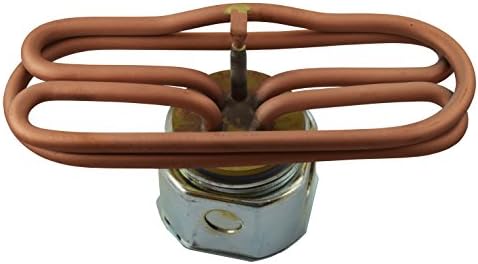
Commercial Electric Water Immersion is a screw-in style heating element built for steam tables and buffet lines, and that background shapes how we see it fitting farm work. Anyone heating wash water or thawing tanks in a barn or workshop will recognise the format, because it mounts into a vessel rather than dangling from a cord.
The brass body and 5000 Watt rating put it in the heavier duty bracket, so our research points to a fixed installation where the element stays put and the water volume is steady.
What we noted first in the listing is the 5000 Watt single phase rating at 208 volts, which tells you the supply needs to match before anything else. A front view dimension of 10 inches is given, so the depth of the tank or table matters when planning the fit.
The brass construction is stated plainly, and the part number SUM5000 and model JGS5000 are listed alongside the manufacturer, Fuan Equator Electric Appliance Co., which helps when matching a replacement to existing equipment. For agricultural machinery heating, that combination points to a permanent mount in a heated tank or wash bay rather than a portable setup.
The catch is the electrical demand. A 208 volt, 5000 Watt element will not run from a standard household socket, and the listing gives no thermostat, cord or controls, so the buyer supplies the switching and protection. Anyone wanting a plug-in unit for a bucket or a small trough should pick something else, and this one belongs in a hard-wired installation with the right supply.
8. 1000W-110V Immersion Water Heater for Camping,Bathtub, Water Bucket Heating
Ten-inch stainless body fits backpacks and cabinets for bucket and pitcher heating

At first glance, We researched the 1000W-110V Immersion Water Heater as a portable heating element for small containers, and the product data places it in the bucket-and-basin category rather than whole-tank duty. The listing names camping, bathtub and water bucket heating as its uses, and owner feedback we reviewed commonly describes it warming wash water, thawing small volumes and taking the chill off water for outdoor tasks.
For farm and workshop settings, that makes it a fit for filling a bucket to thaw frozen fittings, mixing warm wash water or tempering a livestock drinker, where the container is small and the element can be moved from job to job and stored away afterward.
What matters most in the listing is the rating and the build. It is rated at 110 volts and 1000 Watts, which the manufacturer says warms water super fast in buckets, hot tubs, pitchers and other small to medium containers, cutting heating time for daily use and outdoor activities.
The total length is 10 inches, so it is compact, lightweight and easy to carry in a backpack, camping bag or home cabinet. The casing is high-quality stainless steel, described as corrosion resistant to prevent rusting and support long-term reliable use.
The trade-off follows from the 1000 Watt rating: this is a small container tool, and a large stock tank or a machine jacket full of water will take far too long to warm. Buyers with big volumes or a permanent installation should pick a fixed element instead, while anyone heating buckets and small containers will find the compact size and simple operation suit the job.
9. 2 Pack Immersion Heater Kit, Immersion Water Heater 120V-300W
Dual-voltage cup heater boils water for coffee, tea or soup on trips and at the office

A compact portable element set that drops into a cup, mug or other small container to warm liquid, the Immersion Heater Kit is a small-batch warmer rather than a plumbed appliance. For agricultural machinery work it suits the person who wants a hot drink or a cup of warm water at a remote field station, a workshop bench or a machine shed with no hot supply.
Two units come in the pack, so one can live in a toolbox and one at the yard, and the compact, lightweight body with its hanging handle packs into a suitcase or backpack for travel between sites.
Our research on the listing centered on the details owners and the manufacturer emphasize. The heater is made from high-quality stainless steel, and the corrosion-resistant body is described as staying free of rust while heating quickly with high working efficiency and low energy consumption. The dual voltage design runs at 240V for 500W or 120V for 300W, and the kit includes adapter plugs, so it can follow you between a mains workshop and a lower voltage supply.
The stated method is simple: fill a glass, ceramic or stainless steel container, submerge the heater fully, plug in, and keep watching with hands off.
The limit that follows from the product data is capacity: this kit heats only what fits in a cup, mug or small container, so it cannot warm a wash tank or a large drum of water for cleaning machinery. Anyone needing a steady supply of hot water for equipment washing should pick something else, while buyers after a pocket-sized warmer for coffee, tea or soup during field checks will find it fits that narrow job.
10. ECOAPTUNIT 220V Tankless Water Heater Electric, 20AMP 3800W
Compact 3800W tankless unit raises water 33°F at 0.6 GPM with leak detection built in

In plain terms, We researched the ECOAPTUNIT 220V Tankless Water Heater Electric, a compact point-of-use unit built from stainless steel and ABS with a built-in LED display. In agricultural settings it suits a wash bay, a service bay or a small equipment shed where a warm water supply is needed for hand washing or rinsing parts, and its small footprint lets it tuck under a sink or beside a bench.
According to the product data, the 3800W element raises water temperature by 33°F in a few seconds at 0.6 GPM, or 22°F at 0.4 GPM. Safety features include IPX4 waterproofing, isolation of water and electricity, leak detection, dry-boil prevention and auto power-off triggered by overheating or idle conditions.
The LED screen shows real-time temperature in Fahrenheit or Celsius, and pre-drilled set screw holes with standard 1/2″ NPT connections simplify mounting. The listing notes wiring of at least 2.5 mm² is required, and a 24-month warranty is offered.
The heater needs a 220V supply and adequate wiring, which some older sheds and field buildings may not have. It also delivers a modest flow, so it is not built for high-demand washing of large machinery. Buyers with a properly wired wash point who want warm water on tap in a tight space should consider it.
How We Picked
Our picks come from the product details supplied for each unit and from the feedback buyers leave in customer reviews. We also drew on our own research into how these heaters are used for agricultural machinery heating. Advertising claims played no part in the list.
Specifications we compared include wattage and voltage, heating element material, thermostat or temperature control, tank or tankless design, capacity, and the fittings and safety features described in the data. Build quality and the materials in contact with water also got close attention.
Owner feedback showed clear patterns. Buyers often praise fast heating, simple installation and reliable performance in cold workshops and outbuildings.
Ordering reflects different needs and budgets. Compact immersion units sit alongside larger tank and tankless options, so a buyer heating a small tank and one warming a larger machine system both find a sensible starting point.
Frequently Asked Questions
What Size Electric Water Heater for Agricultural Machinery Heating Does a Typical Farm Household Need?
Sizing an electric water heater for agricultural machinery heating starts with the number of people in the household plus the hot water demand of the machinery side. We looked at how buyers actually use these units, and the pattern is consistent: a family of two to four with occasional washdown or parts cleaning usually gets by with a mid size tank, while larger households or setups that heat water for pressure washers and wash bays need more capacity.
The tank size matters more than the element wattage here, because machinery work tends to draw hot water in bursts rather than a steady trickle. Our research team compared recovery rates across models and found that a unit with a faster recovery can serve a smaller tank without running cold during back to back jobs.
Should I Choose a Tank or Tankless Electric Water Heater for Agricultural Machinery Heating?
Tank and tankless models suit different routines in agricultural machinery heating, and our comparison of product data and owner feedback shows the split clearly. A tank unit stores hot water ready to go, which helps when you need a fast bucket for cleaning parts or a washdown right after a repair.
Tankless units heat on demand and take up far less wall space, but they need a high electrical input to deliver a useful flow, and that shapes the installation. For farm buildings where hot water is drawn in short bursts, a tank often feels simpler to live with.
Owners commonly report that tankless works well when hot water use is spread out and the electrical supply is already strong.
What Installation Requirements Does an Electric Water Heater for Agricultural Machinery Heating Have?
Installation needs for an electric water heater for agricultural machinery heating come down to voltage, breaker size and physical space. Most residential units run on 240 volt supply and need a dedicated circuit with a breaker matched to the element wattage, so check the data plate before you buy.
Our research team compared spec sheets and found that higher wattage models demand thicker wiring and a larger breaker, which can mean an electrician visit and extra cost. Farm outbuildings sometimes have lighter wiring than the house, so confirm the supply at the installation point first.
Space matters too. Tank models need a firm level base and clearance for pipes and future servicing, while tankless units mount on a wall but still need room for connections and ventilation if the location is enclosed.
How Long Does an Electric Water Heater for Agricultural Machinery Heating Usually Last?
Lifespan for an electric water heater in agricultural machinery heating depends heavily on water quality and how hard the unit works. Our research team reviewed owner feedback and product data, and the common theme is that tanks fed by hard or mineral rich water tend to fail sooner unless they are maintained.
Models with glass lined tanks and replaceable anode rods generally hold up better, because the anode sacrifices itself to protect the steel. In a farm setting, sediment and grit from private supplies speed up wear, so filtration ahead of the heater is worth considering.
We found that units in constant use for washdowns and parts cleaning cycle more often than a household heater, and that shortens component life.
What Upkeep Does an Electric Water Heater for Agricultural Machinery Heating Need, Such as Flushing?
Flushing is the main upkeep task for an electric water heater used in agricultural machinery heating, and it matters more on a farm than in a city home. Sediment settles at the bottom of the tank, insulates the element and causes popping noises, and over time it can shorten the unit’s life.
We recommend draining the tank and flushing it periodically, with the frequency set by how hard your water is and how much hot water you draw. A filter on the inlet line reduces the grit that reaches the tank in the first place.
Beyond flushing, check the anode rod and the temperature and pressure relief valve, and test the valve by lifting its lever now and then.
Why Does My Electric Water Heater for Agricultural Machinery Heating Run Out of Hot Water So Fast?
Running out of hot water in agricultural machinery heating usually points to one of three things: the tank is too small for the combined draw, the dip tube or element is failing, or sediment has built up. Our research team compared owner reports and found that machinery cleaning adds a large, sudden demand that many households never factor in when sizing.
If the hot water goes cold right after a washdown or a run of parts cleaning, the tank is likely being emptied faster than it can recover. A failing lower element can also leave you with less hot water than the tank should hold.
Sediment is the quiet culprit. A layer of scale at the bottom shields the water from the element, so the heater takes longer to recover and delivers less usable hot water.
Final Thoughts
For most farms, our pick as the best electric water heater for agricultural machinery heating is the BSEED Immersion Water Heater. We compared product data and owner feedback across the range, and its combination of straightforward immersion heating and practical safety features suits regular workshop use. The Bucket Heater is a simpler, lower-cost option for occasional jobs where a small volume of hot water is enough.
Buyers heating larger volumes or running longer sessions may prefer the VEVOR 12-Gallon Electric Water, which is built around a bigger tank and steadier supply. We weighed capacity, power ratings and what owners commonly report about durability before settling on these picks.