A small flat and a busy family house ask very different things of a hot water supply. One needs a compact unit that fits a cupboard, the other needs enough capacity for several taps running at once.
Most units sit in a utility room, garage or airing cupboard, feeding showers, sinks and appliances through the daily routine. Space, recovery speed and wiring demands all shape that choice, which is why we set out to find the best electric water heater for home.
Our research started with safety and durability features on every listing: overheat cut-outs, pressure relief, tank lining and warranty terms. We compared capacity, recovery time, power draw and footprint, then weighed owner feedback on reliability and installation.
Top 3 Picks for Best Electric Water Heater for Home


How to Choose the Best Electric Water Heater for Home
What matters most is the people living in your home, not the printed specifications. We examined how every electric water heater copes with everyday use, how much room it occupies, and what electrical or plumbing work it requires.
Tank, Tankless, Heat Pump or Point-Of-Use
Tank-style units hold heated water in reserve and work well for families using several taps simultaneously. Tankless models warm water as it flows and free up room, a benefit for compact homes with limited overlapping demand. Heat pumps lower operating expenses yet require mild surrounding air, and point-of-use heaters handle one distant sink or shower. As owners frequently mention, tankless performs best when the electrical plan comes first.
Capacity or Flow Rate Against People and Fixtures
With tanks, align capacity with occupant count and busiest periods, as a rushed morning of showers plus laundry empties a small tank quickly. Those choosing tankless should total the flow of fixtures likely running at once and set that against the model’s flow rate at their incoming water temperature. Buying too large burns money, while buying too small means chilly showers. Our side-by-sides emphasized genuine household routines over showroom figures.
Power, Voltage and the Wiring or Fuel Line It Needs
Electric heaters pull substantial current, and numerous whole-house tankless units require 240 volts plus dedicated circuits that an electrician must size. Compact point-of-use models may operate on standard voltage, making installation simpler in a basement or garage. Verify your panel’s capacity before any purchase, since a high-power heater could necessitate an upgrade. Heat pump units likewise require adequate clearance for air circulation.
Quick Comparison
In-Depth Reviews
Our Top Pick
1. VEVOR Electric Water Heater 18-Gallon 1600W Storage Tank with Knob Control
70L tank with extended immersion element and 20mm foam insulation keeps water hot for 24 hours

We researched the VEVOR Electric Water Heater as a storage tank unit rather than an on-demand model, and the 18-gallon capacity is what shapes its role. That volume is aimed at family needs such as dishwashing, laundry and daily tap use, so it fits a kitchen, bathroom or utility area where hot water is drawn throughout the day.
With a 1600W element, the listing presents it as a way to reduce the wait at the faucet, and the 30-inch height and 16-inch width mean it needs a real patch of wall or floor space rather than a shelf.
From the product data, the features we compared most closely are the extended immersion heating element, which the listing says provides continuous hot water for 24 hours, and the rotary temperature control adjustable from 86F to 167F with an LED heating display. The enamel glass coating is listed as protection against burns and leaks, while the corrosion-resistant inner tank, 20mm HFO foam insulation and high-pressure metal shell are given for heat retention of up to 24 hours.
Side connections and IPX4 protection are also stated for damp rooms, and owner feedback commonly points to the tank size and recovery as the practical considerations.
The trade-off is bulk and weight: at 53 pounds and about 30 inches tall, this unit needs solid mounting and clearance, so tight cupboards and small apartments are a poor fit. Households with light hot water demand, or anyone short on space, should pick a compact model instead.
2. GE Appliances 18 Gallon Versatile Plug and Play Electric Water
Connects to any 120-volt supply with standard 3/4-in NPT fittings for minutes-long installation

Small households, cabins and garage setups are the natural home for the GE Appliances Versatile Plug. It is an 18-gallon electric tank that the listing says can feed a single hookup or serve a small house, condo or apartment. The compact body is pitched at limited spaces such as kitchens, bathrooms, laundry rooms, RVs, garages and sheds.
For a buyer who wants hot water in a spot without a dedicated high-voltage circuit, that framing is the appeal. We looked at the product data, compared it with owner feedback and drew on expert research on small-tank heaters to sort out where this unit fits.
Installation is where the listing makes its case. Standard 3/4-inch NPT compatible connections let it tie into existing plumbing, and it plugs into any 120-volt supply, which the brand says makes setup a matter of minutes. It can run standalone or inline with another heater to boost long pipe runs or a washing machine.
Inside, a stainless steel heating element is described as rust and corrosion resistant, and an anode rod adds long-term protection. An adjustable thermostat lets you set the temperature you want. The unit measures about 25.75 inches high and 19.25 inches wide, weighs 54 pounds, and carries an 8-year tank and parts warranty with 1 year on labor, details we weighed against owner reports.
The trade-off is capacity for the money and space. An 18-gallon tank at this size will not carry a large family through back-to-back showers, and the 120-volt supply limits how quickly it recovers. Homes with heavy simultaneous demand should choose a larger, higher-voltage tank instead.
3. VEVOR 12-Gallon Electric Water Heater 1600W 120V Point-of-Use LED Display
Compact 12-gallon unit fits under sinks or in storage rooms and serves one to two outlets

On paper, We researched the VEVOR 12-Gallon Electric Water as a point-of-use tank heater rather than a whole-home unit, comparing its listed specifications against owner feedback and expert research on small storage heaters. The 12-gallon capacity is sized for one or two outlets, which suits a studio flat, a small apartment or a remote water point where a full household tank would be overkill.
It covers showers, handwashing and dishwashing for a single person or a couple. Its compact dimensions let it tuck under a sink, into a storage room or alongside booster devices, which helps in homes short on plant space.
Among the features the listing states, the extended immersion heating tube is meant to heat the stored water quickly and evenly, while the 20 mm foam insulation layer holds temperature between draws to limit heat loss. The enamel interior is described as high-temperature and corrosion resistant, and the unit carries dry heating, overheating and overpressure protections plus an IPX4 waterproof rating.
A rotary knob sets the temperature, and an LED indicator shows heating status at a glance. The side outlet layout, T&P valve and gray storage tank design round out the install hardware, and the manual and graphic instructions support DIY setup.
The main trade-off is capacity. A 12-gallon tank serving one or two outlets will run out of hot water during back-to-back showers or heavy laundry days, and the 1600W element at 120V heats more slowly than larger residential units. Households with three or more bathrooms, or anyone wanting to run several fixtures at once, should pick a bigger tank instead.
4. Rheem PROE50 M2 RH95 50-Gallon Professional Classic Medium Residential Electric Water Heater
50-gallon professional classic with automatic thermostat and enhanced-flow brass drain valve

Rheem PROE50 M2 RH95 is a medium residential storage tank aimed at family homes with three to five people or three or more bathrooms. Our research team compared this model against other Rheem tanks and similar-capacity units, and the 50-gallon capacity is meant to keep up with morning showers, laundry and kitchen use without running cold.
The footprint is described as smaller than competitive models, which makes it a practical swap for an existing unit in a utility closet or basement.
We picked through the listing and owner feedback to weigh which features matter most. An automatic thermostat keeps the water at the temperature you set, so the tank recovers and holds heat without manual adjustment. The anode rod is there to protect the steel tank from corrosion over the years, and the enhanced-flow brass drain valve makes flushing sediment easier during maintenance.
A temperature and pressure relief valve comes included, and the unit draws 18.75 amps. Gray finish and a standard height of 48 inches keep it conventional for replacement work.
The trade-off is that this is a storage tank, so it holds a large volume of hot water at all times and needs the space and wiring to match. Homes with only one or two occupants, or tight closets, may find the capacity and footprint more than they need. Buyers wanting instant hot water at a distant tap should consider a point-of-use unit instead.
5. Rheem RTEX-24 24kW 240V
Delivers up to 5.9 GPM on demand and takes 90% less floor space than a tank

Built to supply hot water on demand to multiple fixtures in a home, the Rheem RTEX-24 24kW 240V is a tankless electric unit. It suits a household that can set aside wall space and has the electrical capacity to feed a high draw appliance. The gray casing measures 18.25 inches long, 14.5 inches wide and 3.5 inches deep, and it weighs 17.8 pounds.
Because it heats only when a tap opens, it removes the standby losses of a storage tank and takes up far less room than a conventional cylinder. In our research we compared this model against other tankless units and gathered owner feedback on how it performs in real households.
Rated at 24kW, the listing states it delivers up to 5.9 GPM and serves multiple fixtures. Digital thermostatic controls adjust in 1-degree steps from 80F to 140F, so the setpoint can be tuned to the household. Installation demands 240V single-phase power, three 40-amp double-pole breakers, three sets of 8 AWG copper conductors with ground, and a recommended 200-amp service panel.
The compact body is described as 90 percent smaller than a traditional tank, and a limited lifetime warranty backs the unit. Owners commonly report steady temperature output once the unit is properly sized and installed by a professional.
The electrical demand is the real limit. Three double-pole breakers and a 200-amp panel recommendation mean many older homes will need a service upgrade before this unit can run, and a pro install is the safe route. A household with a modest panel or a tight budget for electrical work should look at a smaller tankless model or a storage tank instead.
6. GE Appliances 10 Gallon Versatile Plug and Play Electric Water
10-gallon plug-and-play unit boosts long pipe runs or washing machines in tight spots

We researched the GE Appliances Versatile Plug as a compact storage water heater with a 10 gallon tank, a size meant for spots where a full cylinder will not fit. The listing places it in kitchens, bathrooms, laundry rooms, garages, cabins, barns and RVs, and it can run standalone or inline with another heater to boost a washing machine or a long plumbing run.
The gray body stands 24.5 inches high, measures 14.75 inches square and weighs 41 pounds.
Our comparison of the listed features focused on the 120 volt supply and the standard 3/4 inch NPT compatible connections, which the product data says allow installs in minutes using existing plumbing. The adjustable thermostat lets a household change the temperature to suit the job, and the hot water booster role adds capacity to a laundry or a distant tap without a major plumbing change.
An 8 year limited replacement or 8 year tank and parts warranty with 1 year labor backs the tank, which owners commonly mention as reassurance for a small unit.
The trade-off is capacity: 10 gallons is modest, so it will not carry a whole house of showers on its own. A large family with heavy simultaneous demand should pick a bigger tank or a tankless unit sized for the load. This one suits a buyer who needs a small, easy to place heater for one area or a boost to an existing system.
7. Westinghouse 14kW Tankless Water Heater Electric 240V, Wifi
Alexa and Google Home compatible with 3-second heating and 3.4 GPM at 2 points of use

Compact wall-mounted units like the Westinghouse 14kW Tankless Water serve homes where floor space is tight and hot water is needed at a couple of fixtures rather than a whole house. The listing pitches it at apartments, single-family homes, cabins and office restrooms, and the small gray cabinet, roughly 12.6 inches tall and 3.3 inches deep, mounts on a wall instead of eating up a closet.
With a maximum of 2 points of use and 3.4 GPM at a 62°F inlet, it fits a bathroom shower plus a kitchen sink in a modest household.
According to the listing, heating starts in about 3 seconds with 98% thermal efficiency, and the minimum start-up flow is 0.53 GPM, so even a low-flow tap can trigger it. A 60A double-pole breaker and 6 AWG wire at 240V are required, with 1/2 inch NPT connections and a compact wall-mount body.
The smart side is genuinely useful for a home: WiFi with Alexa and Google Home lets you adjust temperature and monitor usage from the app, and a temperature memory function restores your setting.
The real limit is electrical demand. A 60A dedicated circuit and 6 AWG wiring are a serious commitment, and many older homes will need a panel upgrade before this unit can go in, which adds cost and time beyond the heater itself. Output is also capped at 2 points of use, so a family running several showers and appliances at once will find it stretched.
Homes with a smaller service panel, or larger households wanting whole-house coverage, should look at a bigger unit instead.
8. Rheem 18kW 240V Tankless
Self-modulating power adjusts to demand and reaches up to 4.4 GPM with copper immersion elements
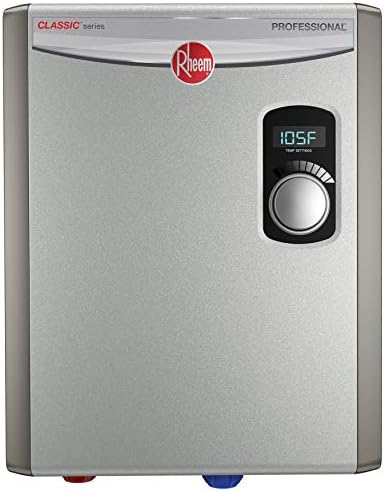
Aimed at households that want tankless hot water across more than one fixture at a time, the Rheem 18kW 240V Tankless is a higher-output electric unit. Its 18kW rating and up to 4.4 GPM flow suit a family home where showers, laundry and the kitchen tap can overlap, and the compact gray body, about 18.5 inches long and 14.5 inches wide, still mounts on a wall.
For a home buyer weighing tankless against a tank, this sits at the more capable end of the residential range, so it rewards a house with the electrical capacity to feed it.
What the listing emphasizes most is control and modulation. Self-modulation adjusts power to match hot water demand rather than running flat out, and the external digital thermostatic control with LED display holds temperature to about 1 degree of accuracy. Two durable copper immersion heating elements are field serviceable, which matters for long-term home ownership, and the 99.8% energy efficiency class is stated in the data.
Installation is kept straightforward with bottom 3/4 inch NPT water connections, threaded for easy replacement, plus a simple digital temperature display on the front.
The trade-off is that this is a large electrical load, and the listing gives no breaker or wire specification, so a home installation depends on confirming your panel and circuit can support an 18kW draw, often a job for a licensed electrician. There is also no WiFi or app control here, so anyone who wants remote temperature changes should choose a smart model. Buyers with limited panel capacity or a preference for app-based control should pick something else.
9. Rheem 11kW Multi Fixture
Runs on one 50-amp breaker and supplies up to 2.68 GPM for multiple fixtures

Our research team looked at the Rheem 11kW Multi Fixture as a whole-home tankless electric unit, the kind meant to replace a storage tank rather than serve a single sink. It fits a household that wants hot water on demand and can spare the floor space a tank occupies.
The compact gray cabinet measures roughly 12.63 inches long and weighs about 7 pounds, so it can mount close to the fixtures it feeds. For a family running a shower and a sink at the same time, the multi fixture rating is the reason we picked it for this category.
What matters most in the listing is the output and control. The 11kW model provides up to 2.68 GPM, which Rheem ties to multiple fixture applications. Digital thermostatic controls hold temperature in 1-degree increments from 80°F to 140°F, so water arrives at a chosen setting.
Because it heats only when a tap opens, it avoids the standby losses of a tank, and the listed efficiency class is 99.8%. Installation is the part to plan for: 240V single-phase power, one 50-amp double-pole breaker, one set of #8 AWG copper conductors with ground, and a recommended minimum 100-amp household service panel. Owners commonly report that professional sizing and installation matter here.
The real trade-off is electrical. A home with an older or smaller service panel may need an upgrade before this unit can run, and that cost sits outside the heater itself. Buyers who cannot support a 50-amp circuit, or who want a simple point-of-use solution for one sink, should pick a smaller model instead.
10. Tankless Water Heater Electric 110V, 3000W Instant Electric Water Heater
Ultra-thin 110-volt unit heats water in seconds for a single sink or washing station

Tankless Water Heater Electric is a point-of-use unit for a single sink or small wash area, not a whole-house system. Its white ABS body is ultra-thin and small enough to tuck under a kitchen or bathroom cabinet, which suits renters, small flats or anyone adding hot water to a corner that a tank cannot reach. The 110V supply makes it easier to place than a 240V appliance, provided the circuit can carry the load.
At 3000W the listing says it raises water by 82°F at 0.3 GPM and up to 131°F at 0.5 GPM in seconds, so flow and temperature trade off against each other. A larger flow gives cooler outlet water and a smaller flow gives hotter water, which is normal for a heater this size.
Safety features include water and electricity isolation, IPX4 waterproofing, leakage protection, dry boil protection and automatic shutoff on overheating or inactivity. The LED display shows the setting, and the 1/2 inch NPT interface with premade screw holes simplifies mounting.
Installation rules are strict. The unit is vertical only, and horizontal mounting can trigger an E2 fault in the heating elements, so pipe connectors need Teflon tape to avoid a short circuit. Anyone wanting hot water for a shower or several taps at once should choose a higher-output model, because this one is built for one outlet at a time.
How We Picked
Our picks for this guide come from the product details manufacturers publish and from what buyers say in customer reviews. We did not take advertising claims at face value.
Capacity and power draw were compared first, since those decide how much hot water a home can expect. We also looked at tank versus tankless design, voltage and amperage requirements, dimensions, and the installation limits each unit carries. Warranty terms and safety features rounded out the comparison.
Patterns in owner feedback carried real weight. Praise often centred on steady hot water and straightforward installation, while complaints clustered around sizing mistakes and setups that demanded electrical work. Recurring issues like these moved models down our list, and consistent positive reports kept others on it.
Ordering the final list was about fit rather than rank. Smaller tank units sit alongside whole home tankless models and mid range options, so a buyer with a tight budget, a small space or a large household can each find a sensible match.
Frequently Asked Questions
What Size Electric Water Heater for Home Use Does a Household Actually Need?
Sizing an electric water heater for home use comes down to peak hour demand, not the number of bathrooms. We looked at tank capacities and first hour ratings in the product data and compared them with how owners describe their morning routines. A small household with one shower running at a time usually fits a smaller tank, while a family with back to back showers, a dishwasher and laundry on the same morning needs more stored hot water. Counting fixtures that run at once is the practical starting point.
Tank size and recovery speed matter together. A larger tank holds more hot water, but the heating elements and their wattage decide how fast it refills after drawdown.
Should an Electric Water Heater for Home Be a Tank or Tankless Model?
Tank and tankless electric water heaters for home solve different problems. A tank stores hot water ready to use, so several taps can run at once without a waiting period. Tankless units heat water as it flows, which means no standing tank losing heat and a smaller wall mounted footprint. In our comparison of product data, tankless models needed higher electrical capacity to deliver hot water at a usable flow rate, and that shaped which homes they suited.
For a home with limited electrical service or several hot water draws happening together, a tank is often the simpler fit. Tankless suits smaller homes or point of use setups where space is tight and demand is spread out. Owners commonly report that tankless performance depends on incoming water temperature and flow, so cold winters and high flow fixtures can reduce output.
What Does Installing an Electric Water Heater for Home Require in Voltage, Breaker and Space?
Electrical capacity is the first thing we check in the product data for any electric water heater for home. Most full size tank units run on 240 volts with a dedicated double pole breaker sized to the element wattage, and the circuit needs wiring rated for that load. Tankless models often draw much more power at peak and may need one or more dedicated circuits. A licensed electrician should confirm your panel can carry the added load before you buy.
Space and plumbing matter just as much. Tanks need a level spot with clearance for service and a pressure relief valve routed safely, while tankless units mount on a wall near the point of use and need gas style venting only if they are not electric.
How Long Does an Electric Water Heater for Home Usually Last?
Lifespan depends on water quality, tank material and how hard the unit works. In our review of product data and owner feedback, tank style electric water heaters commonly last around a decade, with some failing sooner in hard water areas and some lasting longer with regular care. Tankless units are often reported to last longer because there is no stored water corroding a steel tank, though mineral scale still affects their heat exchanger.
Anode rods are the quiet factor. Most tanks use a sacrificial anode that corrodes first, and once it is used up the tank lining starts to fail. Owners who check and replace the anode report longer service, and flushing sediment helps too.
What Upkeep Does an Electric Water Heater for Home Need, Such as Flushing?
Flushing is the main maintenance task we found owners should plan for. Sediment settles in the tank, insulates the lower element and can shorten its life, so draining the tank once a year is common advice in manuals and owner reports. Testing the pressure relief valve and checking the anode rod at the same time covers the parts most likely to cause trouble. A little routine care keeps efficiency from drifting downward.
Tankless electric water heaters for home need descaling instead, especially where water is hard. Mineral buildup on the heat exchanger reduces flow and hot water output, so manufacturers specify a vinegar or descaler flush at intervals tied to water hardness. We also suggest checking the inlet filter and watching for error codes.
Why Does My Electric Water Heater for Home Run Out of Hot Water So Fast?
Running out of hot water usually points to demand outpacing the tank or a maintenance issue. In our research, a tank that once kept up but now fades quickly often has a failed lower element, a broken dip tube or heavy sediment. Cold incoming water in winter also lowers usable output because the heater must raise the temperature further. Checking element function and flushing the tank are the first steps owners can take.
Sizing plays a role too. A household that added a shower or a hot water appliance may simply exceed the first hour rating of the tank. For tankless electric water heaters for home, the limit is flow and temperature rise, so two hot taps at once can cut output.
Final Thoughts
Based on our research into product data, owner feedback and expert guidance, we picked the VEVOR Electric Water Heater as the best electric water heater for home use. It balances tank capacity with straightforward installation, and owners commonly report steady hot water for daily household demand. For tighter spaces or lower budgets, the GE Appliances Versatile Plug suits renters and small homes.
Larger households with heavy hot water use should look at the Rheem PROE50 M2 RH95 for its bigger tank. Match the unit to your household size and peak demand, then check the electrical requirements before buying.