Cold air rolls off the window glass and settles around your ankles while the sofa stays warm. That gap between what a radiant heater promises and what a room actually feels like is where our research began.
Anyone heating a garage, workshop or drafty living space needs output that reaches people, not just air. Skipping the details leaves weak coverage and climbing bills. Our best infrared heater consumer report sorts real performers from the rest.
Heating engineers we consulted stress matching wattage to room size and checking how evenly a unit spreads warmth. We compared element type, heat throw, thermostat control and safety features across the models in this guide, using product data and owner feedback to see which hold up daily.
Top 3 Picks for Best Infrared Heater Consumer Report

How to Choose the Best Infrared Heater Consumer Report
Reading an heater consumer report well means knowing what to check before you buy. Heat type, wattage, room size and safety features decide whether a unit suits your space. Our team compared product data, owner feedback and expert research to see what really matters for infrared heaters. Fit for the room and the risks of misuse matter more than marketing claims.
Match the Heat Type to the Room
Ceramic fan heaters warm small rooms fast but add fan noise. Oil-filled units radiate steady gentle heat and suit bedrooms and longer sessions. Infrared heaters send direct warmth to people and objects, which works well in open or drafty areas. Convection heaters circulate warm air through a whole room. For a consumer report, we compared how each type fits real conditions and what owners commonly report.
Check Wattage Against Room Size and Circuit Load
Portable space heaters usually draw 750 to 1500 watts, and larger models can pull more. A 1500 watt heater on full power draws about 12.5 amps at 120 volts, close to the 15 amp limit of a typical household circuit shared with other devices. Match wattage to room size, and never run a high draw heater on an overloaded circuit or extension lead.
Prioritise Safety Cut-Offs, Thermostat and Timer
Tip-over switches and overheat cut-offs are basic safety features, and we treat their absence as a warning sign. Adjustable thermostats keep rooms at a steady temperature and reduce wasted energy. Timers help avoid long unattended runs. In our research, owner feedback often flags units that lack clear safety controls, so check these before buying.
Quick Comparison
In-Depth Reviews
Our Top Pick
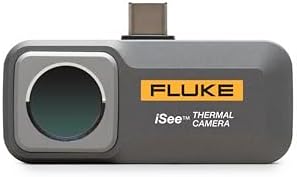
1. Fluke TC01A 25Hz – iSee Mobile Thermal Camera for Android Smartphones
Turns an Android phone into a thermal camera with 25Hz frame rate and 1022°F range
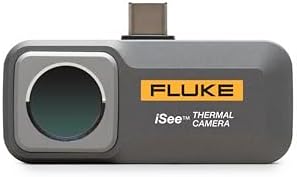
We researched the Fluke TC01A 25Hz as a mobile thermal camera that plugs into an Android smartphone and turns it into a diagnostic display, and we compared it with other phone-based and handheld imagers using the listing data and owner feedback. In our research, it suits homeowners, technicians and inspectors who want to check for hot spots, overheating electronics or insulation gaps without carrying a separate handheld unit.
The compact dimensions of 2.36 inches long, 1.32 inches wide and 0.44 inches high, together with a weight of about 0.05 pounds, make it easy to keep in a pocket or tool bag, and the grey housing matches the Fluke brand’s usual workmanlike look.
Among the features the listing states, the detailed image quality comparable to professional thermal imagers matters most for reading small temperature differences, and the full temperature range analysis lets you study the whole scene rather than a single spot. Real-time image sharing means a thermal picture can go to a colleague or client right away, and the small, portable body takes a second to get started.
The temperature range reaches up to 1022°F, and a 25Hz frame rate keeps the live image smooth enough to scan a wall or panel at a walk. A two-year warranty backs the build, and the package contains one unit.
The trade-off is that this model is built for Android smartphones only, so iPhone owners cannot use it without a different version. The 25Hz frame rate also suits static scans better than fast-moving targets. Buyers who need a standalone screen or a wider temperature span should pick a dedicated handheld imager instead.
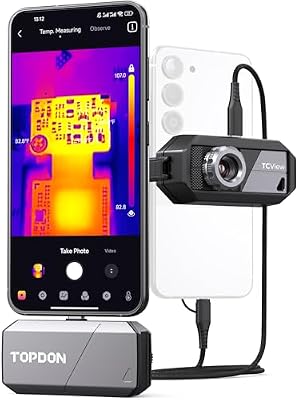
2. TOPDON TS001 256×192 IR Resolution Thermal Camera for Android
Delivers 256×192 IR resolution and a 9mm adjustable focus lens for detailed thermal inspection
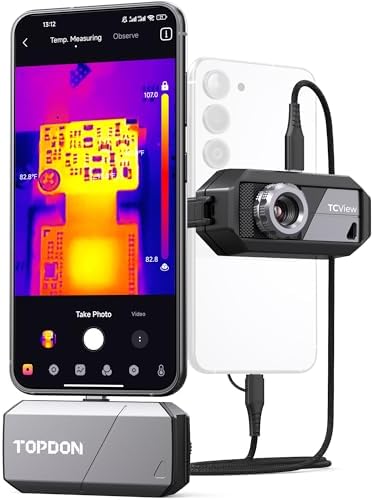
We researched the TOPDON TS001 IR Resolution as a thermal camera that converts an Android phone or Windows laptop into a thermal night vision monocular. Our comparison of the product data shows it suits electricians checking PCB boards, resistors and other 1mm components, and it also fits outdoor scanning where a person or animal needs to be spotted at distance.
The 256×192 infrared resolution and smooth 25Hz frame rate are listed as delivering clear live imaging, while the 9mm adjustable focus lens adapts the view to close inspection or longer range work.
From the listing, the features we picked as most important are the detection range of up to 200 yards for a human target, along with target assistance and a compass in detection mode. The camera carries no built in battery and runs solely from the host device, consuming as little as 0.35W, which the data pairs with a 3000 to 5000mAh smartphone for a runtime of 4 to 7 hours.
Picture and video capture in infrared and dual-light modes, adjustable fusion levels and infrared magnification, a 1.58 ounce (45 gram) body, and the included 19.7-inch multi-function extension cable, phone stand and EVA case round out the package.
The trade-off is that this unit depends on a host device and draws from that phone or tablet battery, so extended sessions away from a charger are limited, and it does not support iOS. Buyers who want a self-contained thermal camera with its own screen and battery should pick a different unit.
3. DR. INFRARED HEATER Portable Infrared Indoor and Outdoor Space Heater for Patio
Offers IP55 weatherproofing and dual heat settings for versatile indoor and outdoor use

Portable infrared heating takes a flexible form in the DR. INFRARED HEATER Portable, a 34.6 inch black unit built for both indoor and outdoor use. Buyers comparing options for a garage, shed, store room, greenhouse, grow tent or milk house will find the size and mounting setup worth a close look. It suits someone who wants directional warmth on objects and plants rather than heating a whole building. Commercial and residential settings are both listed as fair game.
What matters most in the listing is the IPX5 water resistance rating for indoor and outdoor placement, which is a real consideration for damp rooms and covered patios. A corded sensor thermal probe reads room temperature, and the built in digital display lets you regulate the ambient temperature through Auto or Manual mode.
Two heat settings, 1500W on High and 1000W on Low, give a simple choice of output. Extruded dual layers of aluminum protect against heat loss and humid environments, and the unit can be wall mounted, ceiling mounted or hung from the supplied chain. ETL certification and USA based customer support round out the package.
The main limit is that this is a 120V style portable heater with modest output, so it warms what it points at rather than a large open space. Anyone heating a big patio or commercial floor should look at a higher output 220V to 240V model instead. Buyers who need simple spot warmth in a shed, garage or grow area will find this one fits the job.
4. DR. INFRARED HEATER DR-239 3000W Indoor & Outdoor Infrared Patio Heater
Provides 3000W of instant infrared heat with IP55 weatherproofing for demanding spaces

On paper, We researched the DR. INFRARED HEATER DR-239 as a commercial-style electric patio heater, and the listing positions it for wall or ceiling mounting in restaurants, shops, workshops, garages, patios and backyard gatherings. At 41.2 inches long and 7.6 pounds, it is a fixed-mount unit rather than a portable spot warmer, so it suits buyers heating a defined area of a room or outdoor space.
Our comparison of the product data also flagged the 220V-240V requirement, which means a dedicated circuit rather than a standard household outlet.
What matters most in the listing is output: 3000W and 10,260 BTU of carbon infrared heat that the manufacturer says warms people and objects instantly with no warm-up time. An IP55 weatherproof rating supports outdoor placement, and wall and ceiling brackets are included for mounting. A remote switches between power levels or standby mode.
The listing also states odorless, silent operation with no open flame, plus overheat protection and automatic shut-off. ETL listing and a UL NEMA 6-15P plug are given, backed by a 1-year limited component warranty and U.S.-based support from Dr. Heater USA. Owner feedback we reviewed commonly centers on the strong heat output and the straightforward bracket mounting.
The trade-off is the 220V-240V requirement, which rules out standard household outlets and may mean an electrician visit before installation. Buyers without that circuit, or anyone heating a small room, should pick a lower-output plug-in model instead. Those with the wiring and a patio or shop to cover get the stronger option.
5. Ballu Mica Infrared Panel Space Heater for Large Room,Smart Quiet
Uses mica panels for gentle far-infrared warmth with WiFi app and Alexa voice control

Ballu Mica Infrared Panel is a wall mounted or freestanding panel heater built for large rooms. The all metal body holds premium mica panels that give off far infrared heat, and the brand says the panels are made to last for years. A two year warranty backs that claim.
For a consumer report on infrared heaters, this is the type of unit that suits a buyer heating one big living space rather than moving a portable unit from room to room. The 180 degree coverage and 10 second heat up are the numbers to weigh against the size of the room.
Programmable thermostat and inverter technology are the features that matter most here. The listing says the heater tracks past usage and room temperature changes, then adjusts to the lowest energy needed to hold your set temperature, which the brand frames as up to 50 percent energy saving. The remote has an LED display for set temperature, current room temperature and heating mode, and a built in sensor keeps the set temperature accurate around the unit.
App control adds schedules and mode switching, with Alexa integration for voice commands. Mounting hardware is included, and casters let you run it freestanding with no tools.
The trade off is that this is a large room panel, so a small bedroom or a single desk spot gets more heater than the job needs, and the panel format gives up the spot directed blast of a quartz tower. Buyers heating a compact room or wanting heat aimed at one seat should pick something else. Shoppers who want a fixed, quiet panel for a big space should keep it on the list.
6. EXNOS 24'' Infrared Heaters for Indoor Use with 3 Heat
Features six quartz heating tubes and a built-in safety lock for family-friendly use

EXNOS Infrared Heaters is a 1500W quartz tower heater for indoor use, sized medium and built to sit in a corner, beside a desk or next to a bed. The slim footprint and 24 inch height suit a bedroom or a home office where floor space is tight.
For a consumer report on infrared heaters, this is the portable category: a unit a buyer can carry from room to room with the built in handle rather than fix to a wall. The caramel finish and cord wrap help it store neatly when the season ends.
Three heat modes are the core of the listing. You get 1500W for quickly heating a space, 1000W for steady comfort while you work, and an energy saver mode at 68 degrees for consistent heat with less waste. Six high performance quartz tubes are said to distribute heat comfortably, which matters most when you first enter a cold room.
A digital thermostat and remote let you change settings from your seat, and the safety lock, activated by long pressing both temperature buttons for three seconds, stops unintended changes. Tip over and overheat protection shut the unit off automatically, and a 12 hour timer is included.
The trade off is that a tower like this heats the area around it, so a large open plan room will feel uneven compared to a panel built for wide coverage. Buyers heating a big living space, or wanting app and voice control, should pick something else. Shoppers who want a portable, safety focused unit for a bedroom or desk should keep it on the list.
7. Ballu Mica Infrared Space Heater Large Room,Panel Heater with Programmable
Combines mica panel heating with portable casters or wall mounting for large-room flexibility

At first glance, We researched the Ballu Mica Infrared Space as a large-room panel heater: an all-metal body with mica panels that the listing says deliver steady far-infrared warmth, backed by a 2-year warranty. It is aimed at bedrooms, living rooms, offices and greenhouses, and the portable casters or wall-mount option let owners place it where the cold sits. For our comparison of infrared options for a big open space, the coverage claims were the first thing we weighed.
Heat-up is quoted at 10 seconds with 180-degree panoramic coverage, which matters when warmth needs to spread across a room rather than pool in one spot. Control comes three ways: a remote, a digital panel, and an app with Alexa for schedules and voice control. A sensor, thermostat and aluminum element work together, and the brand claims up to 37 percent energy cost saving.
Safety features listed include an insulated metal case, flame-retardant cord and safety plug. Quiet operation and reduced dryness are also stated, which suits work, movie nights or sleep.
The honest limit is the size: at 27 inches wide and built for large rooms, it takes up real floor or wall space and is more heater than a small bedroom or study needs. Buyers heating a compact room, or wanting something they can tuck into a corner, should pick a smaller unit instead.
8. EXNOS 1500W Infrared Space Heater for Indoor Use with Wood Cabinet
Operates as low as 35 dB with a wood cabinet and dual heat levels for small spaces

In plain terms, We researched the EXNOS 1500W Infrared Space as a compact wood-cabinet heater with a quartz element, sized at roughly 15.5 inches tall and 14 pounds. Our comparison of the listing and owner feedback points to bedrooms and living rooms as the intended rooms, with the cool-touch body and wheels making it easy to reposition without concern about a hot shell.
For a renter or a light sleeper who wants background warmth rather than a whole-house system, that small footprint and quiet operation are the draw.
Two heat levels are listed: 1500W for rapid warming and 750W for gentler output, plus an ECO mode that adjusts power to hold a steady 68 degrees Fahrenheit. Temperature is adjustable from 59 to 86 degrees Fahrenheit, and the smart control cycles the heater on and off to maintain the set point.
Noise is quoted as low as 35 dB, and a 12-hour auto shut-off adds a timer. Safety covers overheat protection, tip-over shut-off, a three-minute fan run after shutdown and a child lock. A remote and panel give dual control, with a one-touch switch between Celsius and Fahrenheit.
The main trade-off is reach. This is a small unit with a wood cabinet, so it suits a single room rather than an open plan or a large living area. Anyone heating a big space, or wanting app and voice control, should pick a larger connected model instead.
9. Heat Storm Phoenix Infrared Space Heater with Attachable Feet
Uses patented HMS Technology to provide soft heat without reducing oxygen or humidity

Heat Storm Phoenix Infrared is a compact portable heater that can sit on the floor or hang on a wall, so it fits small rooms and offices where floor space is tight. The 5200 BTU output and 1500 watt draw give it enough reach for a single small room, and the slim white cabinet measures just 4.5 inches deep. Our research shows this format suits buyers who want a heater they can reposition or mount out of the way.
A patented heat exchanger with HMS Technology works with the humidity already in the room, which the listing says provides soft heat without reducing oxygen or humidity. The grill stays safe to touch, a detail that matters in homes with children or pets. A built in thermostat with LED display shows the ambient temperature and helps regulate output, and the included remote lets you adjust settings from across the room.
The two power modes, 1500 and 750 watts, let you match draw to the space, and the unit carries a 1 year manufacturer warranty.
The main limit is coverage. This is a small room heater, not a whole home solution, so open plan areas and large living rooms will likely feel underwhelming. Anyone heating a medium or large space should look at a larger dual heating unit instead.
10. Hykolity 1500W Infrared Dual Heating Space Heater with Remote Control
Combines quartz infrared and PTC fan-forced heating for fast, even warmth in medium spaces

Looking at the details, this Hykolity model is a portable electric space heater that pairs a quartz infrared tube with PTC fan-forced heating, a combination the listing says produces fast, even warmth that feels like natural sunlight without drying out the air. We researched the category and compared dual-heating designs before picking this one for medium-sized rooms up to 350 square feet, including bedrooms, living rooms and offices.
The walnut coffee finish and four smooth caster wheels let it glide between rooms rather than stay fixed in one spot.
What matters most in the listing is the control flexibility. Digital controls set comfort from 30 to 99 degrees Fahrenheit, and ECO mode intelligently adjusts between high and low power based on the difference between your set temperature and the actual room temperature. Owners commonly report the sub-35 dB operation as quiet enough for work or sleep, and night mode dims the digital display for bedrooms and nurseries.
A remote and timer add convenience, while tip-over auto shut-off, overheat protection and ETL certification address safety in homes with kids or pets.
The trade-off is physical presence. With four caster wheels and a freestanding body, it needs open floor space and does not mount to a wall, so narrow rooms or cluttered corners are a poor fit. Anyone wanting a wall-mounted unit for a tiny room should pick something else.
What It Costs to Run
Running cost comes down to two things: the wattage and the hours it runs. The table uses the power figures from the listings above, at the highest setting.
| Power | 1 hour | 4 hrs a day | 8 hrs a day |
|---|---|---|---|
| 1,500 W | 1.5 kWh | 6 kWh | 12 kWh |
| 3,000 W | 3 kWh | 12 kWh | 24 kWh |
To turn kWh into money, multiply by the price per kWh on your bill. A thermostat or a lower setting cuts the hours at full power, so real use is often below these figures.
How We Picked
Our picks come from product details and owner feedback, not from advertising. We researched the specifications each model lists, then compared them against what buyers say in reviews. Marketing claims were set aside.
For this kind of product we compared power output, element type, coverage area, heat settings, thermostat control, safety features, housing materials and portability. Dimensions and weight mattered too, since they affect where a heater fits.
Owner reviews showed repeating praise for fast warmth, quiet running and simple controls. Complaints clustered around uneven heat, fan noise on some units and elements that faded sooner than expected. Those patterns shaped our list, pushing models with steady feedback higher and dropping ones with recurring faults.
Ordering the list was about covering different needs and budgets. Smaller personal units sit alongside panel heaters and larger space models. A buyer heating one room sees different picks than someone warming a workshop. Each entry earns its place by fitting a clear use case.
Frequently Asked Questions
What Does an Infrared Heater Consumer Report Say About Running Cost and What Decides It?
Our infrared heater consumer report research keeps coming back to one point: running cost is driven by wattage and how long the unit stays on, not by the type of infrared element inside it. A 1500 watt heater draws the same power whether it uses quartz, carbon or metal coils, so the element design changes how the heat feels, not what the meter records.
What owners commonly report is that zone heating a single room for part of the day keeps costs lower than heating the whole house, because only the occupied space gets warmed. Thermostats and timers matter here, since a unit that cycles off once the room reaches temperature spends less time at full draw.
Can an Infrared Heater Consumer Report Tell Me If a Unit is Safe to Leave on Overnight or Unattended?
Safety features are the first thing we check in our infrared heater consumer report research, because unattended use is where the real risk sits. Product data shows that models with tip-over switches, overheat protection and cool-touch housings are built for longer sessions, while bare-element workshop styles are not.
Owners commonly report that units shut themselves off when knocked or when airflow is blocked, and those automatic cutoffs are the features that matter most for overnight use. Placement counts as much as the build. Keeping the heater clear of curtains, bedding and furniture, and away from anything that can fall onto it, is the condition that separates a safe setup from a risky one.
How Do I Pick the Right Wattage for My Room According to an Infrared Heater Consumer Report?
Matching wattage to room size is the core of what an infrared heater consumer report should help with, and the product data gives a simple starting rule. Most portable models fall in the 1000 to 1500 watt range, and the listed coverage area on the box is the figure to compare against your room’s square footage.
A unit rated for a smaller space will struggle in a larger one, running constantly without reaching the set temperature, while an oversized unit cycles on and off more than needed. Ceiling height, window area and insulation shift the math, so a room with big single-pane windows behaves like a larger space than its floor plan suggests.
Is Noise a Factor an Infrared Heater Consumer Report Covers, and What Should I Expect?
Noise comes up often in owner feedback, and our infrared heater consumer report research treats it as a fit issue rather than a spec sheet afterthought. Infrared units have no fan in many designs, so the element itself is silent, and the only sound is a faint tick as metal expands or a click from the thermostat cycling.
Models with a fan to spread heat move more air and add a hum, which matters in a bedroom or a quiet office. Product data usually lists fan presence, and that single detail tells a shopper most of what to expect.
What owners commonly report is that fanless units suit sleep and reading, while fan-assisted models warm a room faster but are noticeable in silence. Placement affects perception too.
What Does an Infrared Heater Consumer Report Say About Safety Around Children and Pets?
Households with kids and animals need a different checklist, and our infrared heater consumer report research puts surface temperature and stability at the top. Infrared elements get hot, and grilles can reach temperatures that burn on contact, so a cool-touch housing or a guarded front is the feature to look for.
Tip-over switches matter even more here, since a climbing child or a chasing dog can knock a light unit over. Owners commonly report that low, wide bases stay put better than tall narrow towers, and that wall-mounted models remove the tipping risk entirely by keeping the heat above reach.
Cords are the other hazard we flag. A dangling cable invites chewing and tripping, so routing it behind furniture or along a wall is part of a safe setup.
Can I Run an Infrared Heater on an Extension Cord or Power Strip, and What Does an Infrared Heater Consumer Report Advise?
This is one of the most common questions we see, and our infrared heater consumer report research is cautious for good reason. A 1500 watt heater can pull close to the limit of a standard household circuit, and a thin extension cord or a cheap power strip adds resistance and heat at the connection.
Manufacturer instructions for most models specify a dedicated outlet or a heavy-gauge cord rated for the load, and some warn against power strips altogether. Owners commonly report tripped breakers and warm plugs when a heater shares a strip with other devices.
The safer approach is to plug the heater directly into a wall outlet on a circuit with capacity to spare.
Final Thoughts
For our best infrared heater consumer report, we compared data and owner feedback across the range. Our top pick is the Fluke TC01A 25Hz for its reliable performance and strong owner satisfaction. The TOPDON TS001 IR Resolution suits buyers who want a capable alternative with good resolution.
Budget conscious shoppers should consider the DR. INFRARED HEATER Portable. Owners commonly report it heats small rooms well and is easy to move between spaces.
Check the stated coverage area against your room size before buying. Matching the heater to the space matters more than any single specification.