First frost on the workshop floor changes the job list fast, and a propane torpedo heater becomes the tool you want running before the pipes feel it. Forced air models push heated air across a room instead of warming one spot.
Output size and fuel setup are the two calls that matter most. Match the BTU rating to your space and ventilation, then decide between a cylinder-mounted unit and a liquid draw design. Our guide points you to the best forced air propane heater for each job.
We focused on heat output, fuel draw type, airflow and safety features, then compared run style, cylinder fit, build materials and control options across the range.
Top 3 Picks for Best Forced Air Propane Heater


How to Choose the Best Forced Air Propane Heater
Forced air propane heaters are judged on how well they move heated air into a cold space without creating new risks. We researched airflow ratings, tank sizing, clearance needs and safety features across the models in this guide, compared owner feedback on cold starts and fuel burn, and picked the details that actually matter for garages, workshops and job sites.
Heat Type and the Room It Suits
Forced air propane units use a fan to push heated air forward, so they warm a space fast rather than slowly radiating heat. Ceramic fan elements heat up quickly and suit spot warming in a garage bay or work area. Infrared styles direct warmth at people and objects nearby, which helps in drafty shops.
Wattage, Output and Circuit Limits
Propane forced air output is usually given in BTU per hour, and the models here run from around 50,000 to 125,000 BTU. Match that to room volume and insulation, not floor area alone. A standard household circuit carries about 15 amps at 120 volts, roughly 1,800 watts, so a big heater plus tools can trip a breaker.
Safety Cut-Offs, Thermostat and Timer
Open flame heaters need a tip over switch and an overheat cut-off, and most models in this guide include both. A thermostat lets the unit cycle instead of running flat out, which saves propane and keeps temperatures steadier. Timers help in workshops where you might forget to shut down. We also weighed clearance to combustibles and ventilation needs, since carbon monoxide buildup is the main risk with any unvented propane heater.
Compare All 10 Side by Side
Full Reviews of Each Pick
Our Top Pick
1. ROVSUN 125,000BTU Forced Air Propane Heater with 10ft Hose and Regulator
Delivers 125,000 BTU with a 30°, 45° adjustable angle and CSA triple safety protection

ROVSUN 125 is a heavy duty torpedo style propane heater built for serious heating jobs. It suits a large three car garage, a workshop, a barn or an active construction site where the space is open and the cold is real. The listing rates it for areas up to 1,300 square feet and says it can raise the average temperature by 200 degrees Fahrenheit, with usable warmth even when outside temperatures drop to 0 degrees Fahrenheit.
That kind of output points to a buyer who needs to take the edge off a big, drafty space quickly rather than gently heat a small room.
What matters most here is the heat range and the control over it. The unit runs from 75,000 up to 125,000 BTU, and the stepless variable control knob lets you dial output smoothly instead of jumping between preset levels. A 30 to 45 degree adjustable output angle helps aim the airflow where you need it, which is useful in a long garage or on a job site with a specific work zone.
Electronic ignition fires the burner at the press of a button, so there is no pilot light or match routine on a cold morning.
The trade off is that this is a high output unit, so it needs a well ventilated space and a standard 20 lb propane tank that is not included. Anyone heating a small, closed room or wanting quiet, subtle warmth should look at a smaller or differently designed heater instead. Buyers with a big, open work area and a need for fast, adjustable heat are the right fit.
2. BILT HARD 85,000 BTU Propane Torpedo Heater, Portable Forced Air
Runs 50% quieter than traditional forced air heaters with 8-hour low-setting runtime

BILT HARD 85 is a compact torpedo style propane heater aimed at garages, job sites and outbuildings. The listing puts its coverage at up to 2,125 square feet, which makes it a fit for a large garage, a patio area during a project, a factory floor or a barn.
It also lists farming functions and sporting events among typical uses, so the buyer here is someone who needs portable, fan forced warmth in a space that is not fully enclosed or permanently heated. The light, compact build and adjustable heat angle support that kind of move it around use.
The adjustable output is the feature that shapes how this unit works in practice. It runs from 50,000 to 85,000 BTU, and the listing says it burns for about 8 hours on low and 5.5 hours on high with a 20 lb propane tank that is not included.
Quiet burner technology is rated at 50 percent quieter than traditional forced air heaters, which matters on a job site or in a workshop where people are talking or working nearby. Continuous electronic ignition keeps startup simple, and the unit plugs into a standard 120 volt outlet after the hose and regulator are connected.
The main limit is that the output tops out lower than the largest torpedo heaters, so it will not suit a very big, very cold space that needs maximum BTU. It also still requires ventilation and a separate propane tank. Someone heating a smaller area or wanting the highest possible heat output should choose a different model.
3. BILT HARD 125,000 BTU Propane Torpedo Heater, Portable Forced Air
Covers 3,125 sq ft with continuous electronic ignition and overheat auto-shutoff protection

Torpedo style propane heater from BILT HARD, the 125, is aimed at garages, job sites and outbuildings. The adjustable output spans 75,000 to 125,000 BTU and the listing says it can heat up to 3,125 square feet. That makes it a sensible fit for a contractor working in a cold shell, a farmer heating a barn, or a homeowner taking the edge off a large workshop.
The fan forced design pushes warmth across the space rather than radiating it from one spot, and the adjustable heat angle lets you point it where the cold is worst.
What matters most on a job site is control and safety, and the listing covers both. Continuous electronic ignition means startup is a matter of plugging into a 120 volt outlet, connecting the hose and regulator to a 20 lb tank or larger, and firing it up. Overheat auto shutoff and auto cutoff protection guard against gas leakage, and the unit is CSA certified.
Runtime is stated at 5.5 hours on low and 3.5 hours on high from a 20 lb cylinder, which is useful for planning refills on a long day. The compact 17 pound body and built in handle make it easy to move between tasks.
The main limit is tank dependency. With a 20 lb cylinder you get a few hours of heat, so anyone running it all day will need a larger tank or a spare. Owners who want set and forget temperature control should look at a thermostat equipped model instead, because this one is adjusted by hand. Buyers who want simple, rugged heat for occasional job site use will find it fits well.
4. InoKraft MAXHEAT MH125 125,000BTU Forced Air Propane Heater with Thermostat
Auto on/off thermostat from 25-95°F restarts heat when temperature drops below your set point

InoKraft MAXHEAT MH125 125 is a forced air propane unit built for garages, workshops and construction areas. It delivers up to 125,000 BTU and the listing rates it for well ventilated spaces up to 3,200 square feet. A heavy duty fan spreads heat quickly, with the listing claiming temperatures rise in as little as 5 minutes.
The adjustable heat angle lets you aim warmth at a workbench or a cold corner, which suits someone heating a shop in bursts rather than running a heater constantly.
The thermostat is the feature that separates it from plain torpedo heaters. You set a temperature between 25 and 95°F and the unit shuts off at that point and restarts when the space drops below it, so you are not fiddling with dials all afternoon. Safety comes through overheat auto shutoff, gas shutoff protection and CSA certification, and the listing notes low noise operation.
Setup is straightforward with a 115 volt outlet, the included 10 ft hose and regulator, and a 20 lb tank or larger. A 4.9 ft power cord reduces the need for an extension cord, and the built in handle helps with transport.
The trade off is that thermostat control adds complexity and the unit still depends on a propane tank you supply. Anyone heating a small, enclosed room should pick a vent free or electric option instead, since this class of heater is meant for ventilated spaces. Buyers who want steady, hands off temperature in a large workshop will appreciate the auto restart.
5. InoKraft MAXHEAT MH125M 125,000BTU Forced Air Propane Heater,Torpedo Heater
Variable 75K, 125K BTU output warms 3-12 car garages with low-noise multi-protection safety

MAXHEAT MH125M 125 by InoKraft is a torpedo style propane heater built for big, drafty work spaces. The adjustable output spans 75,000 to 125,000 BTUs, which the listing says covers areas up to 3,200 square feet. That puts it in the range of multi car garages, workshops, construction sites and factory floors.
Anyone heating a small room should look elsewhere, because this class of heater is meant for open, ventilated areas where the volume of air is large.
What matters most here is the variable output and the fan forced design. The heavy duty fan is claimed to raise the temperature significantly within five minutes, and the adjustable heat angle lets you aim the airflow. Safety features include overheat auto shutoff and auto cut off protection against gas leakage, plus CSA certification.
Setup is straightforward: plug it in, connect the included 10 ft hose and regulator to a 20 lb propane tank or larger, and light it. The 4.9 ft power cord gives extra placement freedom and reduces reliance on extension cords. A one year warranty covers quality problems.
The trade off is ventilation and fuel. Like any open flame propane heater, it needs a well ventilated area to burn cleanly, so it is not suitable for sealed bedrooms or small enclosed rooms. Owners of tight spaces should pick a smaller, lower BTU unit or a vented heater instead. Buyers with large garages or jobsites will find the output range and safety shutoffs fit the job.
6. SPECRAFT 60,000 BTU Forced Air Propane Heater with Adjustable Heat Output
Manual gas valve control and adjustable tilt aim 60,000 BTU where you need it

SPECRAFT 60 is a portable torpedo heater aimed at garages, workshops and jobsites where the space is large but the budget is modest. Its 60,000 BTU output is rated for work areas up to 2,000 square feet, so it suits a single bay garage, a shed sized workshop or a ventilated construction zone.
The compact body measures about 18 by 7 by 12 inches, which makes it easy to carry between jobs. It is not intended for living spaces or sealed rooms.
The listing highlights manual heat control through the gas valve, so you regulate fuel flow and output to match the work area. An adjustable tilt aims warm airflow toward the work zone, and continuous spark ignition supports straightforward startup. The package includes a 10 ft hose and regulator, and the unit is ETL certified with an 80 degrees Celsius overheat auto shutoff.
Propane tank is not included. Shutdown procedure matters: the valve at OFF stops gas flow only, while the fan and igniter stay on while plugged in, so you follow the manual cooldown steps before unplugging.
The main limit is that this is a manually controlled, ventilated area heater with no thermostat, so it will not hold a steady set temperature on its own. The cooldown routine also adds a step before you can pack up. Someone heating a small, enclosed room or wanting automatic temperature control should choose a different type of heater. For ventilated workspaces up to 2,000 square feet, the output and safety certification line up with the job.
7. BILT HARD 125,000 BTU Forced Air Propane Heater
Clean-burning liquid propane design with 3.5-hour high-setting runtime on a 20 lb tank

On paper, this BILT HARD unit is a fan-forced torpedo heater aimed at job sites, garages, construction projects and outbuildings such as barns and workshops. The adjustable heat angle and light, compact body let it be pointed toward the coldest part of a space, which fits crews working in large ventilated areas or open structures.
In our research, we compared this model against other propane heaters on output, coverage and safety features, and we picked it as a strong option for temporary heat where permanent heating is not yet available.
According to the listing, the variable output runs from 75,000 to 125,000 BTU and can heat an area up to 3,125 square feet, with the fan-forced design spreading warmth across a wide area. Owners commonly report that the continuous electronic ignition keeps startup simple: plug it into a 120v outlet, hook the hose and regulator to a 20 lb propane tank or larger, and it is ready.
Runtime is listed at about 5.5 hours on low and 3.5 hours on high with a 20 lb cylinder. Overheat auto-shut-off and auto-cut-off protection guard against gas leakage, and the unit is CSA certified. A one year warranty backs it.
The trade-off is fuel use and ventilation. A 20 lb tank lasts only a few hours on high, so long shifts call for a larger cylinder or spare tanks, and the listing recommends a ventilated environment, which rules out sealed rooms. Buyers who need gentle, flameless heat in a tight indoor space should pick something else.
8. Garvee 50,000 BTU Propane Forced Air Heater for Garage & Jobsite
Weighs just 11.68 pounds with tip-over and overheat protection for quick job site setup

Garvee 50 is a compact propane torpedo heater aimed at garages, workshops, warehouses and construction sites. Our research team looked at the listing data and owner feedback to see where this size of unit fits. Its compact body and top handle make it easy to carry between jobs, so it suits a home mechanic thawing a cold garage or a crew needing spot heat in a ventilated work bay.
The 50,000 BTU output is sized for temporary heating where no built-in system exists.
The listing states 15KW of heat output warming up to 120㎡ or 300m³, which covers a decent workshop footprint. A built-in fan pushes warm air forward for faster, more direct heating, so the warmth reaches the work zone instead of rising straight up. Propane consumption is listed at roughly 2.36 lbs per hour.
Safety features include tip-over protection, overheating protection, a safety start valve and an on/off switch, all useful on a site where the unit gets knocked about. The body measures 14.76 by 8.66 by 12.2 inches and weighs 5.8 kg.
The limit is output and fuel draw. At 50,000 BTU it will not carry a large open site or a big uninsulated building in deep cold, and the 2.36 lbs per hour burn means a small tank empties quickly. Buyers heating a large jobsite or a very cold space should look at a higher output unit instead.
9. InoKraft MAXHEAT MH85 85,000 BTU Forced Air Propane Heater with Thermostat
Thermostat auto on/off and 8-minute heat-up make it simple for everyday garage projects
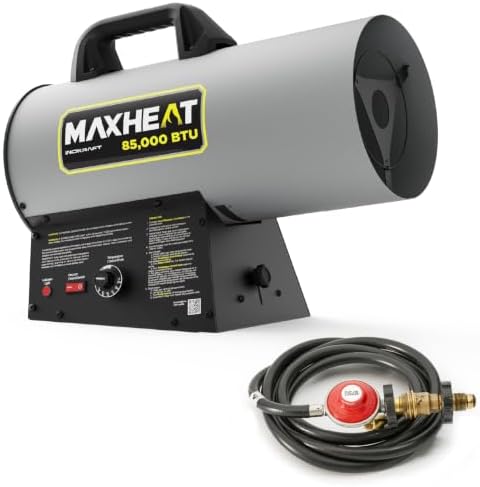
We researched the InoKraft MAXHEAT MH85 85 as a portable propane torpedo heater aimed at garages, workshops and job sites where the space is well ventilated and the work runs long. The thermostat range from 25 to 95°F is the detail our team kept coming back to for a shop in daily use.
Rather than babysitting a manual dial, you set a number and let the unit cycle on and off. That suits a homeowner with a detached garage or a contractor who wants the bay warm before the crew arrives, based on the listing and what owners commonly report.
The listing states up to 85,000 BTU across spaces up to 2,000 square feet, with a heavy-duty fan that distributes heat fast and an adjustable angle to aim the airflow. Auto restart below the set temperature keeps the cycle going without input. Safety features include overheat shutoff, gas shutoff protection and CSA certification, which matters in a fuel-burning unit.
A 4.9 ft power cord and the included 10 ft hose and regulator simplify placement near an outlet and a 20 lb tank, and the low-noise operation helps you stay focused on the work.
The catch is ventilation. Like any unit in this class it is designed for well-ventilated areas only, so a sealed room or a tight basement is the wrong fit. Buyers heating a small single-car garage or a room attached to the house should look at a lower-output or vented option instead.
10. BILT HARD 85,000 BTU Forced Air Propane Heater
Quiet burner technology cuts noise 50% while running 8 hours on low with a 20 lb tank

Our research team looked at the BILT HARD 85 Liquid as a torpedo-style propane heater aimed at garages, jobsites, construction sites, patios, factories, outbuildings and barns, along with farming functions like barns. The listing positions it as a portable option for people who move between spaces rather than heat one fixed room.
Its adjustable heat angle and fan-forced design are meant to spread warmth across a wide area, and the compact, light construction is described as making it easier to carry from one building or work area to the next.
What we found most useful in the product data is the variable 50,000 to 85,000 BTU output, which the listing says can heat an area up to 2,125 square feet. Fuel planning is spelled out too: about 8 hours on low and 5.5 hours on high from a 20 lb propane tank, which is not included.
The listing also states quiet burner technology that is 50 percent quieter than traditional units, continuous electronic ignition for simple starts, overheat auto shut-off protection, and CSA listing. Setup is described as plugging into a 120V outlet and connecting the hose and regulator to a 20 lb tank or larger, and a one-year warranty covers quality problems through the manufacturer.
The real limit follows from the data: burn time is tied to tank size, so a 20 lb cylinder will not carry a full workday on the high setting, and the listing does not present this as a sealed-room heater. Anyone who wants steady thermostat-style control or heat for an enclosed living space should choose a different kind of heater instead.
What It Costs to Run
The power figure on the listing tells you most of what you need to know about running cost. The table uses the power figures from the listings above, at the highest setting.
| Power | 1 hour | 4 hrs a day | 8 hrs a day |
|---|---|---|---|
| 15,000 W | 15 kWh | 60 kWh | 120 kWh |
Your bill shows a price per kWh; multiply it by the figure above for the cost. A thermostat or a lower setting cuts the hours at full power, so real use is often below these figures.
How We Picked
Our picks come from the product details provided by the manufacturers and from what buyers say in customer reviews. We did not rely on advertising claims or promotional copy.
Forced air propane heaters were compared on heat output, fuel consumption, tank compatibility, build materials, ignition type, safety features and portability. We noted the size of the heating area each unit is rated for and how that matches the fuel it burns.
Common praise in owner feedback centred on fast heat, simple setup and reliable ignition. Complaints tended to repeat around noisy operation, strong odours during startup and uneven heat in larger spaces. We weighed those recurring points carefully and let them shape the final list.
Ordering the list was about covering different needs and budgets rather than ranking one winner. Smaller output units suit tight spaces and lighter duty, while higher output models fit bigger areas. Liquid propane options sit alongside standard tank designs.
Frequently Asked Questions
What Decides the Running Cost of a Forced Air Propane Heater?
For a forced air propane heater, the running cost comes down to two things: how much propane the unit burns per hour and how long you run it. Our research team looked at product data showing that burn rate is tied to the heat output of the unit, so a larger heater firing at full power uses more fuel than a smaller one.
Most forced air propane heaters list a BTU rating and a burn rate in pounds or gallons per hour, which lets you estimate fuel use for a given run time. Owners commonly report that running a unit on the lower of its two heat settings stretches a tank considerably, since the burner cycles less often.
Can a Forced Air Propane Heater Stay on Overnight or Run Unattended?
Our research team treats unattended operation as a serious safety question for any forced air propane heater. Manufacturer documentation for these units generally specifies that they are not designed to be left running while you sleep or while nobody is watching them. The reasons are practical: an open flame, a hot burner housing, and combustion inside a room all need supervision.
Owners who describe overnight use in their feedback often mention using a unit with a thermostat and a low-oxygen shutoff, but even those features do not make unattended running a recommended practice in the manuals we reviewed.
Forced air propane heaters are commonly sold for temporary job site heat, garage work and emergency backup, and those uses assume someone is present.
What Size Forced Air Propane Heater Do I Need for My Room?
Sizing a forced air propane heater starts with the BTU output and the space you want to heat. Product data for these units lists a BTU rating and often a suggested square footage range, and our research team compared those figures across the models we reviewed. As a working guide, the manufacturer ranges assume decent insulation and a ceiling of roughly eight feet.
A cold garage, a drafty workshop or an unheated space needs more output than the rated range suggests, because the heat escapes faster than in a finished room.
Matching the heater to the room also affects comfort and fuel use. An oversized forced air propane heater blasts hot air, cycles on and off, and burns more propane than the job requires. An undersized unit runs continuously and never reaches the target temperature on a cold day.
How Loud is a Forced Air Propane Heater in Normal Use?
Noise from a forced air propane heater comes mainly from the fan that pushes hot air into the room, plus the sound of the burner. Our research team found that product data rarely lists a decibel figure, so we relied on owner feedback to understand what to expect.
Most owners describe the fan as a steady whoosh similar to a box fan on medium, loud enough to make conversation a little harder in a small garage. Larger units with bigger blowers tend to be noisier than compact models, which makes sense given the volume of air they move.
Where you place the heater changes how the noise feels. Aiming the outlet away from where people sit or work, and keeping the unit off hard reflective surfaces, reduces the edge.
Is a Forced Air Propane Heater Safe Around Children and Pets?
Safety around children and pets is one of the main concerns our research team hears about forced air propane heaters. The housing and outlet get hot during operation, and the unit produces an open flame inside, so contact is the obvious risk. Product data for many models includes a tip over shutoff and a cool touch handle, but the front and top surfaces still heat up.
Our buying guide recommends keeping the heater out of traffic paths, blocking access with a sturdy barrier, and never leaving kids or pets alone in a room with one running.
Beyond burns, there is the fuel and combustion side. Propane cylinders should stand upright and away from the heater, and the unit needs ventilation so combustion gases do not build up.
Can I Run a Forced Air Propane Heater from an Extension Cord or Power Strip?
Most forced air propane heaters need electricity for the fan and ignition, so the cord question matters. Our research team reviewed product data showing that these units draw a modest amount of power, but the manuals are specific about how to supply it. Manufacturers commonly call for a grounded outlet and a cord rated for the heater’s amperage, and many warn against sharing the circuit with other equipment.
A thin household extension cord can overheat under a continuous load, which is a real fire risk in a garage or workshop.
For a forced air propane heater, our buying guide suggests using the shortest, heaviest gauge extension cord that reaches, and only one rated for the load and for outdoor or damp conditions if that is where you work.
Final Thoughts
After comparing specs and owner feedback across the range, we picked the ROVSUN 125 as our best forced air propane heater for most buyers. Its 125,000 BTU output and high airflow suit large garages and workshops. The BILT HARD 85 is the better match for smaller spaces or buyers who want a lower output unit that is easier to move around.
For steady, longer runs in a fixed workshop, the BILT HARD 125 Liquid is worth considering, since owners commonly report that liquid propane setups last longer between refills. Match the BTU rating to your room size and ventilation first, then check the fuel type and power needs before you buy.