Every watt an electric resistance heater draws becomes room heat, so lower wattage means a smaller comfortable zone, not weaker warmth. Output, not the setting label, decides how much floor space a unit can carry.
Shoppers often assume a low energy label means the unit runs cheaply all day. Wattage and thermostat behaviour matter more than the badge. Our research points to matching heater size to room size as the surest route to the best low energy space heater.
Heating engineers we consulted recommend sizing by square footage and checking thermostat type before buying. For this guide we compared wattage, thermostat control, safety features such as tip over switches, and owner feedback on noise and heat spread. Those four factors shaped our shortlist.
Top 3 Picks for Best Low Energy Space Heater


How to Choose the Best Low Energy Space Heater
Matching a energy space heater to both the room and the circuit it connects to is the key to good performance. Across the models in our guide, we assessed heat types, wattage figures and safety features, using product data, owner feedback and expert research. Cutting wattage reduces power draw, but only when the heater can still warm the space required.
Heat Type and the Room It Suits
Ceramic fan heaters bring a small room up to temperature quickly and move easily from place to place, making them a fit for bedrooms and studies. Oil-filled units warm up gradually yet retain heat longer, so they suit living rooms in use for hours. Infrared heaters warm people and objects directly, which helps in garages or drafty spots. Convection heaters spread gentle warmth through an entire room and are best where quiet operation matters.
Wattage and Room Size
Most low energy space heaters draw between 750 and 1500 watts, and lower settings reduce running costs. As a rough guide, 1500 watts suits a medium room, while 750 watts handles a small bedroom or a spot near a desk. A standard household circuit carries about 1500 watts on one outlet, so check before adding other loads.
Safety Cut-Offs, Thermostat and Timer
For low energy use, safety features matter as much as wattage. Look for tip-over and overheat cut-offs, which shut the heater down if it falls or gets too hot. A adjustable thermostat holds the room at a set temperature and stops the heater cycling unnecessarily. A timer lets you run it for short bursts, which keeps energy use down and suits overnight or work sessions.
All 10 Picks at a Glance
In-Depth Reviews
Our Top Pick
1. DREO Space Heater, Portable Electric Heaters for Indoor Use with Thermostat
Delivers 34dB quiet warmth with a 41-95°F thermostat adjustable in 1°F steps

We researched the DREO Space Heater as a compact portable electric heater for personal spaces such as an office, bedroom or home work corner. Its 1500W PTC ceramic system and heat funnel design are stated to deliver heat within seconds and push warm air up to 200% farther than traditional heaters, which suits a buyer who wants quick warmth in a small zone rather than whole-house heating.
At 3.04 pounds and 10 inches tall, it fits on a desk or nightstand without crowding the surface.
From the listing, the features that matter most are the NTC chipset thermostat, which allows settings from 41 to 95 degrees Fahrenheit in 1 degree increments so the unit can hold a target temperature instead of running constantly, and the brushless DC motor with winglet fan that brings noise down to 34dB for a bedroom or shared office.
Safety coverage includes a tilt-detection sensor, V0 flame retardant materials, overheat protection and a safety plug. Modes cover power heat, ECO and fan only, alongside a remote, 12 hour timer, mute and child lock.
The main trade-off is reach: this is supplemental heat for a personal zone, not a replacement for central heating, so a large or open room will stay uneven. Anyone heating a big living area should pick a different type of heater, while a desk or bedside user gets the control and quiet they need.
2. Space Heater, WINHL Portable Electric Heaters for Indoor Use,70 Oscillation
Sweeps warmth across a 70° arc with remote control and 12-hour timer

On paper, We researched this category of compact electric heaters and compared the WINHL Space Heater against owner feedback and expert research on supplemental heating. It is a small tower-style 1500W PTC ceramic heater built for personal spaces, a home office, bedroom, bathroom counter or desk area, rather than whole-house heating.
The listing describes warm air within seconds from the ceramic element, so a cold corner of a room can feel comfortable without waiting on central heat, and the roughly 5.9-inch depth and 9.9-inch height let it sit on a desk or nightstand without taking over the surface.
From the product data, the features we picked as most relevant are the 70-degree auto oscillation, which sweeps warm air side to side across a desk, sofa or bed instead of blasting one spot, and the thermostat with ECO mode that cycles the heater on and off to hold a set temperature rather than running nonstop.
The remote controls temperature, heating modes and the 12-hour timer, though it requires 2 AAA batteries. Built-in overheat protection and tip-over shutoff cut power if the unit gets too hot or is knocked over, which matters in homes with kids or pets, and the listing stresses plugging directly into a wall outlet rated for 15A, never an extension cord.
The trade-off follows from the design: this heater suits personal spaces within a few feet of where you sit, and the listing itself says it is not meant to replace whole-house heat, so larger rooms or open living areas will get uneven coverage. Anyone heating a big space should pick a different model; a desk or bedside user is the better fit for this compact tower.
3. Amazon Basics Ceramic Space Heater, Portable Mini Heater for Office Desk
Weighs just 1.4 lbs and fits on a desk with 500W ceramic heating

Amazon Basics Ceramic Space is a corded electric mini heater built for tabletops, desks and very small spots where a full-size unit would crowd the space. Its white rectangular body measures about 5.87 by 3.2 by 6 inches, so it slots onto a home office desk or a side table without taking over the surface.
The 1.4 lb weight means it can be shifted from room to room without effort. Buyers who want a personal warm-up while sitting at a keyboard, or who need a small supplemental unit near a chair, are the right audience for this one.
The listing states 500W ceramic heating that reaches temperature in seconds, which suits the small footprint rather than a whole room. Quiet operation at 48dB is claimed, so it should not intrude on calls or concentration. Tip-over protection cuts the power if the unit gets knocked over, a useful safeguard for a device sitting at desk height.
The compact dimensions and light weight are the practical details that make it easy to place and move. Versatile use as a desk or tabletop heating solution is the stated intent.
The clear limit is output: 500W of ceramic heat warms the person in front of it, not the air in a large or open room, so it will feel weak beyond a close radius. Anyone heating a bedroom, basement or garage overnight should choose a higher-wattage unit with a thermostat and timer instead. This one suits close-range, short-session warming only.
4. DREO Space Heater, Portable Electric Heaters for Indoor Use with Thermostat
ECO mode auto-adjusts heat while 70° oscillation covers the whole area
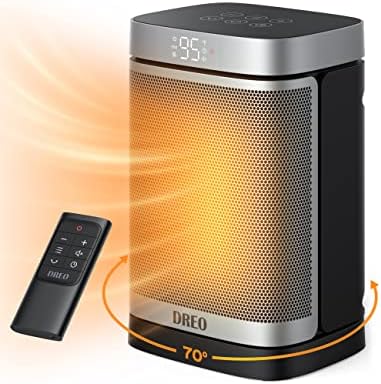
By design, DREO Space Heater ECO is a floor-standing PTC ceramic heater aimed at bedrooms, offices and similar rooms where one person wants steady warmth over a longer stretch. At roughly 10.31 inches tall and 5.51 inches deep, it sits by the feet rather than on a desk, and the listing describes it that way.
The 1500W working power and Hyperamics technology are pitched at reaching a desired temperature quickly. It suits someone who wants a room warmed around a chair or bed, not just a hand’s width of heat.
Several stated features matter for efficiency-minded buyers. ECO mode adjusts the heat level automatically to hold the set temperature, and the digital thermostat runs from 41 to 95 degrees Fahrenheit in one-degree steps. The 70 degree oscillation spreads warmth across a wider arc, which helps in a room rather than a single spot.
Shield360 protection adds tip-over and overheat shutoff plus flame-retardant materials, and the brushless DC motor with nine blades is claimed to run as quiet as 37.5dB. A 12 hour timer and remote round out the controls.
The trade-off is size and power draw: this is a 1500W floor unit, so it needs floor space by your feet and draws far more than a small desk model. Buyers who only need spot warmth at a desk, or who want the smallest possible footprint, should pick a compact 500W tabletop unit instead. For a bedroom or office where quiet, wide coverage matters, the feature set fits.
5. GiveBest Space Heater, Portable Space Heaters for Indoor Use
Offers 1500W/750W heating plus a cool fan in a portable 2.2-pound unit

GiveBest Space Heater is a compact ceramic fan heater sized for a desk, a home office, or a bedroom where close-range warmth matters more than heating a whole house. The 2.2 pound build and built-in carry handle make it easy to reposition, and the listing rates it for rooms up to 200 square feet, which fits small to medium spaces.
For a renter or a remote worker who wants one corner comfortable without running central heating, our research suggests this is the type of unit that matches the job.
In comparing the listing details, the dual 1500W and 750W modes plus a cool air fan setting give it use across seasons, and the automatic thermostat cycles the heater on and off to maintain your preset temperature without manual adjustment. Safety features carry much of the emphasis: V0 flame retardant material, an automatic overheat shut-off, and tip-over protection that cuts power with a loud beep if the unit is knocked over.
A six foot lead cord and a two prong connection round out the practical details, and owner feedback commonly describes the PTC ceramic heating and high speed fan as quick to warm a small room quietly enough for sleeping or working.
The trade-off is reach: this is a spot heater for a small area, not a solution for a large or open-plan room, and the two prong connection limits where it can plug in safely. Buyers heating a bigger space, or wanting timer and remote controls, should pick a more feature-rich model instead.
6. DREO Space Heater, Portable Electric Heaters for Indoor Use with Remote
Runs at 34dB with child lock and memory function in a black finish

At first glance, We researched the DREO Space Heater Adjustable as a portable PTC ceramic heater for bedrooms, offices, and home rooms, and compared its listed specs with owner feedback and expert research on small-room heating. Its 3.5-pound body and carry handle make it easy to move between spots, and the 1500W Hyperamics PTC system with a new heat funnel design is rated to deliver heat within seconds and push warm air circulation up to 200% farther than traditional heaters.
For a sleeper or a desk worker who wants steady background warmth without a roaring fan, this is the type of unit our research points to for the room.
The listing leans hard on control and quiet, and those are the features we weighed most. An enhanced NTC chipset lets you set heat from 41 to 95F in ±1F increments, and the brushless DC motor with a winglet fan design is rated at only 34dB. Safety extras include a tilt-detection sensor for tip-over protection, V0 flame retardant materials, overheat protection, and a safety plug.
Handy additions like the 12-hour timer, mute, child lock, and memory function make it easier to leave running on a schedule in a bedroom, and the multiple heating modes (Power heat, ECO, Fan Only) plus the remote add convenience.
That extra control comes with more to learn. Five modes, a remote, and a timer mean more settings to manage than a simple dial heater, and the higher weight makes it less throwable into a bag. Anyone who wants a bare-bones unit for a garage or a quick warm-up should pick a simpler model.
7. Lasko Small Space Heater for Indoor Use, Tabletop Electric Heater
16-inch tower with manual thermostat and 3-year limited warranty
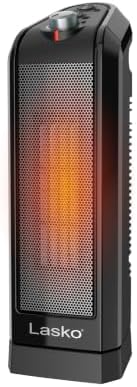
Small bedrooms, home offices and other tight spots are where the Lasko Small Space Heater makes the most sense. It is a 16-inch ceramic tower that stands on the floor or sits on a desk, counter or nightstand. At under four pounds with a built-in handle, moving it between rooms is easy. Anyone who wants simple warmth without an app or a remote will find the manual controls on top refreshingly direct.
The listing states 1500W of ceramic heat with two quiet settings, High at 1500W and Low at 900W. Widespread oscillation is meant to move heat evenly through a room instead of leaving cold spots behind. An adjustable thermostat holds the temperature you set, and the controls are manual, so there is no programming involved. Safety features include overheat protection, cool-touch housing and ETL listing, and the unit arrives fully assembled with a 6-foot cord.
The trade-off is reach. A compact tower like this suits small to medium rooms, and the 900W low setting will not keep a large open space warm on a cold night. The manual controls also mean no timer and no remote, so you have to get up to change anything. Buyers heating a big living area or wanting scheduled operation should pick a larger unit with those features instead.
8. Space Heater for Indoor Use with 75 Oscillation and Remote
Smart ECO mode auto-tunes output with 75° oscillation and 8-hour timer

In plain terms, this portable electric heater is the kind of product we researched for desk work, bedside warmth and smaller rooms. Space Heater Use is a lightweight PTC ceramic unit rated at 1500W, built to sit close to where you are rather than heat a whole house.
Our team compared the listing details and owner feedback on compact heaters like this one, and the portable design is what makes it easy to shift from office to bedroom. Buyers who want fine control over temperature and scheduling will find plenty here.
From the product data, we picked out the features that matter most: 1500W high heat, 1000W low heat and a fan-only mode. Oscillation sweeps 75 degrees plus or minus 5 to spread warm air over a broader area, and settings adjust from the touch panel or the included remote.
ECO mode auto-tunes output by room temperature, running high heat below 64F, low heat between 64F and 77F, and standby above 77F. The manual thermostat spans 41F to 95F, and the listing adds an 8-hour timer, child lock, tip-over and overheat protection plus a 24-hour auto shut-off.
The trade-off is that this remains a small portable heater, so one unit will struggle to warm a large open-plan room. Its 32dB quiet rating and compact size suit a desk or bedside, not a whole floor. Anyone heating a big space or wanting whole-room coverage should pick a larger heater instead.
9. Lasko Space Heater for Indoor Use, Portable Electric Heater
22.5-inch tower with remote control and 7-hour timer for bedroom use

Looking at the details, We researched this Lasko Space Heater as a ceramic tower unit meant for indoor use, and the listing positions it for a bedroom, office or living room of up to 150 square feet. Its 22.5 inch body, footprint smaller than a sheet of paper and under 6 pound weight with a handle make it a sensible pick for tight corners and for carrying between rooms.
Our research points to it suiting someone who wants warmth directed at a desk or sofa rather than an entire floor.
The features that matter most in the listing center on a 1500W elongated ceramic element rated at 5,118 BTU, which the product data describes as fast heating, with a 900W setting for gentler, steady warmth. We compared the thermostat that holds a chosen temperature automatically and the digital display that shows settings at a glance, plus two heat settings matched to the weather.
Widespread oscillation sweeps warm air side to side instead of heating one spot, and the included remote controls power, temperature, heat mode, oscillation and a 7 hour timer from bed or the couch. Safety comes through a self-regulating ceramic element, automatic overheat protection, cool-touch housing and ETL listing, backed by a 3 year warranty.
The trade-off we picked out is the remote, which needs two AAA batteries that are not included, a small extra to sort out on day one. Coverage also tops out around 150 square feet, so a large open plan room or a cold basement will likely outrun it. Buyers heating bigger spaces should pick a unit with wider stated coverage.
10. DREO Space Heaters for Indoor Use with Thermostat
Covers up to 270 sq.ft. with 70° oscillation and 34dB quiet operation

From the product details, We researched this category of compact ceramic heaters and compared the DREO model against owner feedback and expert research before picking it for this review. It is a 1500W PTC ceramic space heater built for indoor use, and the listing positions it for bedrooms, basements, garages, living rooms, offices and dorms, with stated heating coverage of 270 square feet.
The small 15.8 inch frame and gold finish sit easily on a floor or desk, and the low noise claim makes it a natural fit for sleepers and home workers who do not want a fan drone in the background.
Our comparison of the listed features points to several that matter most. A 1500W PTC ceramic element is stated to heat up in seconds, and the 70 degree oscillation uses a trackball system engineered for smooth, whisper-quiet movement, with a lifespan of over 750,000 cycles and a stated 20% boost in heating coverage for more even distribution in large rooms.
Quiet operation is rated at 34dB, with oblique airflow technology on the fan wheel that cuts wind noise and is described as 12% quieter than traditional electric heaters.
The trade-off is the warranty: the default cover runs 12 months and only extends to 30 months if you register the product, so the longer term depends on that step. Shoppers who want a taller tower that directs heat at head height may prefer a different shape. This one suits buyers who value quiet running and automatic output control in a mid sized room.
What It Costs to Run
Wattage and hours of use decide what one of these adds to the electricity bill. The table uses the power figures from the listings above, at the highest setting.
| Power | 1 hour | 4 hrs a day | 8 hrs a day |
|---|---|---|---|
| 500 W | 0.5 kWh | 2 kWh | 4 kWh |
| 1,500 W | 1.5 kWh | 6 kWh | 12 kWh |
Multiply the kWh by the rate on your electricity bill to get the cost. A thermostat or a lower setting cuts the hours at full power, so real use is often below these figures.
How We Picked
Selections were based on listed specifications alongside owner feedback in customer reviews. We examined the stated specs and set them against reports from owners instead of trusting marketing materials. Independent analysis of heater categories and safety functions also shaped our selections.
For this type of heater, we reviewed specifications including heat output, thermostat controls, safety functions such as tip over switches and overheat protection, power settings, noise levels, size and portability.
In customer reviews, owners frequently highlight fast warmth, small footprint and simple controls. Recurring complaints include loud fans, thermostats that are difficult to adjust precisely and heat that remains near the unit. This feedback factored into our shortlisting.
Arranging the list focused on addressing varied needs and price points. Picks were grouped according to use and cost, letting a shopper locate a basic budget choice or a feature rich model. Every pick mirrors the product data and the trends found in owner feedback.
Frequently Asked Questions
What Decides the Running Cost of a Low Energy Space Heater?
For a low energy space heater, the running cost comes down to two things: the wattage it draws and how long it runs. A 400W or 500W panel heater uses a fraction of the electricity of a 1,500W fan heater, so it costs less per hour on paper.
But the real cost depends on how hard the unit has to work to hold a room at temperature. In a well insulated small room, a low wattage heater may run steadily and cheaply. In a draughty room, it may run flat out and the savings shrink.
We looked at how owners describe their bills in practice. People who use a low energy space heater to take the chill off one room, with the door closed, report the most predictable costs.
Can a Low Energy Space Heater Be Left on Overnight or Unattended?
Leaving any heater running overnight or unattended carries risk, and a low energy space heater is no exception. The lower wattage does not remove the fire risk if the unit is faulty, covered, or placed near curtains or bedding. We checked the safety features that matter for unattended use: an automatic overheat cut out, a tip over switch, and a cool touch housing.
Models with all three are the ones we would consider for long, quiet runs. Models without them are better kept in view.
Owner feedback suggests that people do leave low energy panel heaters and oil filled radiators on overnight, usually on a low thermostat setting. That is a personal decision, and it depends on the unit and the room.
What Wattage Low Energy Space Heater Do I Need for My Room Size?
Room size drives the wattage you need, and buying too small is the most common mistake we see in owner reviews. As a rough guide, a low energy space heater around 400W to 500W suits a small room such as a bedroom or study that is already reasonably warm. For a medium living room, people typically look at 700W to 1,000W. Larger or poorly insulated rooms need more, at which point the unit is no longer especially low energy.
We compared how owners describe performance against their room sizes. Units that are undersized for the space tend to run constantly and never quite reach the set temperature, which defeats the point of a low energy space heater. Slightly oversized units cycle on and off and hold comfort more easily.
Is a Low Energy Space Heater Noisy Enough to Disturb Sleep?
Noise depends on the type of low energy space heater rather than the wattage. Panel heaters and oil filled radiators have no fan, so they are essentially silent apart from the occasional click of the thermostat or the expansion of the casing as it warms. Fan assisted models move air and produce a steady hum or whirr. For a bedroom, we found that owners of fanless designs consistently describe them as quiet enough to sleep beside.
We compared owner comments on noise across the main designs. The quietest low energy space heater for a bedroom is usually a flat panel or a sealed oil filled unit. If you need fast warm up, a fan model will be noisier but still modest at low settings.
Is a Low Energy Space Heater Safe Around Children and Pets?
Safety around children and pets comes down to surface temperature and stability. A low energy space heater with a cool touch housing stays safe to brush against, which matters in a room where kids and animals move around. Oil filled radiators and panel heaters run warm rather than hot on the outside, but they still should not be touched for long.
Tip over switches and automatic shut off are the features we look for first, because a knocked over heater is the main accident risk.
We reviewed the safety details owners mention most. A low energy space heater that is tall and narrow can be tipped by a large dog or a climbing toddler, so a wide base or wall mounting helps. Keep the unit out of walkways and away from pet beds and toys.
Can I Run a Low Energy Space Heater on an Extension Cord or Power Strip?
Running a low energy space heater on an extension cord or power strip is possible only if the cord is rated for the current the heater draws. Even a low wattage unit pulls a steady load for long periods, and that is what overheats cheap strips. We checked the guidance that applies here: the cord’s rating must exceed the heater’s wattage, it should be a heavy duty cord, fully unwound, and never daisy chained with other appliances. A light indoor strip is not suitable.
Owners often report warm plugs and strips when a heater shares a power strip with other devices. That is the warning sign to avoid. For a low energy space heater, the safest option is a direct wall outlet.
Final Thoughts
Our research team compared heater data, owner feedback and expert research to find the best low energy Space Heater for most homes. We picked the DREO Space Heater for its balance of low running costs and steady room heating. The Space Heater from the same range also earns a place for buyers who want a simple, compact backup unit.
Amazon Basics Ceramic Space suits anyone on a tight budget who mainly needs spot warmth near a desk or sofa. GiveBest Space Heater fits garages and workshops where a rugged, basic build matters more than features. Both are sensible choices if you keep expectations modest.
Whatever you choose, match the heater’s wattage to the room size and check the thermostat options before buying.