Oversizing by the old tank’s capacity is the most common error with outdoor electric tankless units, since wattage, voltage and climate decide real output. Actual hot-water demand matters more than the label.
A correctly matched unit delivers hot water on demand, no tank to run dry and no standby losses. Our research guides owners toward the best outdoor electric tankless water heater for their climate and fixtures.
Control and safety separate a basic model from a full-featured one. We compared kW ratings and voltage requirements, freeze protection for cold installs, flow rates across multiple fixtures, and owner reports on reliability and support to identify which units truly perform.
Top 3 Picks for Best Outdoor Electric Tankless Water Heater


How to Choose the Best Outdoor Electric Tankless Water Heater
Choosing an electric tankless water heater starts with the weather it will face and the wiring your home can support. We looked at product data, owner feedback and expert research to compare how units handle cold, moisture, hard water and voltage drop. Our picks favour models built for exposed walls, with sealed casings and freeze protection where it matters.
Tank, Tankless, Heat Pump or Point-Of-Use
Outdoor electric tankless units suit homes where the heater sits on an exterior wall or in a sheltered alcove. They free up indoor space and avoid venting, but they are exposed to rain, frost and sun, so casing quality and freeze protection matter more than indoor buyers expect. Point-of-use models work for a single outdoor shower or remote cabin tap. Tank and heat pump types are rarely practical outside.
Capacity or Flow Rate Against People and Fixtures
Match the flow rate to the fixtures running at once, not just the number of people. A single outdoor shower needs far less than a household running two showers and a sink together. Cold incoming water in winter lowers output, so we look for units that hold their rating at low inlet temperatures. Oversizing wastes money on wiring; undersizing gives lukewarm showers.
Power, Voltage and the Wiring or Fuel Line It Needs
Whole-home outdoor electric models commonly draw 11kW to 27kW at 240V, and that load decides your electrical service. Many homes need a dedicated circuit, heavier gauge cable and sometimes a panel upgrade before one of these units can run. Check the required amperage and breaker size against your panel, and confirm the casing is rated for outdoor mounting.
Quick Comparison: All 10 Picks
In-Depth Reviews
Our Top Pick
1. Rheem 18kW 240V Tankless
Self-modulation adjusts power to demand while copper immersion elements stay field serviceable
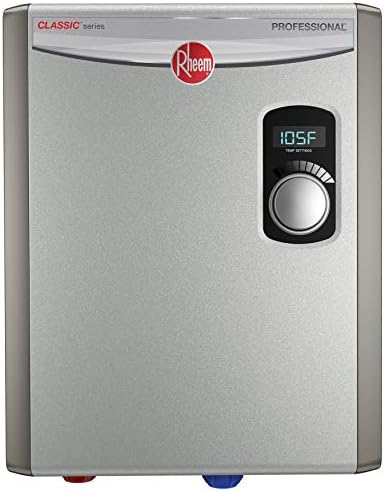
Rheem 18kW 240V Tankless is a wall-mounted electric water heater sized for heavier hot water demand, and its gray cabinet measures 18.5 inches long, 14.5 inches wide and 3.5 inches high at 14.78 pounds, so it mounts on a service wall without taking up floor space.
We researched the RTEX-18 for outbuilding and exterior installations, such as a guest house, workshop or outdoor shower block, where several hot water points may run at once. In our comparison of the lineup, this is the model aimed at larger simultaneous draw rather than a single light tap.
Our research focused on the features the listing states that matter most for that kind of job. Self-modulation adjusts power to meet hot water demand, and the external digital thermostatic control with LED display holds temperature to plus or minus one degree. Copper immersion two heating elements are field serviceable, and the flow rate reaches up to 4.4 GPM.
Bottom 3/4 inch NPT water connections and threaded fittings simplify replacement and hookup, and the stated 99.8% energy efficiency class speaks to how little is wasted in standby. Owners commonly report that the digital display makes temperature setting straightforward.
The trade-off is electrical: an 18kW draw at 240V needs a serious dedicated circuit and a service panel that can carry it, so a buyer with a modest panel should plan for an upgrade first. Anyone heating only one tap or a small cabin should pick something else, as this capacity is more than a light load needs.
2. Rheem 11kW Multi Fixture
Compact 11kW unit handles multiple fixtures and frees floor space with 90% smaller size

Multi-fixture duty is the job the Rheem 11kW Multi Fixture is sized for, making it a sensible pick for an outdoor kitchen, pool house or cabin where a sink and a shower might run at once. At 12.63 inches long and 8.25 inches wide, the gray unit mounts on a wall and frees up space a tank would occupy. Buyers who want on-demand hot water at a few exterior points, without a large footprint, are the right audience.
Our research compared the listing details that matter for an exterior setup. The 11kW model provides up to 2.68 GPM, and digital thermostatic temperature controls adjust in one degree increments from 80F to 140F. Wiring requirements are spelled out clearly: 240V single phase power, one 50 amp double pole breaker, one set of 8 AWG copper conductors with ground, and a recommended minimum 100 amp household service panel.
The compact design is stated as 90% smaller than traditional tank water heaters, and the unit only heats water when a hot water tap is turned on.
The main trade-off is output: 2.68 GPM suits multiple fixtures only when they are used sensibly, so a household expecting several hot taps at full flow at once should pick a higher capacity model. Buyers with a small electrical service should also confirm panel capacity before committing.
3. Westinghouse 14kW Tankless Water Heater Electric 240V, Wifi
Alexa and Google Home control plus temperature memory make this 14kW unit a connected choice

Outdoor cabins, apartment patios and office restrooms are the kind of spots the Westinghouse 14kW Tankless Water fits, a compact wall-mountable electric unit with smart controls. Its gray body measures 12.59 inches high, 9.56 inches wide and 3.28 inches deep, small enough to tuck onto a service wall. A buyer who wants app and voice control over an exterior hot water point is the target here.
Listing details that matter for exterior use start with the 3 second heat-up and 98% thermal efficiency, plus a minimum start-up flow rate of 0.53 GPM and 3.4 GPM at a stated inlet and outlet temperature pair, supporting two points of use. WiFi compatibility with Alexa and Google Home allows temperature changes and usage monitoring by voice or app, and a temperature memory function restores settings.
ETL certification comes with four layer protection covering leakage, overheat, dry fire and over voltage, an IPX4 rating, separated water and electricity pathways and anti fog technology for damp spots. A removable inlet filter and rotor help with scale and corrosion.
Installation is the catch: the listing calls for a dedicated 60A double pole breaker and 6 AWG wire at 240V, so a panel without that capacity needs work first. Buyers heating a whole large home or several fixtures at once should choose a higher output unit instead.
4. Rheem RTEX-24 24kW 240V
24kW output pushes 5.9 GPM for heavy demand while digital controls hold 1-degree settings

Whole-house electric tankless unit Rheem RTEX-24 24kW 240V suits larger households running several fixtures at once. Its 24kW rating supports up to 5.9 GPM, which the listing ties to multiple fixture applications. That output level suits a home with a few bathrooms and a busy kitchen, and the gray cabinet fits neatly on a utility room wall. Buyers planning a serious install should treat it as a fixed appliance that needs a proper electrical plan.
The electrical requirements are the first thing we checked, because they decide whether this unit can work in your home at all. It needs 240V single-phase power, three 40-amp double-pole breakers, three sets of 8 AWG copper conductors with ground, and a recommended minimum 200-amp household service panel.
Temperature is set on digital thermostatic controls in 1-degree increments from 80F to 140F. The design heats only when a hot tap opens, and the compact body is listed as 90% smaller than a traditional tank.
That breaker and panel demand is the real limit. Homes with a 100-amp service or an already crowded panel will need an upgrade before this unit can run, and that work adds cost and time to the job. Buyers who cannot support three double-pole breakers should look at a lower-kW unit or a different heating approach instead.
5. 14kW Tankless Water Heater Electric ORBEK on Demand Heater 240V 3.38GPM
Orbek delivers 3-second heating and 1-degree stability with ETL certification at 14kW

14kW Tankless Water Heater is a modest on-demand unit aimed at small homes, cabins and light-duty setups where one or two hot taps run at a time. Its 3.38 GPM maximum output is described as comfortable for 2 to 3 points of use, such as a bathroom and a kitchen.
The pearl-colored body is compact at 14.2 by 9.5 by 3.1 inches, so it tucks into tight corners. For a buyer with limited hot water demand, that pairing of size and output makes sense.
Heating starts in about 3 seconds according to the listing, and the built-in chip adjusts power 20,000 times per second to hold temperature within 1F. The digital LED screen sets temperature between 86F and 140F and shows real-time changes. Safety coverage includes ETL certification plus leakage, over-temperature and dry-heating protection, along with lightning resistance. Water and electricity are separated to limit scale and corrosion, and the unit is listed as using up to 60% less electricity than tank heaters.
The catch is the electrical supply. This model needs a 240V/60AMP two-pole breaker, one set of 6 AWG wires and a household panel with at least 150 amps total capacity, which rules out many older or smaller services. Anyone with a lower-capacity panel, or a household running several hot fixtures at once, should choose a different setup.
6. APUS 27kW Electric Tankless Water Heater, 240V, Up to 6.5 GPM
27kW and 6.5 GPM feed three to four simultaneous uses with self-modulating output

We researched this category as a research team, comparing listings, owner feedback and expert commentary, and the APUS 27kW Electric Tankless is the highest-output unit in this group, aimed at larger households that need several hot points running together. The listing rates it for up to 6.5 GPM and 3 to 4 simultaneous uses, covering showers, sinks and laundry.
That makes it a fit for a full family home rather than a cabin or a single bathroom, and the slim wall-mounted body keeps it out of the way in a utility room or basement.
From the product data, the features that matter most start with digital control from 86F to 140F in 1F steps on the LED display, plus a memory function that brings back your last setting. Self-modulating technology matches heating output to real-time flow and temperature demand, and the lack of a storage tank means no standby loss.
The body measures about 17.7 by 11.4 by 3.5 inches with standard 3/4-inch NPT connections, and safeguards monitor temperature, water flow and electrical conditions, with fault codes shown on the display.
The trade-off is the installation demand. This unit needs permanent 240V residential wiring with three 40A breakers and 6 by 8 AWG cable, so the panel and service must be ready for that load. Buyers with a smaller electrical service, or a modest hot water need, should pick a lower-kW model instead.
7. Tankless Water Heater Electric 110V, 3000W Instant Electric Water Heater
Ultra-thin 110V unit fits under sinks with IPX4 waterproofing and dry-boil protection

Small and simple, the Tankless Water Heater Electric is a point of use unit built for a single sink or a small washing area. The 110 volt, 3000 watt design suits a kitchenette, a bathroom basin, a garage sink or a workshop corner where one tap needs hot water without a tank.
It is also a practical fit for a cabin, shed or converted space where a full heater would be overkill. The compact ABS cabinet measures roughly 7.86 inches tall and 4.32 inches wide, so it tucks into tight spots.
What matters most for this kind of install is how the heat behaves and how the unit survives damp conditions. The listing states it can raise water by 82 degrees F at 0.3 GPM up to 131 degrees F at 0.5 GPM, so flow and temperature trade off against each other.
A digital LED display lets you read the setting at a glance. Protection includes water and electricity isolation, IPX4 waterproofing, leakage protection, dry boil protection and automatic shutoff on overheating or inactivity. The 1/2 inch NPT fittings and premade screw holes keep plumbing simple.
The real limit is output: at 3000 watts and 110 volts it cannot serve a whole house or run multiple hot taps at once, and the temperature drops as flow rises. It also must be mounted vertically, and loose pipe connectors without Teflon tape can trigger an E2 fault. Buyers who need several showers running together, or who want a gas fired outdoor unit with far higher capacity, should look at a larger model instead.
8. Tankless Water Heater Electric, 3000W Tankless Electric Water Heater 110V
Prefabricated screw holes and 1/2 inch NPT connections simplify this 3000W point-of-use heater

Built for tight spaces, the Tankless Water Heater Electric is a compact on demand unit aimed at single fixtures rather than whole homes. A wall mounted cabinet keeps it out of the way in a kitchen, bathroom, laundry corner or utility room, and the compact, lightweight design is meant to free up precious space rather than take it.
It also suits a garage sink, a small workshop or a rental unit where adding a tank makes little sense. The small footprint makes it easy to place near the tap it serves.
For spots that see moisture, the protection list is the part worth reading closely. The listing states IPX4 waterproofing, leakage protection, dry burning protection and automatic power off when the unit overheats or sits inactive. Thermal efficiency is quoted at 98 percent, and the 3000 watt element raises water by 82 degrees F at 0.3 GPM up to 131 degrees F at 0.5 GPM.
The LED display can be set to Fahrenheit or Celsius, and the unit qualifies for the ETL standard. Prefabricated screw holes, English instructions and 1/2 inch NPT connections simplify the plumbing.
Capacity is the catch. This is a 110 volt, 3000 watt heater, so it handles one tap at a time and temperature falls as flow increases. It also requires vertical mounting, and the listing warns that loose pipe connections without Teflon tape can cause an E2 fault. Anyone heating a whole house or running several fixtures at once should choose a higher output unit instead.
9. Rheem RTG Series 8.4 GPM Natural Gas Tankless Water Heater Outdoor
Outdoor non-condensing gas model delivers 8.4 GPM with built-in freeze protection and no venting
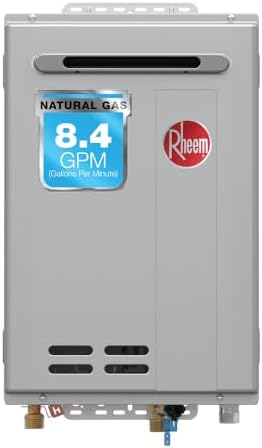
On paper, We researched the Rheem RTG Series 8.4 as a natural gas, non-condensing tankless water heater built for outdoor wall mounting and whole-house use. Its 180,000 BTU input and 8.4 GPM at a 35°F temperature rise, per the listing, size it for large families and multi-bathroom homes where three or four showers may run at once.
Because it installs outdoors, it eliminates indoor venting, which suits an exterior wall or utility alcove. The durable metal cabinet measures about 20.75 inches tall, 13.5 inches wide and 9.4 inches long, and weighs roughly 39 pounds.
Among the listed features, several matter most for an exterior installation. The 0.82 Uniform Energy Factor is quoted as saving up to 34 percent on energy costs versus 50-gallon electric tank heaters, and on-demand heating avoids standby losses. A digital LED panel allows precision ±1°F adjustments, and built-in freeze protection matters in cold climates.
Flame failure protection and a multi-point safety system round out the safeguards. The unit is CSA certified, and the package includes mounting hardware and a detailed installation manual, backed by a 15-year heat exchanger warranty and 5-year parts warranty.
The trade-off is that this is a gas unit requiring professional installation by a qualified installer, and its non-condensing design is intended for outdoor mounting rather than indoor spaces. Buyers without a natural gas line, or those wanting a small point-of-use electric heater for a single sink, should pick a different type of unit. Households with high simultaneous demand and gas available will find the capacity here.
How We Picked
Our picks start with product details and owner feedback, not advertising. We researched the specifications published for each unit and read through what buyers say in customer reviews. Marketing claims were set aside. Only models with enough real owner experience behind them made the cut.
Key details we compared include power output and voltage, flow rate and the number of fixtures a unit can serve, physical size and mounting options, and the electrical supply each model demands. We also looked at freeze protection and weather resistance, since these units sit outdoors.
Common praise in reviews centres on steady hot water, straightforward installation and units that hold up outdoors. Recurring complaints mention tripped breakers, limited flow at high demand and settings that take time to learn.
Ordering reflects different needs and budgets. Smaller units suit a single fixture or a cabin, while larger ones cover whole homes with heavy demand. Buyers with modest electrical panels get options that fit their supply.
Frequently Asked Questions
What Size Outdoor Electric Tankless Water Heater Do We Need for Our Household?
Sizing starts with how many fixtures you plan to run at once. An outdoor electric tankless water heater is rated by flow rate and by the temperature rise it can deliver at that flow. In warm climates the incoming groundwater is milder, so a given unit covers more demand than it would in a cold region.
Add up the flow of the showers, sinks and appliances you expect to use together, then match that to the unit’s rated capacity at your local temperature rise.
For a small home or cabin with one shower and a kitchen sink, a modest unit is usually enough. Larger households running two showers at once need a higher flow rating, and homes with cold incoming water need more power for the same output. Think about peak morning use rather than the total number of bathrooms.
Should We Choose a Tank or an Outdoor Electric Tankless Water Heater for an Outdoor Setup?
A tankless unit heats water only when a tap opens, so there is no standing tank to lose heat outdoors. That matters in exposed locations where a tank would shed warmth constantly. Tankless also frees up floor space, which helps when the unit sits on an exterior wall or in a tight utility corner. The tradeoff is that output is limited by the unit’s power, so simultaneous demand has to be planned for.
A tank gives you a reserve of hot water, which can suit a household that draws large volumes all at once. But outdoors, a tank has to be insulated well and protected from freezing, and it takes up more room. For most outdoor installations we lean toward tankless because there is no stored water to keep hot and nothing bulky to shelter.
What Does Installing an Outdoor Electric Tankless Water Heater Require in Terms of Voltage and Breaker Size?
Electric tankless units draw a lot of current, so the electrical supply is the first thing to check. Most models run on dedicated circuits, and larger units may need more than one. The product data lists the voltage and amperage each model requires, and the breaker has to match that rating. A unit wired to an undersized circuit will trip breakers or fail to reach its rated output, so confirm your panel can carry the load before you buy.
Outdoor placement adds a few practical points. The unit needs a weather rated location, clearance from combustible surfaces, and drainage for the condensate some models produce. Wiring has to be suitable for wet locations, and the enclosure should keep rain off the connections.
How Long Does an Outdoor Electric Tankless Water Heater Usually Last?
Lifespan depends heavily on water quality and how well the unit is maintained. Scale buildup is the main enemy, and in hard water areas it collects faster inside the heat exchanger. Owners who flush their unit regularly commonly report longer service than those who never do. Outdoor placement also exposes the unit to weather, so a sheltered spot and a weather rated enclosure help.
From the product data and owner feedback we reviewed, most units are built to last many years when cared for. The heating elements and electronics are the parts that tend to fail first, and hard water speeds that up. We tell buyers to factor in annual flushing and a periodic check of the fittings and wiring. A well maintained outdoor unit in a mild climate will generally outlast a neglected one in a hard water area.
How Often Should We Flush an Outdoor Electric Tankless Water Heater?
Flushing removes the mineral scale that builds up inside the heat exchanger. In hard water areas, annual flushing is the common recommendation, and some owners in very hard water flush twice a year. In soft water areas, less frequent flushing may be fine, but yearly is still a sensible habit. The product data and owner feedback we reviewed point to scale as the top cause of reduced performance.
Outdoor units face the same scale issue as indoor ones, plus weather exposure that can affect fittings and connections. A flush involves circulating a descaling solution through the unit, then rinsing it out. We suggest checking the inlet filter screen at the same time, since debris collects there. Skipping flushes leads to lower flow and hotter running elements, which shortens the unit’s life.
Why Does Our Outdoor Electric Tankless Water Heater Run Out of Hot Water?
Running out of hot water with a tankless unit usually means demand has outpaced the unit’s capacity. If two showers run at once, or a shower and a dishwasher, the combined flow can exceed what the heater can raise to temperature. Cold incoming water makes this worse, because the unit has to work harder for the same output. Check the flow rate of the fixtures in use against the unit’s rating at your temperature rise.
Scale buildup is the other common cause. A fouled heat exchanger cannot transfer heat as efficiently, so the water comes out cooler even at normal flow. Flushing the unit often restores performance. Outdoor units can also be affected by a tripped breaker or a loose connection after weather exposure.
Final Thoughts
Our research team compared specs, owner feedback and expert research to pick the best outdoor electric tankless water heater for most homes. The Rheem 18kW 240V Tankless balances output and price for whole home use in warmer climates. For smaller setups, the Rheem 11kW Multi Fixture suits cabins and single bathroom use.
Buyers with larger households or colder incoming water should look at higher capacity options like the Rheem RTEX-24 24kW 240V. Owners commonly report that matching the unit to your flow rate and temperature rise matters more than brand.
Check your breaker panel and wiring capacity before ordering. Electric tankless units draw heavy current, and the install cost often exceeds the unit price.