First frost catches exposed plumbing off guard, and an outdoor unit has to keep water flowing without indoor space. These heaters warm water only as it passes, mounted outside where clearance is scarce.
Many shoppers assume a bigger unit always means hotter water. In reality, wattage, flow rate and incoming water temperature decide real output, so climate and demand matter more than size. Our guide points you toward the best outdoor tankless water heater for your setup.
We began with freeze protection and housing durability, since outdoor units face rain, wind and cold. Then we compared ignition type, flow capacity, temperature rise and efficiency across listings. Cold-weather reliability rounded out the picture before we made our picks.
Top 3 Picks for Best Outdoor Tankless Water Heater

How to Choose the Best Outdoor Tankless Water Heater
Selecting an tankless water heater hinges on your hot-water needs beyond the house and the conditions the unit has to endure. We examined product specifications, owner reviews and expert studies covering venting, freeze protection, flow rates and fuel type. Our selections center on models designed for exterior installation, so weather resistance and safe exhaust count as much as hot water capacity.
Tank, Tankless, Heat Pump or Point-Of-Use
Tankless models warm water on demand and fit homes wanting unlimited hot water without a large tank, but outdoor versions must carry a rating for exterior installation. Point-of-use heaters serve one far-off fixture, such as an outdoor shower or garden sink. Tank and heat pump designs seldom suit outdoor placement given weather exposure and space needs.
Capacity and Flow Rate Against People and Fixtures
The flow rate, given in gallons per minute, determines how many fixtures may operate simultaneously. One outdoor shower or hose bib calls for modest flow, whereas a home with multiple hot taps running at once requires a higher rating. Tally the fixtures you plan to run together, then align the unit’s flow rate with that number.
Power, Voltage and the Wiring or Fuel Line It Needs
Electric outdoor models pull substantial current and typically require a dedicated circuit matched to the unit, so verify your panel capacity before purchase. Propane and natural gas models require a correctly sized fuel line and safe outdoor venting, and many owners say installation quality shapes performance more than the unit itself. Check the voltage, amperage or gas supply your selected model demands and whether a licensed installer is required.
All 10 Picks at a Glance
Full Reviews of Each Pick
Our Top Pick
1. Westinghouse 120,000 BTU Natural Gas Tankless Water Heater Outdoor
Delivers 5.1 GPM with ±1°F stability for 2-4 fixtures and includes freeze protection
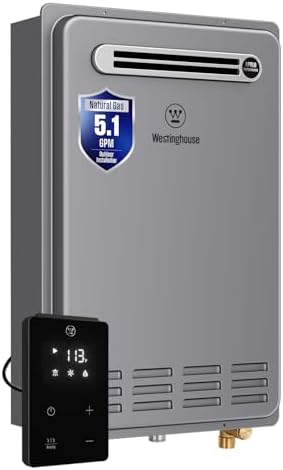
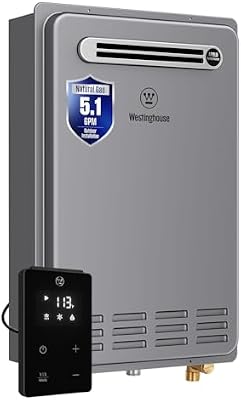
Westinghouse 120 is a natural gas tankless unit built for mounting outdoors, and its 5.1 GPM flow and 120,000 BTU output suit households running two to four fixtures at once. Showers, sinks, dishwashers and laundry can share the supply without the cold bursts that come from a tank running low.
The compact wall-mounted cabinet keeps mechanical space indoors free, which matters when there is no utility room to spare. For a family that wants on-demand hot water without cutting into living space, this is a sensible size.
What we found most useful in the listing is the self-modulating control, which trims gas and water flow to hold temperature within plus or minus one degree. The unit heats only when a tap opens, so standby losses disappear compared with a storage tank, and the stated UEF above 0.81 reflects that efficiency.
Outdoor placement means no venting run, and CSA certification plus integrated freeze protection, a variable-speed combustion fan and durable internals address the weather exposure that comes with an exterior install. Standard three-quarter inch connections simplify the plumbing side.
One real limit is the power and climate requirement. The unit needs a 120V AC source at the install point, and below 5 degrees Fahrenheit, or after long idle stretches, the system has to be fully drained to avoid damage. Buyers in hard-freeze regions who want set-and-forget winter operation should look at a unit with stronger cold-weather provisions, while mild-climate homes with an outdoor wall and a nearby outlet will find the capacity well matched.
2. Rheem RTG Series 8.4 GPM Natural Gas Tankless Water Heater Outdoor
Pushes 8.4 GPM at 180,000 BTU to support 3-4 showers simultaneously
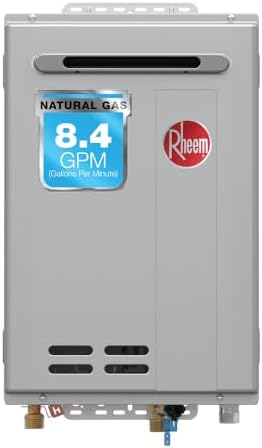
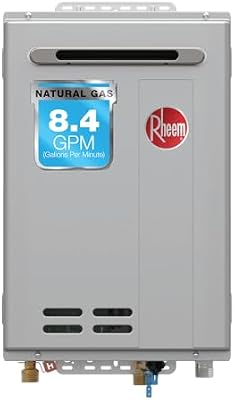
We researched the Rheem RTG Series 8.4 as a natural gas tankless water heater built for whole-house residential use, and the listing positions it for large families and multi-bathroom homes. Its 8.4 GPM at a 35°F temperature rise and 180,000 BTU/hr output are stated to support three to four simultaneous showers, so the capacity suits households where several bathrooms see demand at once.
Because the unit is designed for outdoor installation, it eliminates venting, and the durable metal cabinet with wall mounting by a qualified installer rounds out the physical package. Our comparison of the product data places it in a higher-output class than smaller residential units.
Among the features the listing states, flow and control matter most for daily use. A 0.82 Uniform Energy Factor and on-demand heating are cited as saving up to 34% on energy costs versus 50-gallon electric tank heaters, and the digital LED temperature control panel offers precision of plus or minus 1°F for consistent hot water temperature.
Safety coverage includes built-in freeze protection, flame failure protection and a multi-point safety system, with CSA certification behind the claims. The package includes mounting hardware and a detailed installation manual, and the warranty runs 15 years on the heat exchanger and 5 years on parts.
The trade-off is installation and climate scope. Professional installation is required, and the non-condensing design limits the unit to outdoor mounting, so homes without a suitable exterior wall or gas line routing will need a different approach. Owners in severe freeze zones should confirm the built-in freeze protection suits their winters, and anyone wanting a simple do-it-yourself swap should pick a smaller, simpler unit instead.
3. Rheem RTG Series 7.0 GPM Natural Gas Tankless Water Heater Outdoor
Balances 7.0 GPM output with 160,000 BTU for 2-3 simultaneous showers

Natural gas powers the Rheem RTG Series 7.0, a unit built for whole house residential use that suits large families and multi bathroom homes where several hot water draws happen at once. The 7.0 GPM rating at a 35°F temperature rise works out to enough capacity for two or three simultaneous showers, so a busy morning routine does not stall.
Because it is designed for outdoor installation, it frees up indoor space and keeps the gas appliance out of living areas.
Output sits at 160,000 BTU per hour with a 0.82 Uniform Energy Factor, which the listing frames as up to 34 percent savings against a 50 gallon electric tank. On demand heating means the burner only fires when water flows, so standby losses drop away. The digital LED panel adjusts temperature in steps of plus or minus 1°F, and built in freeze protection matters for cold climates where an outdoor unit sees frost.
Flame failure protection and a multi point safety system round out the package, along with a 15 year heat exchanger warranty and 5 year parts coverage.
Non condensing design and outdoor only placement mean you cannot tuck this unit into a closet or run it in a tight interior mechanical room, and the gas line and venting work call for a licensed installer rather than a weekend DIY job. Households with modest hot water demand or a tight budget may find the capacity and install requirements more than they need. Buyers wanting a simple propane setup should look at the VEVOR instead.
4. VEVOR Tankless Water Heater Propane 5.3Gal 100000 BTU Instant Hot Water
Includes a 32.8ft wired control panel and nine safety protections for outdoor installs

VEVOR Tankless Water Heater runs on propane and is aimed at whole house residential use where natural gas is not piped in. The 5.3 gallon rating and 120,000 BTU per hour output suit a family that wants constant hot water for showers without a storage tank.
At 29.1 pounds and roughly 23 inches tall, it is lighter and more compact than many gas units, which helps on an exterior wall. A vent outlet on the outdoor cabinet connects to a direct vent for safe exhaust routing.
Smart sensors hold water temperature within plus or minus 1°F of the set value, cutting the swing you feel in the shower when another tap opens. The wired control panel reaches 32.8 feet, so the unit can hang outside while adjustments happen indoors, including one touch on off and unit switching.
Nine listed protections cover leakage, flameout, dry burning, overheating, timeout, pipe damage, high temperature lock, wind pressure and antifreeze. Installation uses a standard 3/4 inch NPT connector, and the package is set up for a straightforward outdoor mount.
Propane needs a tank or supply line on site, and the 120,000 BTU ceiling limits how many fixtures can run together compared with larger gas units. Buyers with three bathrooms drawing at once or a natural gas connection already in place should pick something else. This one fits off grid homes and smaller households that want propane convenience at a lower capacity.
5. Syfuulv Propane Tankless Water Heater Outdoor, 1.58 GPM Portable Water
Weighs just 9.7 lbs with a foldable handle and runs on 3 PSI water pressure

Syfuulv Propane Tankless Water is a compact portable unit built for campsites, RVs, cabins and boats where hot water has to travel with you. Its 17.3 by 11.8 by 5.1 inch body weighs about 9.7 pounds and carries a foldable handle, so it fits in a camping bag or car trunk. Buyers who need hot water away from a fixed plumbing line are the ones this suits. It is not a whole house appliance.
What matters most here is the low pressure startup. The unit runs at 3 PSI, which helps in remote cabins, campsites and boats where supply pressure is weak. The 41,000 BTU burner and 3-second instant heating claim quick output, and the 1.58 GPM flow keeps a steady stream for a shower head.
Winter mode holds a stable 113 plus or minus 2 degrees Fahrenheit even at 23 degrees Fahrenheit, while summer mode cuts gas use. The CSA approved regulator and hose come in the box, along with a 5 foot on and off switch shower head and two garden hose adapters.
We noted the listing states 89 percent thermal efficiency and a 20 pound tank as the fuel reference.
The biggest limit is that the water pump is not included, so buyers must source one separately before the unit can draw from a tank or lake. The listing also warns against Teflon tape on the gas regulator connection and stresses keeping the unit dry. Anyone wanting a fixed whole house install should look elsewhere. Campers and cabin owners who accept the pump extra will find the package complete.
6. Westinghouse Tankless Water Heater Propane Outdoor, 5.1 GPM 120,000BTU
Propane version delivers 5.1 GPM and ±1°F stability with a 2-year comprehensive warranty

Wall mounted propane design defines the Westinghouse Tankless Water Heater, aimed at whole house use for two to four person households. It is engineered for outdoor wall mounting and supports 2 to 4 fixtures at once, including showers, kitchen sinks, dishwashers and laundry. Families replacing a tank heater or outfitting a new build are the intended buyers. It needs a 120V AC power connection and professional licensed installation is recommended.
The headline figure is 5.1 GPM at 120,000 BTU, which the listing ties to continuous flow across multiple fixtures. Self-modulating water-gas linkage matches gas input to water flow in real time and holds outlet temperature within plus or minus 1 degree, which should reduce hot-cold swings during showers.
On demand activation means heating starts only when water runs, and the listing states UEF above 0.81. Safety coverage includes CSA and ANSI certification, a high-temperature limiter, flame failure protection and low-water-flow dry-fire protection. A 12-speed DC fan speeds up in strong winds, and anti-freeze protection matters for cold outdoor walls.
The wired digital controller adjusts from 95 to 158 degrees Fahrenheit with one-touch Fahrenheit and Celsius switching, and self-diagnosis shows error codes.
The trade-off is installation scope. This unit needs a 120V AC supply and licensed professional fitting, so it is not a drop-in for renters or quick camp setups. Buyers wanting a portable unit for trips should pick something else. Homeowners with a fixed outdoor wall and a plumber lined up get the multi-fixture capacity and freeze protection this class of heater is built for.
7. CAMPLUX 5L Portable Tankless Water Heater, 1.32 GPM Outdoor Propane
Runs on two D-size batteries and starts at 3.0 PSI for off-grid showering

We researched the CAMPLUX Portable Tankless Water as a compact propane heater aimed at campsites, RVs and off-grid cabins. At 10 lbs with a folding handle, it fits in a car trunk or RV compartment, and campers, fishers and road-tripping families are the clear audience since the unit is built to be carried to wherever hot water is needed. It runs on propane and needs no mains electricity, which suits remote spots where power hookups are not an option.
Our comparison of the listing data highlighted the flow of 1.32 gallons per minute, enough for a shower or a dish wash without a long warm-up wait. Low pressure startup at 3.0 PSI lets it draw from a small 12V pump or even a gravity water bag, an advantage deep in the woods.
Two D-size batteries handle ignition, and the package includes a shower head, a 5-foot gas regulator and the hoses for a basic hookup. CSA approval and six built-in safety checks, including overheat and anti-flame protection, are the assurances owners commonly cite for washing kids and pets outdoors.
The small flow rate is the honest limit. A 1.32 GPM unit handles one shower or a sink at a time, so a household expecting to run several hot taps together will find it stretched. Buyers who want a fixed wall unit for a full home should look at a higher capacity model instead.
8. Outdoor Propane Tankless Water Heater, 110000 BTU 4.76 GPM Instant
Comes with a 16.4ft indoor remote cable and weather-resistant body for harsh outdoor use

On paper, We researched this VELPAX unit as a wall-mounted propane water heater built for permanent exterior installation at a home or RV. Its 110,000 BTU rating (36kW rated heat load) and 4.76 GPM flow rate point to multi-outlet use, so a kitchen, bathroom and outdoor shower can draw hot water without the unit falling behind.
The listing specifies operation at 3-116 PSI (0.02-0.8 MPa) water pressure and 2.8 kPa propane inlet gas pressure, which tells us it is designed for low-pressure startup on a standard exterior wall.
Staged combustion and an oxygen-free copper heat exchanger are the features the listing leans on for reduced temperature fluctuation, fast heating and corrosion resistance over a long service life. A digital remote panel with a 16.4ft (5m) connection cable lets the controls sit indoors in a kitchen, bathroom, basement or living room while the heater stays outside.
The body is described as weather-proof, wind-proof, rain-proof and freeze-resistant, so the data says it can operate in snow, rain and frigid conditions. Standard 1/2″ NPT threads on the water inlet, water outlet and gas inlet, clear pipeline markings and an included adjustment wrench keep the plumbing side straightforward for quick assembly.
The trade-off follows from the power and fuel requirements: this unit needs 110V-60Hz AC power and a propane supply, so it is not a fit for deep off-grid trips where neither is available. The exterior wall-mount design also makes it a fixed installation rather than a portable one. Campers who want a heater they can carry should pick a lighter battery-ignited option instead.
9. Rheem RTG Series 7.0 GPM Liquid Propane Tankless Water Heater Outdoor
Liquid propane model provides 7.0 GPM and 160,000 BTU for multi-bathroom homes

At first glance, We researched the Rheem RTG Series Liquid as a liquid propane tankless unit for whole house residential use, and the listing positions it for large families and multi bathroom homes. Its 7.0 GPM flow at a 35°F temperature rise supports two or three showers at once, so a busy household can draw hot water without waiting on a tank to recover.
The non-condensing design is meant for installation outdoors, which eliminates venting and frees indoor space. A qualified installer handles wall mounting, and the package includes mounting hardware and a manual.
Our comparison of the product data put 160,000 BTU/hr output and a 0.82 Uniform Energy Factor at the center, since on demand heating avoids the standby losses of a storage tank and the listing cites savings up to 34% versus a 50 gallon electric tank heater.
The digital LED panel adjusts temperature in fine steps for consistent delivery, and built in freeze protection, flame failure protection and a multi point safety system address the risks of a gas appliance mounted outside.
The trade-off is that professional installation is required and the non-condensing design cannot be treated as a simple DIY swap for an indoor model, so anyone without outdoor wall space and a propane supply should pick something else. Households wanting a small portable setup for camping or a cabin are better served by a different type of unit; this one fits a large home with an exterior mounting spot.
10. CAMPLUX Outdoor Tankless Water Heater Propane, 4.22 GPM Propane Tankless Water Heater
Offers 4.22 GPM with an ECO/FULL knob and six safety protections for remote cabins

Camping, remote cabins, tiny houses and mobile homes are the targets of the CAMPLUX Outdoor Tankless Water, a propane unit where hot water has to come from a compact wall mounted box rather than a household system. At 4.22 GPM it covers an outdoor shower or a cabin sink, and the listing says installation takes about five minutes with the included accessories.
The white cabinet measures roughly 25.6 by 15.8 by 7.1 inches and weighs 27 pounds.
The 110,000 BTU/hr burner delivers endless hot water on demand, and the listing cites 11.5 percent energy savings from the exchanger and main burner design. Water pressure between 4.0 and 110 PSI triggers the unit, which matters for gravity fed or pump fed setups off grid.
An LED display and an ECO/FULL knob give straightforward control, and the six in one protection set covers flame failure, overheating and anti freezing. A drain plug lets you empty residual water before cold snaps.
The listing warns against Teflon tape between the gas regulator and inlet pipe, and improper operation can cause a fire, so the gas connection deserves care. Freeze damage to the exchanger or valves is possible if the unit is stored in cold climate without draining. Campers and cabin owners who want a small outdoor unit fit here, while a full household should look at a larger model.
How We Picked
Every pick in this guide began with product data and owner feedback, not marketing claims. We researched the specifications published for each outdoor unit and read through customer reviews to see how the heaters hold up in real use.
Comparing the product details meant looking closely at flow rate, fuel type, ignition method, venting and installation requirements. We weighed power output against the demands of typical outdoor use, and checked which units offer freeze protection or low water pressure startup.
Owner reviews revealed clear patterns. Praise often centers on steady hot water, straightforward installation and reliable ignition, while complaints tend to involve inconsistent temperatures, noisy operation or parts that fail early.
Ordering the list was about covering different needs and budgets rather than ranking one winner. We placed high capacity models alongside compact and budget friendly options so that a small cabin, a busy household or a tight budget all find a sensible fit.
Frequently Asked Questions
What Size Outdoor Tankless Water Heater Do We Need for Our Household?
Sizing an outdoor tankless water heater starts with the number of fixtures that may run at once. Add up the flow rates of the showers, sinks and appliances you expect to use together, then match that total to the unit’s flow capacity at your incoming ground water temperature. Cold climates cut capacity, because the heater must raise colder water further, so a northern household often needs a larger unit than the same family in the south.
Count bathrooms and people as a quick guide. One or two bathrooms usually suit a smaller capacity, while three or more bathrooms with simultaneous use push you toward the higher end. Our research compares published flow ratings at temperature rise rather than headline numbers, since outdoor units face colder inlet water and wind.
Should We Choose a Tank or an Outdoor Tankless Water Heater for an Outside Wall?
A tank unit stores hot water and needs a protected space, which is awkward outdoors in freezing weather. An outdoor tankless water heater is built to sit on an exterior wall, vents directly and frees up indoor room. That makes it a natural fit for homes where interior space is tight or where running venting through the roof is difficult.
Tankless also avoids standby losses, because water is heated only when a tap opens. The trade-offs are higher upfront equipment cost and a minimum flow rate before the burner fires. Owners commonly report endless hot water within capacity but slower delivery at distant taps. For outdoor mounting, the tankless design wins on space and freeze protection, provided the unit is rated for exterior installation.
What Does Installing an Outdoor Tankless Water Heater Require for Voltage, Breaker and Space?
Gas outdoor tankless water heater models usually need a standard 120 volt circuit for the controls and ignition, on its own breaker sized to the manufacturer’s label. Electric models draw far more and need dedicated high amperage circuits, often more than one. Check the data plate before buying, because the electrical demand decides whether your panel can support the unit.
Space matters as much as power. Clearances to windows, doors and combustible walls are set by the manufacturer and by local code, and the unit needs room for venting and service access. Mounting height keeps the exhaust away from openings and snow lines. We compare clearance charts across models, since a tight corner can rule out an otherwise suitable outdoor tankless water heater.
How Long Does an Outdoor Tankless Water Heater Last Compared with a Tank Model?
Tankless units generally carry longer expected service lives than storage tanks, since there is no tank to rust through. Manufacturers commonly publish figures around 20 years for tankless against roughly 10 for tanks, though outdoor exposure and water quality affect the real outcome. Hard water scale is the main enemy, and freeze damage is a risk unique to exterior mounting.
Our research looks at heat exchanger materials and warranty terms as proxies for durability. Copper and stainless exchangers resist corrosion better, and longer warranties usually signal confidence in the design. Owners in hard water areas report shorter intervals between descaling. An outdoor tankless water heater that is winterized and flushed on schedule tends to reach the upper end of its expected life.
How Often Should We Flush an Outdoor Tankless Water Heater, and What Upkeep Does It Need?
Descaling is the core maintenance task. Most makers recommend flushing with a vinegar solution once a year, and every six months in hard water areas where scale builds faster. The process uses a small pump, two hoses and a bucket, and it takes under an hour for most owners. Skipping it shortens the life of the heat exchanger.
Beyond flushing, check the inlet filter screen and clear debris from the air intake and exhaust, since outdoor units collect leaves and dust. In freezing regions, drain the unit or rely on freeze protection if the model has it. We compare maintenance requirements across models, and simpler designs with accessible service ports tend to cost less in effort over the years.
Why Does Our Outdoor Tankless Water Heater Run Out of Hot Water?
Running out of hot water from a tankless unit usually means demand exceeded capacity, not that a tank emptied. If two showers and a dishwasher run together, total flow can pass the unit’s rating, and the burner cannot keep up. Cold inlet water in winter lowers the achievable temperature rise, so the same fixtures that worked in summer may feel lukewarm in January.
Scale buildup is the other common cause, because a clogged heat exchanger transfers less heat. Minimum flow settings and a shared hot water line to distant fixtures can also cause temperature swings that feel like running out. We suggest checking the error code, descaling the unit and reviewing simultaneous fixture use before assuming the outdoor tankless water heater is faulty.
Final Thoughts
To determine the top outdoor tankless water heater for the majority of shoppers, our team weighed product specifications, input from owners, and professional analysis. The Westinghouse 120 takes that title thanks to its blend of output and a construction suited to outdoor placement. Households with greater hot water needs should consider the Rheem RTG Series 8.4, which delivers a higher hot water capacity for heavier demand. Those are our picks for the best outdoor tankless water heater.
Those with smaller installations or tighter budgets might favor the Rheem RTG Series 7.0, built for lighter usage at a lower cost. Align the unit’s flow rate with your maximum hot water demand, and verify that it is rated for outdoor installation.