Going without the right heater means cold water on cool evenings, wasted gas, and a pool nobody uses. A properly sized unit keeps the water warm and the running cost predictable.
Many shoppers assume a bigger heater always means faster, cheaper heating. In truth, matching the unit to your pool volume and gas supply matters more than raw size. Our research points to the best natural gas swimming pool heater as the one sized correctly for your pool.
What should you compare first? We looked at heating capacity and pool volume, gas input and supply requirements, efficiency, and owner feedback on reliability. These factors show whether a unit heats your pool quickly without wasting fuel or straining your gas line.
Top 3 Picks for Best Natural Gas Swimming Pool Heater


How to Choose the Best Natural Gas Swimming Pool Heater
Picking a natural gas pool heater comes down to matching the unit to your pool, your gas supply and how you run the pump. We researched heat exchanger materials, ignition types and safety controls across the models above, compared owner feedback on reliability and noise, and weighed expert guidance on sizing. For gas units, venting, airflow and steady supply pressure matter as much as raw output.
Choosing the Heat Type for a Pool Setup
Most gas pool heaters use a finned copper tube heat exchanger with a burner, which suits outdoor pools and fast heat-up demands. Ceramic fan and infrared designs appear in smaller space heaters, while oil-filled units hold heat longer and convection units warm quietly. For an outdoor pool, the burner and exchanger style is the practical match. Venting and airflow around the unit decide how well any type performs.
Matching Wattage and Room Size
Pool heating is sized in BTUs, and the usual guide is roughly 1,000 BTUs per 10 square feet of surface plus wind and temperature losses. A typical household gas line and meter can only carry so much, so check supply capacity before choosing a large unit. Undersizing leaves you waiting days for warmth. Oversizing wastes gas and can short cycle.
Safety Cut-Offs, Thermostat and Timer
Look for a high limit switch, flame roll-out protection and a low water flow cut-off, since these guard against overheating and dry running. A digital thermostat with a timer lets you heat before swimming and idle the rest of the day. Owners commonly report that set-and-forget scheduling cuts running costs. Confirm the unit vents safely and sits clear of windows and doors.
Compare All 10 Side by Side
In-Depth Reviews
Our Top Pick
1. Hayward H-Series Natural Gas Pool Heater for Inground Pools 150,000 BTU
Digital LED panel with self-diagnostics suits inground pools up to 450 sq ft

Hayward H-Series Natural Gas is an in-ground pool and spa heater built around a 150,000 BTU burner and a copper nickel heat exchanger. The listing sizes this model for pools and spas up to 450 square feet, with other versions covering 600, 750, or 1,200 square feet.
That makes it a fit for homeowners with a permanent in-ground pool who have a natural gas connection and want a heater sized to their water volume. The digital LED display and self-diagnostic panel are aimed at routine operation and maintenance rather than fiddling with dials.
What matters most for gas pool heating is the heat exchanger and the controls. The copper nickel exchanger is designed to resist corrosion from unbalanced water chemistry, which is a real concern in pools that swing in pH and chlorine. Flexible gas and electric connections on the right or left side, plus a built-in 3/4 inch gas connection, simplify fuel line setup during installation.
Low NOx certification keeps the unit compliant with emissions rules in many areas. The self-diagnostic capability helps track performance and catch faults early, and the efficient design is meant to cut circulation pump run time for energy savings.
The trade-off is coverage. At 150,000 BTU this model tops out around 450 square feet, so larger in-ground pools will need one of the bigger H-Series sizes. Homeowners with a small pool and a straightforward gas hookup will find the fit natural. Anyone heating a big pool or spa combination should size up instead.
2. Raypak 206
Space-age polymer body resists residual heat and harsh weather conditions

We researched the Raypak 206 as a digital electronic ignition gas pool heater rated at 206,000 BTU, and our comparison places it among compact units built to withstand various weather conditions. The listing positions it as a solution for environments requiring efficiency, convenience and versatility, which points to pool owners with a modest equipment pad and a need for dependable ignition.
Its dimensions of 40 inches long, 28 inches wide and 20 inches high, at 187 pounds, describe a unit that fits tighter spaces than many full-size heaters.
In our comparison of the features the listing states, the ignition and cabinet details mattered most. Intermittent spark ignition pilot safety controls mean the pilot only comes on when there is a call for heat, a more economical approach than a standing pilot. The space-age material is designed so the heater will not retain residual heat after it is turned off, allowing installation without costly metal heat sinks.
High efficiency and a small footprint complete the package, with Part Number 009216 and Model Number P-R206A-EN-C identifying the exact configuration we reviewed.
The trade-off is that the product data gives no pool volume coverage figure and no heat exchanger material detail, so matching this heater to a specific pool takes more homework. Owners who need a documented square footage rating or a stated corrosion-resistant exchanger spec should pick a model that publishes those numbers. Buyers who value a compact, efficient cabinet and electronic ignition will find this one worth a look.
3. Raypak 105
Compact analog-dial unit fits above ground pools, small inground pools and spas

On paper, We researched the Raypak 105 as a compact gas heater for above ground pools, smaller in ground pools and spas. Its 105,000 BTU rating and 1/2 inch NPT gas connection suit setups where a full size heater would be overkill, and the 27.5 inch height with 12 inch width keeps the footprint narrow along a pool pad or equipment area.
Our comparison of owner feedback and product data points to modest water volumes as the clear audience here, not large family pools.
Installation flexibility is the headline in the listing. The unit ships with a standard 120v three prong power cord and can be converted to 220v, which helps when the pool pad has limited electrical options. A simple analog thermostat dial handles temperature setting without menus or digital controls, and the cabinet is built to be fully serviceable, so parts access for routine maintenance is part of the design.
The gas connection sits 4 5/8 inches off ground level, a detail we suggest checking against local piping before buying.
The trade-off follows from the same data: the analog dial and modest output are not built for fast recovery on big water. If your pool is large or you want push button precision, pick a digital unit instead. Buyers with small pools or spas who value simple, serviceable hardware should keep this one on the shortlist.
4. Pentair EC-462024 -Natural Gas
82 percent efficiency and premixed combustion speed heat for smaller water bodies

At first glance, We researched the Pentair EC-462024 125K heater as a compact heating option for smaller water bodies. Our comparison of the product data places it for aboveground pools, spas and inground pools up to 15,000 gallons, where its 1-1/2 inch plumbing connection matches the shorter pipe runs typical of those installations.
The almond cabinet and digital display controller give the unit a clean, current look on the equipment pad. Based on owner feedback and expert research, we picked it as a fit for people who want faster warm-up on a modest pool rather than whole-pool heating for a large one.
What our research kept coming back to are the specs the listing states. The 82 percent energy efficiency figure is called the highest in class, and that number carries weight when gas consumption is the main ongoing cost of ownership. Pre-mixed combustion technology is described as delivering ultra-fast heat up, which owners commonly value on cool mornings before a swim.
The easy-to-use digital display and controller make setting and reading temperature simpler than a dial, and the 1-1/2 inch connection keeps plumbing straightforward on smaller pools. Dimensions of 36 inches long, 25 inches wide and 22.5 inches high, at 20 pounds, further describe a unit built for compact pads.
The trade-off is capacity: the 15,000 gallon ceiling is a real limit, and pools above that size will overwhelm a 125K heater. Anyone heating a larger pool who wants the fastest possible recovery should pick a bigger unit instead. For small pools and spas where efficiency and digital control matter, our research supports this as a sensible pick.
5. Hayward H-Series Natural Gas Pool Heater for Inground Pools 400,000 BTU
400,000 BTU output covers the largest inground pools up to 1200 sq ft

Built for larger inground pools and spas, Hayward H-Series Natural 400,000 is a high output gas heater. The 400,000 BTU rating and coverage up to 1200 sq ft make it a fit for homeowners with bigger water volumes who want faster heat recovery. A digital LED display keeps water temperature visible and the self diagnostic panel helps with upkeep. Flexible gas and electric connections on either side give installers room to work around existing plumbing.
The cupo nickel heat exchanger is designed to resist corrosion from unbalanced water chemistry, which matters in pools where pH and sanitizer levels drift. Low NOx certification means the unit meets stricter air quality rules in some regions. Owners commonly report that the intuitive control panel is simple to set and the self diagnostics help catch issues early. The built in 3/4 inch gas connection simplifies fuel line setup for most residential installations.
One limit is size and weight. At 34 inches wide and 24 inches tall, the unit needs a dedicated pad and clearance, so tight equipment areas may not work. Homeowners with small pools under 750 sq ft will likely pay for capacity they do not need. Buyers with limited gas supply pressure should confirm their line can feed 400,000 BTU before choosing this model.
6. Hayward H-Series Natural Gas Pool Heater for Inground Pools 250,000 BTU
250,000 BTU mid-range model bridges 450 and 400,000 BTU coverage needs
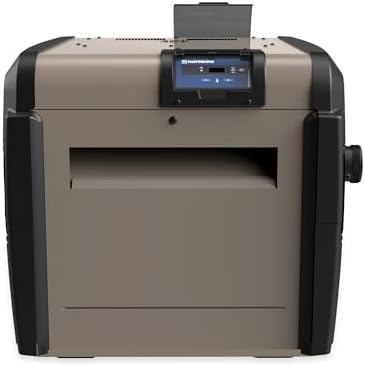
In plain terms, We researched the Hayward H-Series Natural 250,000 as an inground pool and spa heater for residential settings. Its 250,000 BTU rating and universal H-Series design suit in-ground pools and spas up to 750 sq ft, and the lower output makes it a sensible match for mid sized pools where a larger unit would be overkill.
The tan cabinet measures 24 inches high, 29.5 inches long and 25 inches wide at 171 pounds, so it fits typical equipment pads.
From the listing, the features that matter most are the cupo nickel heat exchanger, built to resist corrosion from unbalanced water chemistry, and the low NOx certification for eco-friendly operation under stricter regional rules. A digital LED display shows water temperature and supports self diagnostics, while flexible gas and electric connections on either side ease installation.
The built-in 3/4 inch gas connection simplifies fuel line setup, and the efficient design reduces pump run time for energy savings. Owner feedback commonly notes easy control panel operation and straightforward troubleshooting.
The trade-off is heating speed: at 250,000 BTU, pools above 750 sq ft will warm more slowly and may struggle to hold temperature in cool weather. Homeowners with larger pools or year round heating needs should pick the higher output model, and buyers with a tight pad should confirm the 25 inch width fits.
7. MasterTemp 400 High Performance
Rust proof exterior and premix combustion certified for indoor and outdoor installs

MasterTemp 400 High Performance is a natural gas heater aimed at pool and spa owners who want quick heat and a unit that tolerates the outdoors. Its almond cabinet measures 36 inches long, 30 inches wide and 22.5 inches tall, and it weighs 65 pounds, so it is manageable for a single installer on a pad.
Pentair certifies it for both outdoor and indoor installation, which gives buyers some flexibility on where the equipment sits. For a typical residential pool or spa, this is the kind of heater that suits a household wanting fast turnaround on warm water.
Premix combustion technology is the headline claim, and Pentair says it delivers fast and efficient warm-ups, which matters on cool mornings when the pool has lost heat overnight. The rust proof exterior is a practical detail for anyone housing the unit outdoors near splashing and weather. Built in safety features protect the system, and the rotatable controls can be turned to face wherever the operator stands.
Those controls are described as intuitive, which helps when you are adjusting temperature with wet hands. Indoor and outdoor certification rounds out the package for buyers with an equipment room.
The trade-off is that a 400,000 BTU class heater of this size and weight still needs proper gas supply, venting and clearance, so a buyer with a tight pad or a small gas line may face extra installation work. Anyone wanting a lighter, simpler unit for a small above ground pool should look at a lower output model instead. Pick this one when fast warm-ups and a weather resistant cabinet matter more than a compact footprint.
8. Raypak 266
Digital electronic ignition with intermittent pilot suits larger pools and spas
Digital electronic ignition gas heater Raypak 266 is built for pools and spas, aimed at owners in changeable climates who want efficiency and convenience without fuss. The unit stands 29 inches tall, 44 inches long and 31 inches wide, and it weighs 210 pounds, so it is a heavier piece that usually wants a solid pad and a two person lift.
Raypak says it is built to withstand various weather conditions, which suits an outdoor install that sees rain, wind and temperature swings. For a household that heats a pool through a long season, this is a workhorse option.
Intermittent spark ignition is the detail that matters most here. The pilot only comes on when there is a call for heat, so gas is not burned standing idle between cycles. Raypak also uses a space age material that will not retain residual heat after shutdown, which lets the heater be installed without costly metal heat sinks.
Digital electronic ignition keeps startup consistent, and the model number P-R266A-EN-C identifies the exact configuration for parts and service. Gas powered operation covers both swimming pools and spas, so one unit can serve either.
The catch is weight and footprint. At 210 pounds and 44 inches long, this heater needs a sturdy base and room to service it, and the higher output means gas supply and venting have to be sized correctly. A buyer with a cramped equipment area or a very small pool should consider a lighter, lower output unit. Choose Raypak 266 when weather resistance and pilot gas savings matter more than a small cabinet.
9. Raypak BTU Natural Gas
Corrosion-free polymer headers and copper fin exchanger tube protect longevity
High capacity gas heater Raypak BTU Natural Gas is built for larger in-ground pools where a standard unit would take too long to bring the water up to temperature. Its 336,000 BTU rating puts it in the range that suits big bodies of water, and the 230 pound cabinet points to a substantial heat exchanger inside.
Buyers with a spa attached to the pool often look at units in this class because the extra output handles the smaller volume quickly. It is the sort of heater you mount outdoors beside the equipment pad and feed from a dedicated gas line.
Copper is the headline material here. The exchanger uses integral fin copper tubing, which is a common choice for moving heat into pool water efficiently, and the headers are polymer so they resist the corrosion that unbalanced water can cause. A self-diagnostic microprocessor handles ignition and reports faults, which helps when a heater refuses to fire.
Backlit LCD controls let you set and read temperature in low light. The single unit ships as one item and the model number is 009218, so parts and documentation are easy to match.
The trade-off is weight and size. At 230 pounds this is a heavy cabinet to move into place, and a unit with this much output needs a gas supply sized to match, so the install is not a simple swap for a smaller heater. Owners who want a lighter unit or who have a modest pool should look at a lower BTU model instead.
10. Hayward H-Series Natural Gas Pool Heater for Inground Pools 200,000 BTU
200,000 BTU entry model covers inground pools and spas up to 600 sq ft

Looking at the details, We researched the Hayward H-Series Natural 200,000 as a mid-range gas heater for in-ground pools and spas, sized for pools up to about 600 square feet. The 200,000 BTU version sits in the middle of a family that also covers 450, 750 and 1,200 square foot pools, so buyers can match capacity to water volume.
The tan cabinet measures roughly 33 inches long, 33 wide and 31 tall and weighs 161 pounds, making it more manageable on an existing equipment pad than the largest units. It suits a household that wants a straightforward heater with a digital display rather than a bare dial.
Our comparison of the listing highlights the cupo nickel heat exchanger, which the product data presents as protection against corrosion caused by unbalanced water chemistry, a real concern in pools where pH drifts. A digital LED panel shows water temperature and runs self diagnostics, so faults are easier to spot.
The built-in gas connection is three quarters of an inch, and gas and electric can be routed on either the right or left side, giving the installer room to work around an existing pad. The unit is certified for low NOx emissions, which matters in areas with air quality rules, and the efficient design is meant to reduce pump run time for energy savings.
The trade-off is capacity: at 200,000 BTU this heater is sized for pools up to 600 square feet, so a larger pool will warm slowly and the unit will run long. Owners with bigger volumes, or anyone wanting faster heat up, should pick a higher BTU model in the same line.
How We Picked
Our picks come from product details and from what buyers say in customer reviews, not from advertising. We researched the specifications and owner feedback for every model in this category. Marketing claims did not decide the list. Actual owner experience did.
We compared the product details that matter for this kind of heater. Heat output and efficiency ratings were checked against pool size guidance. We also looked at ignition type, venting options, footprint and materials.
Patterns in customer reviews shaped the final list. Owners often praise fast heating, steady temperature and simple controls. Common complaints involve noisy operation, installation quirks and parts that wear over time. We weighed how often these themes appeared and how serious they were.
Ordering the picks was about fit, not one winner. Some models suit small pools and tight budgets, while others are built for larger pools and heavier use. We grouped them so different needs and budgets are covered.
Frequently Asked Questions
How Much Does It Cost to Run a Natural Gas Swimming Pool Heater and What Decides the Running Cost?
Running cost for a natural gas swimming pool heater depends mostly on the heater’s input rating, how many hours it runs, your local gas rate and how much heat the pool loses. A bigger BTU input burns more gas per hour, so a large heater costs more to run each hour but heats the pool faster.
Heat loss from the water surface, air temperature, wind and whether you use a cover all change how long the heater must fire to hold your target temperature. A cover is one of the simplest ways to cut run time.
We compared how heater sizing and pool habits interact, because an oversized heater short-cycles and an undersized one runs constantly. Owners commonly report that a covered pool holds heat far better and needs shorter heat-up sessions.
Can a Natural Gas Swimming Pool Heater Stay on Overnight or Run Unattended?
Most natural gas swimming pool heaters are designed for automatic operation, so they can run overnight or unattended when installed and vented correctly. Modern units have safety controls like flame sensors, high-limit switches and pressure switches that shut the burner down if something is wrong. That said, unattended operation depends on proper installation, good ventilation and a clear exhaust path. A pool cover left on overnight also reduces run time and keeps heat in.
We looked at owner feedback and manufacturer guidance on continuous operation and found that the main risks are blocked vents, low water flow and debris in the burner area. Keeping the pump running so water flows through the heater is essential, because no flow means the unit will trip its safety limits.
What Size Natural Gas Swimming Pool Heater Do I Need for My Pool?
Sizing a natural gas swimming pool heater comes down to pool volume, the temperature you want and how fast you expect to heat the water. Heaters are rated by BTU input, and the common approach is to match the rating to the surface area and volume of the pool so the unit can raise temperature in a reasonable time.
A larger pool or a bigger gap between water and air temperature calls for more BTU input. An undersized heater runs constantly and struggles, while an oversized one cycles on and off.
We compared published sizing charts and owner reports to see how pool volume and heat-up goals translate into BTU ratings. The general rule is roughly one BTU input per gallon for a moderate heat-up, with more capacity for faster warming or colder climates.
Is a Natural Gas Swimming Pool Heater Noisy, and What Causes the Noise?
Noise from a natural gas swimming pool heater usually comes from the burner, the blower or the water flowing through the heat exchanger. Many units use an induced-draft blower that produces a steady hum, and the burner can make a low rumble when firing. Normal operation is generally quieter than a typical air conditioner, but louder units or poor installation can make more sound. Vibration and resonance against the equipment pad or nearby walls can amplify it.
We reviewed owner feedback and spec data on sound levels and found that most complaints trace to installation rather than the heater itself. A unit set on a solid, level pad with clearance around it tends to run quieter, and loose panels or debris in the blower add rattle.
What Safety Steps Matter Around Children and Pets with a Gas Swimming Pool Heater?
Safety around a natural gas swimming pool heater centers on heat, exhaust and gas. The flue and outer surfaces get hot during operation, so a barrier or clearance keeps children and pets from touching them. The exhaust vent must discharge away from windows, doors and play areas so combustion gases do not drift back inside. A carbon monoxide alarm near the equipment area is a sensible backup, and the heater should never be enclosed in a way that blocks airflow.
We compared installation guidance and owner reports on placement and found that fencing the equipment pad and keeping the area clear of toys and pet beds reduces risk. Pets can chew wiring or hoses, so routing and protecting lines matters.
Can I Plug a Gas Swimming Pool Heater into an Extension Cord or Power Strip?
A natural gas swimming pool heater still needs electricity for its controls, blower and ignition, but that draw should come from a dedicated circuit, not an extension cord or power strip. Extension cords and power strips are not rated for the outdoor, damp conditions around a pool and can overheat or trip.
Most heaters specify a grounded connection on its own breaker, and the manufacturer’s installation manual states the electrical requirements. Following that guidance protects the unit and keeps the warranty intact.
We reviewed installation manuals and owner feedback and found that nuisance shutdowns often trace to inadequate power or a tripped breaker on a shared circuit. A dedicated GFCI-protected circuit near the equipment pad is the typical requirement, and a qualified electrician should handle the wiring.
Final Thoughts
Our research team compared the product data, owner feedback and expert research to name the Hayward H-Series Natural Gas as the best natural gas swimming pool heater for most buyers. Its lineup covers a useful spread of outputs, and owners commonly report dependable heating season after season. For smaller pools or tighter budgets, the Raypak 206 is a sensible alternative with a lower output that suits modest water volumes.
Buyers with larger pools should look at the MasterTemp 400 High Performance, which is built for heavier heating demands. The extra capacity makes more sense there than on a small pool, where it would simply cost more to run without much benefit.