Even a dark coloured solar collector can heat a pool while the air feels cool, because it absorbs sunlight rather than relying on warm weather. That simple fact explains why so many owners get results from a system that looks modest on a roof.
Owners who skip proper sizing usually end up with water that stays lukewarm at best, or a pump that works harder than it should. Matching collector area to pool volume and flow is what separates a useful setup from a decorative one. Our picks for the best solar pool heating system all had to clear that bar.
Every candidate had to show realistic heating for its stated pool size, based on the product data and owner feedback.
Top 3 Picks for Best Solar Pool Heating System


How to Choose the Best Solar Pool Heating System
Picking a pool heating system comes down to matching the collector to your pool, your climate and your pump. We looked at panel types, sizing rules, plumbing fittings and the controls that protect the system. Our picks lean on product data, owner feedback and expert research, so you can weigh cost against how much of the season you want to add.
Collector Types and the Pools They Suit
Most systems use either unglazed matting or glazed tube collectors. Unglazed mats are cheap and work well for above ground pools and warmer climates, while glazed panels hold heat better in cooler areas and extend the season. Evacuated tube designs, like the Duda Solar 30 Tube, perform in cold, sunny conditions. Match the type to your climate first, then to your roof or rack space.
Wattage, Pool Size and Circuit Capacity
Sizing is usually quoted as collector area against pool surface area, and a common rule is roughly half to three quarters of the pool area for a decent lift. Too little collector and the pool never warms; too much and you waste money. Check what your pump and one household circuit can carry, because a large array adds flow and electrical load.
Cut-Offs, Thermostats and Timers
Controls decide how well the system behaves day to day. A differential thermostat runs the pump only when the collector is hotter than the pool, and freeze protection or a manual drain protects panels in cold snaps. Timers help you run heating during sunny hours. Look for clear cut-offs and simple settings, since owner feedback often flags confusing controls.
Compare All 10 Side by Side
Our Picks, Reviewed One by One
Our Top Pick
1. Highest Performing Design – DIY Solar Pool Heater Kit
Over-molded header removes flow barriers and ships as a complete DIY kit with expert support

Highest Performing Design is a do-it-yourself collector kit for homeowners who want to add rooftop heat collection to an existing pool pump and filtration setup. The four panels in this kit measure four by ten feet with a 1.5 inch internal diameter header, so the package suits a mid-size pool and a roof with enough open, sunny space to lay out the collectors.
Because it connects to plumbing you already have, it fits a household that is comfortable with basic PVC work rather than one looking for a plug-in appliance.
What the listing emphasizes most is how water moves through the panel. The manifold is molded directly around the absorber tubes, which removes flow barriers and lets water exit freely into each tube. A single-piece over-molded header is said to cut manufacturing variances, and the panels are made in the US with high-grade materials plus UV stabilizers to handle harsh rooftop conditions across all weather, with a stated 15 to 20 year life expectancy.
The kit includes the mounting hardware, panel connections, tie-down strap and supply and return plumbing fittings, along with installation instructions and support. A 5-year limited and 10-year limited warranty apply.
The trade-off is that this is a full DIY plumbing and mounting project, and the 1.5 inch header limits how much flow the array can carry, so a very large pool or a high-flow pump may need the wider version. Buyers who want a professional install or a strapless high-wind mount should look at the industrial-grade option instead.
2. Highest Performing Design – DIY Solar Pool Heater Kit
Bigger 2-inch header version of the SwimEasy kit for pools needing more collector area
On paper, this is a rooftop solar collector kit for pool owners who want to add heat without changing their existing pump and filtration setup. The Highest Performing Design package pairs four panels, each four by twelve feet, with a 2 inch internal diameter header, so it offers more absorber surface and a larger water opening than the smaller kits we compared.
In our research, this configuration came up as the fit for a household with a bigger pool and a high-flow pump that is planning a fixed rooftop array rather than a portable heater.
What the listing states matters most is the heat path. The manifold is molded directly around the absorber tubes, which the product data describes as removing flow barriers so water can move freely from the header into each tube, and the single-piece over-molded header is presented as reducing manufacturing variances.
Construction is US-made with high-grade materials and specialized UV stabilizers, rated by the manufacturer for 15-20 years against harsh rooftop conditions in all types of weather. The box includes the hardware to mount the panels, connect them together, secure them with a tie-down strap and tie into supply and return plumbing, along with installation instructions and expert support.
Owner feedback we reviewed commonly mentions the completeness of the kit and the help available during installation, and the warranty is 5-year limited plus 10-year limited.
The trade-off is size and labor: four larger panels mean more weight and more roof space, and installation remains a hands-on plumbing job with tie-down strapping. Anyone facing violent storm winds or wanting strapless flush mounting should pick the industrial-grade kit built around that method instead.
3. Industrial Grade Solar Pool Heater DIY Kit – Superior High-Wind
Strapless flush mounting certified for storm winds with patented panel clamps instead of hoses

We researched this two-panel collector kit as an option for roofs exposed to serious weather and for owners who prefer a cleaner mounting method. The panels cover 60 square feet in a four by seven and a half foot size, and the strapless flush design is made to sit on virtually any roof type without tie-down strapping.
In our comparison of mounting approaches, that layout pointed to exposed, windy sites where strapped panels commonly work loose, and to owners who want to avoid regular rooftop hardware checks.
Our team compared the listing details against owner feedback and expert research, and the durability and flow claims drew the most attention. A patented process fuses headers and risers into one solid piece, removing seams and welds that can crack with age and stress. The square header and open flow design are said to maximize flow, raise efficiency and nearly eliminate backpressure, while low head-loss riser tubes guard against clogging and high head pressures.
Patented panel clamps join panels to each other and to PVC pipe without rubber hoses or metal clamps, which the listing says cuts routine rooftop maintenance. The mounting system is certified to withstand violent storm winds, and the warranty runs 12-year limited plus a bonus lifetime limited.
The trade-off follows from the panel count: two collectors of this size cover less area than the four-panel kits, so a large pool in a cold climate may need more of them to reach comparable heat output. Buyers whose main goal is maximum collector area for the money should compare the four-panel options first.
4. Industrial Grade Solar Pool Heater DIY Kit – Superior High-Wind
Four-panel 200 square foot SwimJoy kit built for big pools with the same strapless mounting

Built for homeowners who want a roof-mounted array that holds up to rough weather, Industrial Grade Solar Pool is a do-it-yourself collector kit. The four panels cover 200 square feet, which suits a pool that needs a serious heat boost in a sunny climate. We looked at it as a long-term installation rather than a quick seasonal add-on. Its square header and open flow design are meant to keep water moving freely through the array.
What matters most here is how the panels are put together. The headers and risers are fused into one solid piece through a patented process, so there are no seams or welds to crack over time. The mounting system is certified to survive violent storm winds and lets the panels sit flush without tie-down strapping.
Patented panel clamps connect panels to each other and to PVC pipe, which removes the rubber hoses and metal clamps that usually need rooftop attention. A 12-year limited warranty plus a bonus lifetime limited warranty backs the build.
The catch is that this is a DIY kit aimed at roofs and permanent plumbing, so it asks more of the installer than a simple roll-out mat. Anyone who wants a portable panel to lean on the ground or move around the yard should pick something else. Buyers who plan a fixed rooftop array and can handle the plumbing will find the durable design worth the effort.
5. Highest Performing Design – Universal Solar Pool Heater Panel Replacement
Universal replacement panel with zip-joints every 6 inches fits round 2-inch header systems
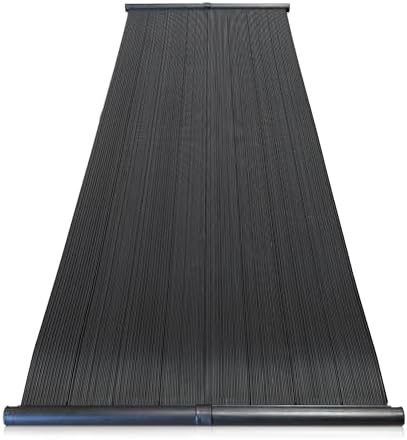
At first glance, this is a replacement panel for an existing array rather than a full start-from-scratch kit, and it suits owners whose old collectors have worn out while the plumbing is still sound. It is built to swap in for any panel that attaches with rubber hoses and hose clamps and has a round 2.0 inch inner diameter header manifold.
The 4 by 12 foot size covers a typical roof section, and the listing positions it for anyone wanting both strong heating performance and long-lasting durability.
Our research centered on the absorber, which combines loose-tube and flat plate designs while omitting what the listing calls their flaws; more heat absorption, in its account, means more heat transferred to the pool. Flexible zip-joints every six inches across the surface let panel sections move with natural temperature variances instead of resisting them, which the listing ties to durability.
The header is molded directly around the absorber tubes, removing flow barriers so water exits freely into each individual tube. High-grade materials with UV stabilizers are specified for harsh roof conditions, and the stated life expectancy is 15 to 20 years, with limited warranty terms of 5 and 10 years.
The trade-off is compatibility: if your current setup uses a different header size or mounts by some method other than hoses and clamps, this panel will not drop in. Anyone building a brand-new array from scratch should pick a complete kit instead of a single replacement panel.
6. Goplus 2.5FT X 10FT/ 20FT Solar Pool Heater for Above
Roll-up PE collector works from -1°F to 194°F and heats up to 3408 gallons

Goplus x / Solar is a compact collector set that arrives as two panels you connect into a single 10 foot by 2.5 foot run. It is aimed at above ground and inground pool owners who want a low-effort way to take the chill off the water. The roll-up design means it can be carried and stored without a permanent roof install. We see it as an entry point for small pools and short swim seasons.
The tube-on-web surface is built to catch as much sun as possible and turn it into heat, and the listing says it can warm up to 3408 gallons. The PE material is rated to keep working from minus 20 Celsius up to 90 Celsius and is described as able to handle rooftop conditions.
No electricity or gas hookup is needed, so the sun does the work. A full accessory set comes in the box, including end caps, hose clamps, connector hoses, elbow connectors and hose adapters. It can sit on the ground, an inclined frame or a roof.
The trade-off is scale and support. Two small panels suit a modest pool, and the 3 month warranty is short compared with the multi-year coverage on larger arrays. Owners heating a big pool or wanting a permanent rooftop system should look at a bigger kit with a longer warranty.
7. Doheny's Solar Pool Heating System for Above Ground Pools Eco-Friendly
Two-panel 5 by 20 foot collector kit sized for 18 to 24 foot round above-ground pools

Doheny’s Solar Pool Heating is a collector kit for above ground pools, sold as a 5′ x 20′ set made up of two 2.5′ x 20′ panels. It suits owners of mid-sized round or oval pools who want to use the sun to warm circulating water instead of leaning on gas or electricity.
The kit is built to sit on plywood beside the pool or up on a roof, so it fits yards where a ground rack is easier than a full roof install. We looked at how the panel size lines up with common pool dimensions before picking it for this spot in our guide.
The listing gives a clear sizing chart, and that matters most here. A 12′ to 15′ round pool calls for a 2.5′ x 20′ collector rated at 40,000 BTU, while an 18′ to 24′ round pool needs the 5′ x 20′ collector at 80,000 BTU.
Pools from 27′ to 28′ round need both sizes together for 120,000 BTU, and a 12′ x 24′ oval uses the smaller 2.5′ x 20′ panel. The kit can be mounted on plywood or a roof, and a roof or rack mounting kit is required for installation.
The real limit is that this is a collector kit only. Pipes, mounting hardware for a roof or rack, and the diverter plumbing all have to be sourced or added, which adds work to the install. Owners with irregular pool shapes or very large pools may find the chart does not line up neatly. Buyers who want a single box with every part included should look at a fuller kit instead.
8. Doheny's Solar Heating Systems for Above Ground Swimming Pools
Single 2.5 by 20 foot collector rated 40,000 BTU suits 12 to 15 foot round pools

Collector kit measuring 2.5′ x 20′, Doheny’s Solar Heating Systems is the smallest panel option in this line. It is aimed at owners of compact above ground pools, roughly 12′ to 15′ round or a 12′ x 24′ oval, where a single panel is enough to take the chill off the water.
The panel warms water as it circulates and returns it to the pool, cutting back on gas or electric heating. For a first step into sun-powered warming, this is the size we would point a small-pool owner toward.
What the listing states matters most is the 40,000 BTU rating that goes with this panel size, which the sizing chart ties to the 12′ to 15′ round and 12′ x 24′ oval pools. The collector can be mounted on plywood beside the pool or roof-mounted, and a roof or rack mounting kit is required for either.
That hardware kit includes five 6′ straps, 15 stainless steel mounting brackets and 15 #14 stainless steel screws. A 2-way diverter valve can be plumbed into the filter and heating setup, and PVC or flex pipes are not included. Larger pools from 18′ to 24′ round need the 5′ x 20′ collector at 80,000 BTU, and 27′ to 28′ round pools need both sizes for 120,000 BTU.
The catch is capacity. One 2.5′ panel is sized for small pools, and owners of bigger round pools will be undersized if they stop here. Pipes and mounting hardware are extra, so the install is not complete out of the box. Someone with an 18′ round pool or larger should step up to the bigger collector kit instead.
9. Duda Solar 30 Tube
Evacuated vacuum tubes with 316L stainless manifold resist chlorinated water corrosion

In plain terms, We researched the Duda Solar 30 Tube as an evacuated vacuum tube collector, a different design from the flat panel kits we compared it against. It is built around 30 glass tubes and a stainless manifold, and in our assessment it suits pool owners who want a more compact, high absorption collector for chlorinated water.
The 316L stainless steel inner manifold is the detail that matters most for pools, because the product data lists it for high chlorinated water corrosion resistance. For anyone plumbing a collector into a salt or chlorine pool system, that material choice is worth a close look.
Our team compared the listing specs that matter most for this type of collector. It states hail resistance up to 1 inch and a maximum operating pressure of 4psi, which tells us this is a low pressure unit. The φ58mm x 1800mm three-target Cu/SS-ALN(H)/SS-ALN(L)/ALN vacuum tubes use high boron silicon 3.3 glass and are rated at 93 to 96 percent sun absorption.
Vacuum rating is less than 5.0 x 10⁻³ Pa, and the stated lifespan is 70 percent at 15 plus years. Inlet and outlet ports are 1 inch male NPT, the unit is easy to disassemble, and a 3 year warranty covers manufacturing defects.
The trade-off we found is pressure and weight. A 4psi maximum operating pressure is low, so this collector will not suit a pool loop pushing high pressure, and the unit weighs close to 196 pounds, which complicates a roof install. Owners with high pressure systems or a need for a light, simple panel should pick a flat collector kit instead.
10. Solar Sun Rings 60-Inch UV Resistant Solar Pool Heater Above
Floating vinyl rings use encapsulated magnets to form a seamless thermal cover that separates for safety

Solar Sun Rings UV is a modular floating cover made of UV-resistant vinyl rings that collect sunlight and pass the warmth into the water. Each ring measures 60 inches across, and the nine pack covers a useful patch of an above ground pool, inground pool or spa. It suits owners who want a cover they can place and remove piece by piece, and who like the idea of a safety design that lets the rings separate if someone falls in.
The listing states two layers of vinyl that absorb sunlight and convert it to heat, so the rings work as a daytime collector rather than only a night blanket. Encapsulated magnets connect the rings into a continuous floating cover, which helps hold heat in and cut evaporation and chemical loss after dark.
A redesigned inner grid with drainage grommets is meant to stop the rings sinking, and the rings pull apart under weight so entrapment is less of a risk. Light weight makes them simple to lift off and stack away. Storage is the real limit. The manufacturer warns against keeping the rings in direct sunlight because they can burn items stored beneath them, so a shaded spot is needed.
Owners also need to accept that a nine pack covers only part of a larger pool, and the magnets only join rings to each other. Anyone heating a big inground pool, or wanting one cover that lifts off in a single piece, should look at a full sheet blanket instead.
How We Picked
Our picks come from the product details supplied for each system and from the feedback buyers leave in customer reviews. We did not rely on advertising or marketing claims. Instead we researched the specifications and compared them with what owners commonly report after purchase.
For this kind of product, we compared the materials used, the collector design and coverage, how each system installs, and what pool sizes and setups the data says it suits. We also looked at durability details and the components included.
Reading owner feedback, we found repeated praise for solid construction, easier installation and better warmth on sunny days. Complaints that came up again and again involved fit issues, weaker performance in cooler conditions and parts that needed care.
Ordering the list was about covering different needs and budgets, not ranking one winner. Some picks suit buyers who want the strongest design, others fit industrial or larger setups, and some serve tighter budgets.
Frequently Asked Questions
What Decides the Running Cost of a Solar Pool Heating System?
For a solar pool heating system, the running cost is mostly decided by how much electricity the pump and controller use, not by the sun itself. Solar collectors gather heat for free, but the pump still has to move water through the panels, and the controller draws a small amount to run valves and sensors.
Our research shows that pump size, run time and flow rate are the biggest factors owners can control. A variable speed pump set to the lowest flow that still transfers heat well tends to keep energy use down.
Weather and pool habits matter too. A covered pool holds heat longer, so the system runs less, while an uncovered pool in a windy spot loses heat and needs more circulation.
Can a Solar Pool Heating System Run Overnight or Unattended?
A solar pool heating system can circulate overnight, but it cannot collect heat without sunlight, so running it after dark mostly wastes pump energy. Most controllers are built to switch the pump off when the panels are cooler than the pool, which protects against heat loss back through the collectors.
Our team looked at controller specs and owner reports, and the common setup runs the system during daylight only. Leaving it unattended during the day is normal, since the controller manages the valves and pump on its own.
Unattended operation still needs a few safeguards. Freeze protection matters in cold climates, and many controllers include a freeze mode that moves water to protect panels and pipes.
What Wattage Solar Pool Heating System Do I Need for My Pool?
Wattage is not the usual way to size a solar pool heating system, because the collectors are rated by surface area rather than electrical watts. What matters is matching collector area to the pool surface, and our research found that owners generally aim for a collector area close to the pool’s own surface area for a reasonable temperature lift.
A pump with enough flow to move water through the panels is the other half of the sizing question. Too small a pump and the panels run hot without transferring heat well.
The electrical draw that does matter comes from the pump and controller. We compared product data and found that variable speed pumps let owners dial flow down, which suits solar collectors because a steady, moderate flow transfers heat efficiently.
Is a Solar Pool Heating System Noisy?
Noise from a solar pool heating system comes almost entirely from the pump, not the collectors. Panels on a roof or rack make no sound, since they simply sit in the sun and pass water through. Our research compared pump types and found that variable speed pumps run far quieter at low speeds than single speed models. Owners commonly report that once the pump is set to a low flow, the system fades into background noise.
Placement and mounting affect what you hear. A pump on a solid pad with vibration isolation is quieter than one bolted to a wooden deck, and keeping it away from bedroom windows helps. We also noted that air trapped in the panels can cause gurgling at startup, which usually clears once flow settles.
Is a Solar Pool Heating System Safe Around Children and Pets?
Safety around children and pets depends on the parts they can reach. A solar pool heating system puts hot water through panels and pipes, and exposed pipework or a hot pump housing can burn curious hands. Our research suggests routing pipes out of reach and insulating them where possible. Pool water heated by the system is not hotter than the pool itself, so the main risks sit at the equipment pad rather than in the water.
Electrical safety matters too. Pumps and controllers should be on a circuit protected by a residual current device, and wiring should be kept dry and enclosed. Owners report that pets chew cables and knock valves, so guarding the pad with a simple fence or cover helps.
Can I Plug a Solar Pool Heating System into an Extension Cord or Power Strip?
We would not run a solar pool heating system from an extension cord or power strip. Pool pumps draw a steady current, and a long or undersized cord causes voltage drop and heat, which raises the risk of fire. Our research into product data shows that pumps are meant to be wired to a dedicated circuit with proper protection. A power strip is rated for small appliances, not the continuous load a pool pump places on it.
Outdoor conditions make this more important. Cords lying on wet ground, splashing from the pool and sunlight degrading the cable all add risk. Owners who need power at a remote equipment pad should have a qualified electrician install a proper outdoor circuit. We compared owner feedback and found that shortcut wiring is a common cause of tripped breakers and damaged pumps.
Final Thoughts
For our best solar pool heating system overall, we picked Highest Performing Design. Its performance data and owner feedback put it ahead of the alternatives we compared. Buyers who want maximum heat output for a larger pool should start there.
Industrial Grade Solar Pool suits owners who need rugged, heavy duty panels for demanding setups. Budget conscious buyers often report good results with Goplus x / Solar for smaller above ground pools.
Our final advice is to match panel area to your pool size and confirm the warranty and connector quality before buying. Check the flow rate and installation requirements too, since those details decide how well any system performs.