A common belief is that a tip over switch alone makes a heater safe. In practice, automatic shut off covers several protections, including overheat cutoffs and tip over sensors. We looked at how each model handles them.
Two things separate a sound pick from a weak one. First, does the shut off work on temperature as well as tilt? Second, does it reset cleanly after tripping? Getting both right is what makes the best space heater with automatic shut off.
We left out oversized units and models with vague safety wording. For this type we compared cutoff triggers, reset behaviour, housing temperature and reported shut off reliability from owners. Our picks follow from that research.
Top 3 Picks for Best Space Heater with Automatic Shut Off


How to Choose the Best Space Heater with Automatic Shut Off
Automatic shut off is the feature that turns a heater from a fire risk into a set-and-forget appliance. We looked at how each model cuts power, what triggers it, and whether the heater keeps working after a tip or an overheated element. Our picks balance a real thermal cut-out with a thermostat that holds a room steady, based on product data and owner feedback.
Heat Type and the Room It Suits
Ceramic fan heaters warm a small room fast and are the usual choice for a bedroom or home office. Oil-filled units heat slowly but hold warmth after shut off, which suits a living room left running on a timer. Infrared warms people and objects directly, so it fits a garage or a draughty corner. Convection heaters circulate gentle warmth through a whole room.
Wattage, Room Size and Circuit Load
Most portable heaters draw 1,500 watts, which is enough for a small to medium room. A standard household circuit usually carries 15 amps, and a single heater at that draw leaves little room for much else on the same line. Running two heaters on one circuit is a common cause of tripped breakers, so check the room before you add a second unit.
Safety Cut-Offs, Thermostat and Timer
A tip-over switch and an overheat cut-out are the two protections we check first, because both shut the heater down without input. A built-in thermostat lets the unit cycle off once the room reaches your setting, and a timer adds a hard stop if you forget. Adjustable models with an ECO mode tend to run cooler and cut power sooner.
All 10 Picks at a Glance
In-Depth Reviews
Our Top Pick
1. Space Heater, WINHL Portable Electric Heaters for Indoor Use,70 Oscillation
Fits a desk at 5.9 inches deep with 70° oscillation and a 12-hour timer

Space Heater is a compact tower unit built for supplemental heat in personal spaces. A 1500W PTC ceramic element warms the air within seconds, which suits a cold home office, a bedroom corner or a desk where central heat does not reach. At roughly 5.9 inches deep and 9.9 inches tall, it sits on a desk, nightstand or bathroom counter without taking over the surface.
It is meant for small rooms and spots within a few feet of where you sit, not whole-house heating.
For shut off safety, the listing states built-in overheat protection and a tip-over shutoff that cut power if the unit gets too hot or is knocked over. That matters in homes with kids or pets moving around. The 70 degree auto oscillation sweeps warm air side to side so a desk, sofa or bed gets even heat instead of one hot stream.
A remote handles temperature, modes and the 12 hour timer, and ECO mode cycles the thermostat on and off to hold your set temperature. The unit is ETL listed, and the listing says to plug it directly into a 15A wall outlet, never an extension cord.
The trade-off follows from the size and the design brief. This is personal, spot heating for a few feet of space, so a larger room or a whole-room job will want a bigger unit. Anyone who needs to heat an open living area should pick something else. Buyers who want a small, safety-focused heater for a desk or bedside will find the shutoff features and oscillation fit that job.
2. DREO Space Heater, Portable Electric Heaters for Indoor Use with Thermostat
Runs at 34dB with a brushless DC motor and 41-95°F thermostat range

DREO Space Heater is a portable electric heater sized for bedrooms, offices and small home rooms where quiet operation matters. Our research team compared this model against other indoor heaters on the market and picked it for buyers who want warmth close to a bed or desk without fan noise interrupting sleep or calls.
The listing describes a 10 inch tower footprint and a built-in handle, so it can sit on a floor or low surface and be carried between spots. It is framed as supplemental indoor heat rather than a replacement for a home heating system.
What the listing states matters most is the combination of fast, far-reaching warmth and layered safety. DREO pairs a Hyperamics 1500W advanced PTC system with a new heat funnel design that is said to deliver heat within seconds and push warm air up to 200% farther than traditional heaters.
For safety, the listing cites a tilt-detection sensor for more accurate tip-over protection, V0 flame retardant materials, overheat protection and a safety plug, all certified. The enhanced NTC chipset brings precision to the thermostat, with a range of 41 to 95F in 1F increments, while a brushless DC motor and winglet fan design hold noise to 34dB.
The trade-off is reach and room size: this is a personal heater for a bedroom or office, so a large open living area or a whole-floor job calls for a different class of unit. Buyers who want precise thermostat control and quiet operation in a small room should look here, while anyone heating a big space should pick something else.
3. DREO Space Heaters for Indoor Use with Thermostat
Taller 16-inch body covers 270 sq ft with trackball oscillation and ECO mode

Covering 270 square feet, DREO Space Heaters is a 1500W ceramic tower designed for larger rooms such as living rooms, basements and open offices. The 16 inch tower stands 15.8 inches tall and weighs about 4.6 pounds, so it can move between rooms without much effort.
Buyers who want warmth spread across a whole seating area rather than one spot will find the shape and output sensible. It also fits dorms, hot yoga studios and garages where a fixed heater is not practical.
For automatic shut off, the safety list matters most. The unit is ETL-certified and built from V0 flame-retardant materials, and it includes tip-over protection and overheat protection. A 12-hour timer and a 24-hour automatic power off without interaction add a second layer, so the heater does not run indefinitely if nobody touches it.
The 6ft flat power cord and flame-retardant plug round out the safety package. Quiet operation at 34dB and the 70 degree oscillation help the warm air reach more of the room, while ECO mode adjusts between 1000W and 1500W to hold a set temperature.
The trade-off is that all this safety and coverage comes in a taller tower that takes up floor space and is not built for tight corners or small desks. The 270 square foot rating also means a very large open plan area will still feel uneven at the edges.
Anyone heating a small bedroom, a bathroom or a single desk should pick a compact unit instead. DREO Space Heaters suits buyers who want strong coverage and layered shut off protection in a mid-sized to large room.
4. Small Portable Space Heater for Indoor Use – VOCRS 1500W
Non-oscillating 8.4-inch unit with three power levels and a built-in carry handle

Small Portable Space Heater is a compact ceramic unit from VOCRS built for bedrooms, offices and desks. At 8.5 inches tall and 5.8 inches long, it sits on a nightstand or under a desk without crowding the space. The built-in carry handle makes it easy to move from room to room, which suits renters and people who work in different spots through the day.
It is a good fit for a single person heating one small zone rather than a whole floor.
For automatic shut off, the safety set is the headline. Overheat protection and tip-over automatic shut-off are both listed, and the 1 to 12 hour timer shuts the unit down when the set time runs out, which matters most at night. ETL certification backs the safety claims. Three heating modes at 700W, 1000W and 1500W let a buyer match output to the room, and the remote control plus high-definition digital display make settings easy to read and change from across the room. The remote needs 2 AAA batteries, which are not included.
The trade-off is coverage. This is an 8.4 inch non-oscillating model, so the warm air stays in a narrow zone and a large room will not heat evenly. The small body also means the fan moves less air than a tower. Buyers heating a big living room or an open plan space should pick a larger oscillating unit. Small Portable Space Heater suits anyone who wants compact, timer-based shut off safety for a bedroom, office or desk.
5. Lasko Space Heater for Indoor Use, Portable Electric Heater
22.5-inch ceramic tower with 5,118 BTU output and a 7-hour timer

A slim ceramic tower designed for bedrooms, offices and living rooms up to about 150 square feet, the Lasko Space Heater stands 22.5 inches tall on a footprint smaller than a sheet of paper and weighs under 6 pounds. Its elongated 1500W element delivers 5,118 BTU quickly, and a 900W setting offers gentler warmth for milder weather.
The included remote handles power, temperature, heat mode, oscillation and timer, so settings can be changed from bed or couch. A carry handle makes it easy to shift between rooms.
For buyers prioritising shut-off safety, the listing states a self-regulating ceramic element, automatic overheat protection and cool-touch housing, and the unit is ETL-listed, meaning an independent lab tested it to recognised safety standards. The thermostat holds a chosen temperature automatically, with settings shown on a digital display. Widespread oscillation sweeps warm air side to side rather than heating one spot, and the 7-hour timer lets the heater switch itself off before bed. A 3-year limited warranty backs the unit.
One limit follows from the design: this is a 1500W tower rated for roughly 150 square feet, so larger open-plan rooms will likely feel underheated. Also, the remote needs two AAA batteries that are not included. Buyers heating bigger spaces, or wanting app control, should look at a different model.
6. DREO Space Heater, Portable Electric Heaters for Indoor Use with Remote
Black 11-inch model with a carry handle, child lock and memory function

We researched the DREO Space Heater Adjustable as a compact portable electric heater for indoor use, sized for offices, bedrooms and home rooms rather than whole floors. Our comparison of the listing data and owner feedback points to a 1500W PTC ceramic unit that stands about 11 inches tall and weighs roughly 3.5 pounds, with a built-in handle for carrying between rooms.
The stated heat funnel design is meant to push warm air farther than traditional heaters, and the brushless DC motor with winglet fan is rated to keep noise at just 34dB. Power heat, ECO and fan-only modes cover everyday warming needs.
Features that matter most in the listing center on control and safety. The enhanced NTC chipset allows thermostat settings from 41 to 95F in 1F increments, giving tighter temperature precision than many basic heaters. For protection, DREO lists a tilt-detection sensor for more accurate tip-over response, V0 flame retardant materials, overheat protection and a safety plug, all certified.
Handy extras include a 12-hour timer, mute, child lock and a memory function that restores the last settings, which owners commonly mention as useful in bedrooms and kid-friendly households.
The trade-off follows from the size: this is a small personal heater, so it warms a spot or a small room rather than a large or connected space. Buyers heating bigger areas should pick a larger unit, while those wanting precise, quiet warmth in a bedroom or office will find a better fit here.
7. WINHL Space Heaters for Indoor Use with Thermostat
Slim 5.51-inch wide 17-inch tower with three power levels and a 6ft cord

WINHL Space Heaters is a ceramic tower heater built for bedrooms, offices and larger rooms where unattended running is common. The 17-inch cabinet sits low and the 70-degree oscillation sweeps heat across a seating area rather than one spot. For a buyer who wants the unit to switch itself off when something goes wrong, the safety package is the main draw.
It suits a desk, a reading corner or a small office where the heater may be left on while attention is elsewhere.
The listing states tip-over protection and overheat auto shut-off, which are the two protections that matter most for hands-off heating. A built-in thermostat reads room temperature and adjusts output, and the 12-hour timer plus a 24-hour automatic power off without interaction add a second layer of shutdown. Three power levels of 700W, 1000W and 1500W let a user match draw to the room, and ECO mode trims output once the target is reached.
The remote control keeps adjustments away from the unit, and ETL listing with V0 flame-retardant materials and a 6ft flat cord rounds out the safety claims.
The trade-off is that automatic shut-off protects against faults, not against a cold room, so a heater that powers down on a timer or after 24 hours will not keep warming a space indefinitely. Anyone who needs constant background heat in a large open area should look at a unit with a longer continuous run or a wired thermostat instead.
8. DREO Space Heater, Portable Electric Heaters for Indoor Use with Thermostat
Silver 10-inch heater with Shield360° protection and 37.5dB quiet operation
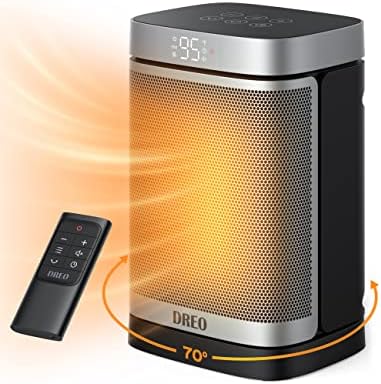
On paper, We researched this category of compact electric heaters and compared the DREO Space Heater ECO against other models in the same size and price band, drawing on the product data and the feedback owners commonly give. It is a 1500W PTC ceramic heater meant to sit on the floor by your feet, and its 10.31-inch height, 5.51-inch length and 6.69-inch width keep the footprint small enough for a bedroom, basement, garage, office or desktop corner.
The 70-degree oscillation and the 3.86-pound weight suit buyers who want warmth delivered close to where they sit or sleep rather than across a whole house.
What the listing states matters most to us are the heating and safety details. DREO Hyperamics technology drives the 1500W element to reach the desired temperature quickly, and the Shield360 system pairs tip-over and overheat protection with an enhanced safety plug, backed by UL94 V-0 flame-retardant housing materials.
ECO mode adjusts the heat level automatically to hold a target, set through a digital thermostat from 41 to 95 degrees Fahrenheit in one-degree increments. The 70-degree sweep covers the surrounding area, a 12-hour timer caps a session, and five modes plus a remote add control options. A brushless DC motor with nine aerodynamic blades is rated as quiet as 37.5 dB, a figure owners frequently mention when describing nighttime use.
The trade-off is that the protective shut-offs respond to tip-over and overheating rather than managing the heater for you, and the 12-hour timer means long unattended stretches need a reset. Anyone heating a large open-plan room, or wanting all-night unattended warmth, should pick a different unit with a longer continuous run.
9. Lasko Space Heater for Indoor Use, Quiet Electric Heater for Large Room
Curved 24-inch Ellipse spreads heat 120° and uses AutoECO to save energy
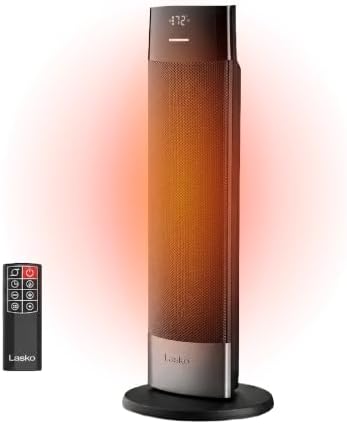
Lasko Space Heater Quiet is a 24 inch Ellipse tower heater built for larger rooms, with a wide curved grill and widespread oscillation that spreads heat across 120 degrees. The design suits a living room or open plan area where you want warmth carried sideways rather than blasted at one spot.
A 5 pound body and 24.1 inch height keep it slim enough to sit against a wall. For anyone who wants set-and-forget comfort, the thermostat and timer do most of the work.
What matters most for automatic shut off is how the unit manages itself when you are not watching. The 12 hour timer lets you cap a session, and AutoECO mode trims output to hold a comfortable temperature instead of running flat out. Quiet operation under 40 dB means it can run overnight in a bedroom without dominating the room.
Touch controls, a dimmable digital display and a 7 function remote cover power, speed, mode, temperature and oscillation from across the room. Three heat settings and two fan settings give you room to tune the output.
The catch is size and reach. At 24 inches tall with a 120 degree sweep, it is built to move air through a big space, so a small bedroom or cramped office gains little from the wide grill. The 3 year manufacturer warranty is generous, but the tower format is not something you tuck on a desk. Buyers heating a single small room should look at a compact unit instead.
10. JIBUFI 17 Inches Space Heaters for Indoor Use
17-inch oscillating heater with tip-over shutoff and 3-second PTC warmup

JIBUFI Space Heaters is a 17 inch portable unit aimed at smaller rooms and tight corners. Its 16.46 inch height and 5.51 inch width let it sit beside a desk, bed or sofa without eating floor space. Three power levels, 700W, 1000W and 1500W, let you match output to the room and the weather. Households with children, pets or older family members are the obvious fit given the safety focus.
Safety features carry the most weight here for automatic shut off. Tip-over shutoff and overheat protection cut power when something goes wrong, and the listing also cites a 24 hour automatic power off when there is no interaction. A 12 hour timer and remote control handle scheduled sessions, while the smart thermostat adjusts output to room temperature.
PTC ceramic elements are stated to deliver warmth in about 3 seconds, and the flame retardant plug and 6ft cord round out the ETL certified package.
The limit is coverage. A 70 degree oscillation sweep on a 16 inch body will not push heat far across a large open plan room, so expect it to warm a zone rather than a whole floor. The 1 year warranty is also shorter than some rivals offer. Shoppers heating a big living space should choose a taller tower instead.
What It Costs to Run
Wattage and hours of use decide what one of these adds to the electricity bill. The table uses the power figures from the listings above, at the highest setting.
| Power | 1 hour | 4 hrs a day | 8 hrs a day |
|---|---|---|---|
| 1,500 W | 1.5 kWh | 6 kWh | 12 kWh |
Multiply the kWh by the rate on your electricity bill to get the cost. A thermostat or a lower setting cuts the hours at full power, so real use is often below these figures.
How We Picked
Our picks for this guide come from two sources: the product details supplied for each model, and the feedback buyers leave in customer reviews. We did not rely on advertising claims or promotional copy.
For this kind of product, we compared the safety features first, especially how the automatic shut off works and what triggers it. We also looked at heat output, size and weight, portability, noise level, thermostat controls, and energy settings.
Patterns in owner feedback shaped the final list. Praise tends to focus on quick warmth, quiet operation and reliable shut off behavior. Complaints that recur involve uneven heating, noisy fans, confusing controls and units that feel flimsy.
Ordering the list was the last step. We grouped picks so that small rooms, larger spaces, tight budgets and quieter bedrooms each have a sensible option. Cheaper compact models sit alongside feature-rich ones, and every pick earns its place through data and owner reports rather than hype.
Frequently Asked Questions
What Does Automatic Shut Off Actually Do on a Space Heater?
At first glance, Automatic shut off is the feature that cuts power to the heating element when a specific condition is met. On most space heater with automatic shut off models, that means a tip over switch that kills the heater if it falls, plus a thermostat or timer that ends the cycle.
Some units also include overheat protection that trips if internal temperatures climb too high. We looked at how these mechanisms are described in product data and what owners say about them in practice.
The important detail for buyers is that these are separate protections, not one feature. A tip over switch protects against knocks and pets, a timer protects against forgetting, and overheat protection guards the unit itself.
Can a Space Heater with Automatic Shut Off Be Left on Overnight or Unattended?
In plain terms, this is the question we see most often, and the honest answer depends on which shut off features the unit has. A space heater with automatic shut off that includes a timer and overheat protection is designed to end its own cycle, which is why some owners do run them overnight in bedrooms.
But unattended use in another room or while you sleep still carries risk, and no shut off feature removes the need for basic precautions like keeping the unit clear of fabric and furniture.
For our research we compared how manufacturers describe overnight use and what owners report about it. Units with adjustable timers are the ones owners most often describe leaving on for a set period, while tip over and overheat protection are treated as backup rather than permission.
What Decides the Running Cost of a Space Heater with Automatic Shut Off?
Running cost comes down to wattage and how long the element is actually energised, and automatic shut off changes the second part. A heater that cycles off on its thermostat or timer draws power only during the on periods, so a well matched unit in a small, sealed room spends more time off. We compared wattage figures across models in our research because that number sets the ceiling on what any heater can draw.
The other half of the equation is the room itself. Heat loss through draughty windows, open doors and thin walls makes the element run longer, which raises consumption no matter what the shut off settings are. Owners often report that a lower wattage heater with a good thermostat ends up cycling less aggressively in a small space than an oversized unit that blasts and cuts out.
How Many Watts Does a Space Heater with Automatic Shut Off Need for My Room?
Wattage should follow room size, and the usual rule owners and guides cite is roughly 10 watts per square foot of floor area in a well insulated room. That means a small bedroom might suit a lower wattage unit while a larger living room needs more output. We used that guidance when comparing models, because an undersized heater runs constantly and never reaches its shut off point, while an oversized one cycles harshly.
The automatic shut off angle matters here too. A heater that is correctly sized will reach its thermostat setpoint and cycle off, which is the whole point of the feature. If the unit is too small for the space, the element stays on and the shut off never triggers on temperature, so you pay for continuous draw.
Is a Space Heater with Automatic Shut Off Noisy?
Noise depends on the type of heater, not on the shut off feature itself. Ceramic and fan forced models use a blower, so owners commonly report fan noise along with the click of the thermostat cycling. Radiant and oil filled units are usually quieter because they have no fan, though they heat more slowly. We compared noise descriptions in owner feedback across these categories when assembling our research.
The automatic shut off plays a small part in how noise is experienced. A unit that cycles on and off frequently produces repeated clicks and fan starts, which some owners find more distracting than a steady hum. A heater that holds temperature and shuts off for longer stretches is often described as less intrusive.
Is a Space Heater with Automatic Shut Off Safe Around Children and Pets?
Looking at the details, Automatic shut off adds a layer of protection around children and pets, but it does not make a heater child safe on its own. The tip over switch is the key feature here, because kids and pets knock things over, and a unit that cuts power when it falls removes one serious risk. Overheat protection covers the case where airflow is blocked by a toy, blanket or cushion pressed against the grille.
We looked at how models describe their safety features and what owners report about living with pets and small children. Cool touch housings and grille designs that keep fingers away from the element come up often in feedback, and those matter as much as the shut off. Our view is that a space heater with automatic shut off should be treated as supervised equipment around kids and pets.
Final Thoughts
Our pick for the best Space Heater with automatic shut off is the Space Heater, which balances safety features with solid everyday heating. For buyers who want more control over running costs, the DREO Space Heater adds adjustable settings and eco options that owners often mention as useful.
A small portable space heater suits tight rooms and desk areas, while the Lasko Space Heater is a reasonable choice for quiet bedrooms based on owner feedback. We compared shut off behaviour, thermostat accuracy and reported reliability across the range before settling on these picks.
Whatever model you choose, check that the automatic shut off covers both tip over and overheating, since those are the two protections that matter most.