Many buyers assume a condensing tankless heater wastes heat up the flue. In fact, it captures that heat to warm the water, which is why it runs more efficiently than a standard unit.
Cold showers and rising bills push homeowners toward a replacement, and small flats and busy family homes both need reliable hot water. Our research points to the best condensing tankless water heater for each setup.
We matched each pick to a room, household size or job, then compared flow rates, efficiency ratings, venting requirements and reported owner feedback. Condensing models recover more heat, so we weighed that against installation limits and gas type.
Top 3 Picks for Best Condensing Tankless Water Heater


How to Choose the Best Condensing Tankless Water Heater
Selecting a tankless water heater hinges on aligning the model with your household size along with the fuel and wiring configuration of your home. Our research involved reviewing product specifications, owner reviews and professional advice regarding efficiency, flow rates and venting. Condensing units extract additional heat from the exhaust, making them appropriate for homes where gas is accessible and a condensate drain line can be installed.
Tank, Tankless, Heat Pump or Point-Of-Use
A condensing tankless model warms water as needed and captures heat from flue gases, which explains why it requires a drain for the acidic condensate it generates. This makes it well suited to households with natural gas or propane and a location close to a drain.
Capacity and Flow Rate Against People and Fixtures
Flow rate determines how many fixtures can operate simultaneously. A small household running one shower at a time can get by with a lower flow, whereas larger homes with several bathrooms require more. Our comparison involved verifying the first-hour and flow figures in the product data, since owners frequently report that undersized units falter when two hot taps run at once.
Power, Voltage and the Wiring or Fuel Line It Needs
Gas condensing models require a correctly sized gas line and, for many, a standard electrical supply for the controls and fan. Propane versions require a tank and line, and natural gas versions require a supply from the meter. We examined the voltage and fuel requirements in the data, because owners often note that installation demands a qualified fitter for the gas and condensate work.
Quick Comparison
In-Depth Reviews
Our Top Pick
1. Rinnai RX130iN Condensing Smart Sense Tankless Water Heater
Runs on natural gas or propane and installs indoors or outdoors with Versa Vent

Rinnai Condensing Smart Sense is a condensing tankless unit built for households that want one appliance to cover several hot water fixtures at once. Its 7.1 GPM rating suits a busy family bathroom setup or a home where the shower, dishwasher and laundry can run close together.
Because the unit can go indoors or outdoors, it also fits homes where a utility closet is tight or where venting through a wall is easier than routing a long flue. The compact suitcase-sized cabinet helps in small mechanical rooms.
What we found most useful in the listing is the fuel flexibility. A Smart Sense gas control system lets the same model run on natural gas or propane, which matters for rural buyers without a gas main. The Versa Vent design supports indoor or outdoor mounting, though an RX-OVC vent cap is required outdoors.
Efficiency is rated at UEF 0.97, and the Quick Flush feature simplifies the periodic flushing that condensing units need to keep the heat exchanger healthy. A 15-year limited heat exchanger warranty backs the build when the product is registered within 90 days.
The main limit is installation. Rinnai recommends a qualified technician, and the listing notes the company does not recommend a DIY install, so this is not a plug-and-play purchase. Buyers on a tight budget or in a region where groundwater runs very cold should check the sizing guides and groundwater map before committing. Anyone wanting a simple swap for an old tank in a closet may prefer a smaller, less complex unit.
2. ThermoMate Condensing Tankless Water Heater Natural Gas, Up to 6 GPM
Dual heat exchanger design supplies two showers at once with a 3.5-inch LED touchscreen

We researched this as an indoor natural gas unit built for residential bathrooms and multi-point heating, and it suits a busy household that wants hot water at more than one tap at once. The listing sizes it at up to 6 GPM and 114,000 BTU, with the stated example of two showers running together at 105°F and 2 GPM each from a 65°F inlet.
That makes it a fit for a home where a storage tank takes up space or runs cold, and the compact cabinet works in a utility closet or on a wall. Standard plumbing connections keep the install familiar for most homes.
What matters most in the listing is efficiency and control. A dual heat exchanger supports a 0.86 UEF rating, and the brand claims potential savings of 15 percent compared with non-condensing units. Eight protections cover boil-dry, freeze, flame-out, overheating, over-temperature, pipe blockage, high-temperature lock and excessive air pressure, with frost protection activating automatically in cold conditions.
A 3.5-inch LED touchscreen lets you set output between 90°F and 140°F and track water flow, fan operation and flame status, while error codes help with diagnosis. Owners commonly report appreciating the on-demand delivery and the visible diagnostics.
The trade-off follows from the condensing design: this unit produces mildly acidic condensate that must be discharged to a drain, and the listing recommends an external neutralizer kit that is not included. Buyers who cannot route a drain, or who want the simplest possible install, should pick a non-condensing model instead.
3. Rheem RTGH Series 8.4 GPM Natural Gas Tankless Water Heater Indoor
Handles 3-4 simultaneous showers with 157,000 BTU and ultra-low NOx emissions

Rheem RTGH Series 8.4 is a natural gas indoor unit built for whole house demand, and it suits large families and multi bathroom homes where several hot water draws happen at once. The listing rates it for three to four simultaneous showers, so a busy morning with everyone getting ready at the same time is the kind of job it was designed around.
Because it is an indoor direct vent model, it needs a proper vent path to the outside, which is a planning point for basement or utility room installs. Homeowners replacing an old tank in a household with high hot water use are the clearest fit.
The headline figure is 157,000 BTU per hour feeding 8.4 GPM at a 35°F rise, and that rise matters in cold climates where incoming water is chilly. Condensing operation brings a 0.93 Uniform Energy Factor, and the listing says it uses up to 34% less energy than a standard 50 gallon electric tank.
Ultra-low NOx compliance helps where local air quality rules are strict. Digital LED control holds temperature within plus or minus 1°F, and built in freeze protection is useful for garages or cold utility spaces. The 15-year heat exchanger warranty and 5-year parts coverage are worth noting for long term ownership.
Professional installation is recommended, and the venting, gas line and condensate handling mean this is not a swap anyone should treat as plug and play. Households with modest hot water needs, or anyone wanting a simple DIY replacement, should look at a smaller unit instead. Buyers in very cold regions should also confirm the freeze protection suits their setup.
4. ThermoMate Condensing Tankless Water Heater Propane, Up to 6 GPM
Propane-fueled unit pairs stainless steel and copper exchangers for 0.86 UEF efficiency

Propane fueled indoor operation defines ThermoMate Condensing Tankless Propane, a residential unit for bathrooms and multi point heating setups where gas supply is already propane rather than natural gas. Its 6 GPM rating and 114,000 BTU input suit households running three to four fixtures at once, which covers most everyday demand without stretching.
The compact 21 inch by 13 inch by 7 inch cabinet helps in tight utility closets and small mechanical rooms. Anyone off the natural gas grid, or with an existing propane tank and line, is the natural buyer here.
A dual heat exchanger pairs a corrosion resistant stainless steel condensing section with an oxygen free copper section, and the listing rates the unit at 0.86 UEF. Nine protections are listed, covering boil dry, freeze, flame out, overheating, over temperature, timeout, pipe blockage, high temperature lock and excessive air pressure.
The 3.5 inch LED touchscreen lets you set output between 90°F and 140°F while tracking water flow, fan operation and flame status, and error codes speed up diagnosis. Standard 3/4 inch NPT water connections, a 1/2 inch NPT gas inlet, a 3 inch vent and a UL approved 120V plug keep hookup familiar for installers.
The lower 0.86 UEF and 6 GPM ceiling mean this unit trails higher output models in efficiency and peak flow, so very large homes with heavy simultaneous demand may want more capacity. Buyers without a propane supply, or with strict venting constraints, should consider a natural gas alternative instead.
5. Rinnai RX199iN Condensing Smart Sense Tankless Water Heater
Delivers 11.1 GPM to seven fixtures at once with a 0.98 UEF rating
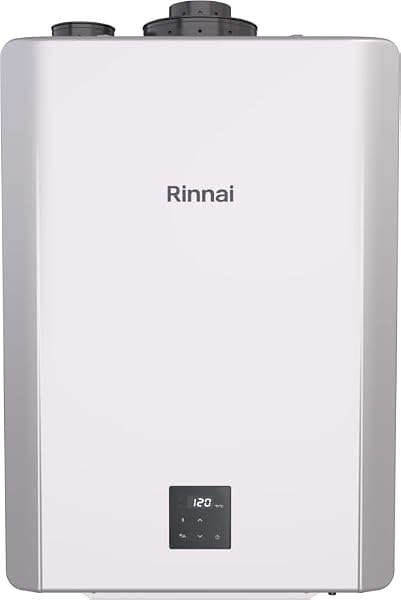
High output gas performance defines Rinnai Condensing Smart 11.1, a unit built for larger homes where several hot water fixtures may run at once. Its listed 11.1 GPM flow and 199k BTU rating point to a household with multiple bathrooms, a busy kitchen and perhaps a laundry all drawing together.
The compact suitcase sized cabinet suits a utility room, garage or exterior wall, and the indoor or outdoor Versa Vent design gives installers more placement options. Buyers weighing a condensing unit for a whole home should note the professional installation recommendation in the listing.
Smart Sense gas control lets the same model run on natural gas or propane, which simplifies planning if fuel supply changes. The UEF of .98 and 96 percent efficiency class reflect the condensing design, where exhaust heat is recovered rather than wasted. A Quick Flush feature simplifies the routine flushing that condensing units need, and the interface is described as easy to use.
The listing also notes a 15 year limited heat exchanger warranty, with parts and labor coverage that depends on registering within 90 days. A Controlr module for WiFi is sold separately.
The main limit is installation and setup: the listing recommends a qualified technician and notes that outdoor mounting requires the RX-OVC vent cap, which is not included. Buyers who want a simple DIY swap or who have low simultaneous demand may prefer a smaller, lower output unit. Households with several bathrooms and a willingness to book professional installation are the better fit here.
6. Vancepic Condensing Natural Gas Tankless Water Heater Indoor
Compact 120,000 BTU unit serves 2-3 bathrooms with an integrated anti-freeze heater

On paper, We researched the Vancepic Condensing Natural Gas model as an indoor, on demand hot water solution, and our comparison of its listing against owner feedback places it in the mid range of the category. The 120,000 BTU output and 5.1 GPM flow rate are sized by the manufacturer for two to three bathrooms, which points to a household where a shower, dishwasher and washing machine can run at once without a temperature swing.
The compact cabinet is described as fitting tight utility spaces, and the box includes a vent pipe and condensate drain line.
What we picked out as the most relevant features from the product data centers on the stainless steel heat exchanger, which the listing says captures heat from exhaust gases that would otherwise be wasted. A 114W heater is built in for sub-zero protection, and the safety package covers overheating, dry burning and exhaust blockage.
The LED digital display lets owners set temperature between 95 and 149 degrees Fahrenheit and monitor real time gas and water flow, with fault code alarms such as E0 and E1 for troubleshooting. Automatic temperature adjustment is listed to hold output steady as fixtures open and close.
The main trade-off we found is coverage: the warranty is a 2 year limited term on the heat exchanger, which is shorter than many buyers expect for a condensing appliance. Installation is also framed for professional installers, so a DIY minded owner should pick something else. Households with modest demand and a qualified installer nearby are the natural fit, while larger homes should compare higher flow models.
7. Rinnai RUCS65IN Tankless Hot Water Heater, Natural Gas
Serves up to five appliances at 6.5 GPM with flexible PVC/CPVC venting options

We researched Rinnai Tankless Hot Water as an indoor natural gas unit for households that want hot water on demand without a storage tank occupying floor space. Its compact white cabinet is sized for a utility closet, garage wall or mechanical room where venting can be routed outside, and the listed dimensions of 35 inches high, 22 inches long and 14.5 inches wide help in planning that spot.
With a flow rate up to 6.5 GPM, the listing positions it for serving several fixtures at once, which suits a family home rather than a single bathroom.
Comparing the listing details, the features that matter most are venting flexibility and efficiency. Multiple venting options are stated, including PVC and CPVC through the Ubbink Concentric to Twin Pipe adaptor, which gives an installer more freedom on placement. The heater only fires when hot water is called for, so it avoids the standby losses of a storage tank, and the energy efficiency class is listed as highly efficient.
Rinnai also backs the heat exchanger with a 12-year residential factory warranty, with 5 years on parts and 1 year on labor. Professional installation is recommended, and Rinnai directs buyers to its Find a Rinnai PRO page to locate a qualified technician.
One real limit is installation. Rinnai does not recommend installing the unit without a technician, so the total project depends on finding a local pro and on the venting route your home allows. Buyers who want a simple swap for an existing tank, or who lack indoor space for a wall unit, should look at a different style of heater.
8. Rheem RTGH Series 9.5 GPM Liquid Propane Tankless Water Heater Indoor
Liquid propane model pushes 199,900 BTU for 3-4 showers with direct venting

At first glance, We researched the Rheem RTGH Series 9.5 as an indoor, liquid propane unit for whole-house hot water, and it suits large families and multi-bathroom homes best. The gray cabinet measures about 23.7 inches high, 17.7 inches wide and 9.8 inches deep, and it vents directly, so it fits a mechanical room or garage where propane is already available.
Its 9.5 GPM at a 35°F rise and 199,900 BTU/hr input put it in the range of three to four simultaneous showers, which is why we picked it for households with heavy demand rather than small apartments.
From the listing, the features that matter most to us are the condensing technology and the efficiency figures. Rheem states a 0.93 Uniform Energy Factor and says the unit uses up to 34% less energy than a standard 50 gallon electric tank. The digital LED control holds temperature within plus or minus 1°F, and built-in freeze protection helps in cold climates.
We also noted ultra-low NOx compliance for areas with strict air quality rules, CSA certification, a multi-point safety system, and the 15-year heat exchanger and 5-year parts warranty.
The main trade-off we found is fuel: this model runs on liquid propane only, so homes without a propane supply would need a different option. Rheem also recommends professional installation, and labor coverage lasts just 1 year. Buyers on natural gas, or with modest hot water needs, should pick a smaller or gas-specific unit instead.
9. Rinnai RX180iN Condensing Smart Sense Tankless Water Heater
Ten GPM across six fixtures with dual-fuel Smart Sense and 0.98 UEF efficiency
Condensing gas performance defines Rinnai Condensing Smart 10, a unit built for households that want one model to cover a lot of ground. Because it can be installed indoors or outdoors and runs on either propane or natural gas, it suits homes where the fuel supply or venting route is still being decided.
At 10 GPM it is sized for larger homes with several bathrooms, and the compact cabinet is only about the size of a small suitcase, so it frees up floor space that a tank would take. Buyers planning a whole house setup with six fixtures running at once are the natural fit here.
What matters most for a condensing unit is efficiency and serviceability, and the listing addresses both. The UEF of .98 is near the top of the scale, which reflects the condensing design recovering heat that would otherwise go up the flue. Smart Sense gas control lets the same unit handle natural gas or propane, and the Quick Flush feature simplifies the periodic flushing that condensing heaters need to keep the heat exchanger healthy.
A simple interface and the Controlr module option for WiFi round out the controls, though that module is sold separately.
The catch is installation: Rinnai recommends a qualified technician, and an outdoor install needs the RX-OVC vent cap, which adds a part to plan for. The 15-year heat exchanger warranty also depends on registering the product within 90 days, otherwise the labor coverage drops to one year. Anyone who wants a simple DIY swap or has very low hot water demand should look at a smaller, simpler unit instead.
10. Rheem RTG Series 7.0 GPM Natural Gas Tankless Water Heater Indoor
Non-condensing design with LeakGuard detection covers 2-3 showers at 7.0 GPM

In plain terms, We researched the Rheem RTG Series 7.0 as a non-condensing natural gas tankless water heater built for whole house residential use, and our comparison of the product data and owner feedback points to homes with two or three bathrooms and large families as the clearest fit.
Its 7.0 GPM at a 35°F temperature rise, backed by 160,000 BTU/hr of output, is rated for two or three showers running at once, so it suits households that have tired of a tank running cold.
From the listing, the features we weighed most are the ones that affect daily use. The digital LED control panel adjusts temperature with precision of plus or minus 1°F for consistent hot water, and the unit carries built-in freeze protection, flame failure protection and a multi-point safety system.
LeakGuard leak detection and prevention watches for internal leaks, large or small, to help protect the home from water damage. The 0.82 Uniform Energy Factor is the efficiency figure the listing cites, alongside savings of up to 34% on energy costs versus 50-gallon electric tank heaters, and on-demand heating means no standby losses from a stored tank. CSA certification covers the natural gas design.
The trade-off follows from the data: this is a non-condensing unit, so it does not capture latent heat the way a condensing model does, and the labor warranty runs one year. Households in cold climates with very cold incoming groundwater may also find the 35°F temperature rise tight when several hot fixtures run together. Buyers who want maximum efficiency or a longer labor warranty should compare a condensing model instead.
How We Picked
We don’t base these selections on advertising. Instead, we examined manufacturer specs and pored over owner feedback in customer reviews. Real-world performance in actual homes guided each choice. Promotional language was ignored. What the specifications and user experiences demonstrate is what this list represents.
In evaluating this category, we assessed capacity and flow rate, gas type, venting requirements, efficiency ratings, and available controls on each unit. Installation demands and the upkeep items that owners bring up were also part of our review.
Positive feedback that appears repeatedly in reviews usually centers on consistent hot water delivery and reduced energy consumption. Negative comments tend to concentrate on installation expense, venting difficulty, and the upkeep that condensing units demand.
Our ordering accommodates varied needs and spending levels, ranging from high-capacity whole-home units to simpler, lower-output models. Picks are organized by demand and features, not by brand. Someone with a large household ends up in a different category than someone with a small home.
Frequently Asked Questions
What Size Condensing Tankless Water Heater Do We Need for Our Household?
Sizing a condensing tankless water heater starts with the cold water temperature in your area and the flow rate of the fixtures you run at the same time. A condensing unit delivers a set temperature rise, so colder incoming water reduces the gallons per minute it can heat.
We researched how manufacturers publish flow rates at different temperature rises, and we compared those figures against common household combinations such as a shower plus a kitchen tap. Bigger is not automatically better, because an oversized unit can short cycle and waste fuel.
Count the fixtures likely to run together and add their flow rates, then match that total to the unit’s rating at your winter groundwater temperature. Households with multiple bathrooms or a large tub usually need more capacity than a single bathroom home.
Is a Condensing Tankless Water Heater Better Than a Storage Tank for a Busy Family?
A condensing tankless water heater heats water on demand and captures latent heat from the exhaust, which is why it reaches higher efficiency than a standard tank. For a busy family, the appeal is endless hot water as long as the flow stays within capacity. A storage tank, by contrast, can run cold once the tank empties and then needs recovery time.
We compared both designs on recovery, standby loss and space, and the tankless design wins on space and standby loss.
The tradeoff is that a tankless unit has a minimum flow threshold and a maximum output, so simultaneous use can still exceed capacity. Owners commonly report that a tank recovers slowly after a long draw, while a condensing tankless unit keeps going until demand stops.
What Does Installing a Condensing Tankless Water Heater Require for Voltage, Breaker and Space?
Most residential condensing tankless water heaters are gas fired and use a standard 120 volt circuit for the control board, fan and igniter, so the electrical demand is modest. We researched installation guides and found the breaker size is usually small, often 15 or 20 amps, but the circuit must be dedicated. Electric condensing tankless models are different and need heavy dedicated circuits, sometimes multiple breakers, so confirm the fuel type before planning wiring.
Space needs go beyond the wall footprint. Condensing units produce acidic condensate that must drain to a suitable location, and the vent runs in PVC or CPVC with specific length and slope limits. We compared clearance requirements from product data and found most units need several inches around the cabinet for service.
How Long Does a Condensing Tankless Water Heater Last Compared with a Tank Unit?
Published service life figures for a condensing tankless water heater are generally longer than for a storage tank, though the heat exchanger is the part that decides. We researched manufacturer literature and owner reports and found that scale buildup is the main threat in hard water areas. A tank usually fails at the tank seam, while a tankless unit fails when the exchanger clogs or corrodes. Maintenance history matters more than the calendar.
Owners who flush their unit regularly commonly report longer service than those who skip it. We compared designs and noted that condensing models add a secondary heat exchanger, which is efficient but sensitive to poor water chemistry. A water softener or a scale control device can protect that exchanger. Venting and gas supply quality also affect longevity.
How Often Should We Flush a Condensing Tankless Water Heater, and What Upkeep Does It Need?
Flushing a condensing tankless water heater with a descaling solution removes mineral buildup from the heat exchanger, and the interval depends on water hardness. We researched maintenance guidance and found that hard water areas call for more frequent flushing, while soft water areas can stretch the interval. The process uses service valves, a small pump and a bucket, and many units include those valves from the factory. Skipping it is the most common cause of reduced flow and error codes.
Beyond descaling, upkeep includes cleaning the inlet filter screen, checking the condensate drain for blockages and confirming the vent stays clear. We compared owner feedback and found that condensate traps and neutralizers need occasional inspection because acidic water can degrade them. Annual checks of the flame sensor and igniter are also common in service guides.
Will a Condensing Tankless Water Heater Run Out of Hot Water During Back to Back Showers?
A condensing tankless water heater does not store hot water, so it cannot run out in the way a tank does, but it can be outpaced. We researched flow ratings and found that two showers plus a dishwasher at once can exceed a smaller unit’s capacity at cold inlet temperatures. When demand tops the rating, the outgoing water temperature drops. Owners commonly report this as a sudden lukewarm shower rather than a true empty tank.
The fix is sizing and flow management. Low flow showerheads and a unit rated for the combined demand keep temperatures steady. We also noted that a minimum activation flow means a trickle tap may not trigger heating at all, which surprises some owners. Recirculation accessories can shorten the wait for hot water at distant fixtures.
Final Thoughts
After comparing product data, owner feedback and expert research, our pick for the best condensing tankless water heater is the Rinnai Condensing Smart Sense. Its smart features and strong efficiency make it a sensible default for most homes. For tighter budgets, the ThermoMate Condensing Tankless Water covers the basics well. Buyers who want higher output can look at the Rheem RTGH Series 8.4 instead.
Match the unit to your household first. Peak hot water demand and gas type matter more than extra features. Check the warranty and venting requirements before you buy.