A sun soaked driveway can feel mild while the same garage sits cold all afternoon. That gap between outdoor comfort and indoor chill is what shapes our approach to garage heat.
Most garages are unheated workrooms, used for repairs, projects and short stints at a bench, so a heater has to warm a hard, drafty space quickly and keep running without fuss. Matching output to room size and fuel type to the job is how we narrow the field to the best kerosene heater for garage use.
We left out radiant patio-style units and small electric space heaters, which struggle in a cold garage.
Top 3 Picks for Best Kerosene Heater for Garage


How to Choose the Best Kerosene Heater for Garage
Garage conditions decide the choice more than the heater’s spec sheet. Cold concrete, poor insulation, fumes and clutter all matter, so we researched heat type, output, circuit load and safety features against real garage use. Our picks lean on product data, owner feedback and expert research, not showroom claims. What follows explains the trade-offs we compared.
Heat Type and the Room It Suits
Ceramic fan heaters push warm air fast, which helps in a cold garage you use in short bursts. Oil-filled units radiate steady, silent heat and suit a workshop where you linger, though they warm up slowly. Infrared heats people and objects rather than air, useful for spot warmth at a bench. Convection models circulate air gently and work best in tighter, better-sealed garages.
Wattage, Room Size and Circuit Load
Match output to the space, not to the label. A single household circuit typically carries around 1,500 watts, so a heater near that limit leaves little room for lights, chargers or power tools on the same line. Larger garages need more output and often a dedicated circuit. We compared stated coverage against typical garage dimensions, and owner reports show undersized units struggle in uninsulated spaces.
Safety Cut-Offs, Thermostat and Timer
Garages bring risks that living rooms do not, so cut-offs matter. Look for tip-over and overheat shutdown, plus a thermostat that holds a set temperature instead of cycling constantly. A timer helps when you heat before a job and want it off later. We favoured models with clear safety listings, since fuel heaters in enclosed spaces demand respect.
Compare All 10 Side by Side
Full Reviews of Each Pick
Our Top Pick
1. VEVOR Kerosene Forced Air Heater, 175000 BTU Portable Torpedo Diesel
Delivers 175,000 BTUs to heat up to 36,021 cubic feet with a 13.2-gallon tank

VEVOR Kerosene Forced Air is a torpedo style space heater built for big, drafty spaces rather than tight residential rooms. In a garage, that output bracket suits a three car bay, a detached workshop or a barn where the door opens and closes all day and cold air keeps pouring in.
The 175,000 BTU rating is aimed at warming large volumes fast, and the listing puts its reach at up to 36,021 cubic feet. For a homeowner or tradesperson who needs the workbench usable within minutes of switching on, this is the class of heater that fits that job.
What matters most for garage duty is the control and the fuel setup. A thermostat knob with a room temperature display lets the unit cycle down once the space reaches the set point, and built-in overheat protection shuts it off at a stated threshold. The 13.2 gallon tank feeds a 1.3 gallon per hour burn rate, which the listing says gives up to 9.5 hours on a full fill, so a long winter work session does not mean constant trips to the can.
The trade-off is bulk and appetite. At roughly 49 pounds and over 40 inches long, this is not a unit you tuck beside a car and forget, and it burns fuel quickly at full tilt, so ventilation and fuel storage become part of garage planning. A buyer heating a small single bay, or one who wants quiet radiant warmth near a chair, should look at a smaller or radiant style unit instead.
2. BILT HARD 85,000 BTU Portable Kerosene Diesel Heater
Offers 85,000 BTUs for 2,200 square feet and runs on multiple fuels

BILT HARD 85 is a forced air torpedo heater sized for the middle ground, more punch than a small personal unit but less bulk than the biggest models. That makes it a sensible fit for a standard two car garage, a workshop bay or a construction site where crews need warmth without dragging around a huge tank.
The listing rates it at 85,000 BTUs for up to 2,200 square feet and up to 9 hours of run time, which covers a typical day of garage projects with fuel to spare.
Fuel flexibility is the headline here. The unit is CSA certified for kerosene, filtered diesel #1 and #2, fuel oil #1 and #2, and jet A fuel, though the maker recommends K1 kerosene for the cleanest burn and best performance. A 5 gallon tank and a stated 0.6 gallon per hour consumption keep refills manageable, and the thermostat knob sets anywhere from 40F to 110F so the heater cycles instead of blasting nonstop.
Self diagnostics and sturdy steel construction round out the package for winter garage conditions, and a one year warranty backs it.
The limit is that 85,000 BTUs will struggle to hold temperature in a very large or poorly sealed space on the coldest nights, and forced air heat still means fuel odor and ventilation planning in an attached garage. Someone heating a big three car shop or an open barn should step up to a higher output model, while a buyer wanting gentle radiant warmth in a small space should choose a different style entirely.
3. BILT HARD 85,000 BTU Forced Air Kerosene Diesel Heater
Rugged steel build with 85,000 BTU output for construction and farming use

We researched the BILT HARD 85,000 BTU Forced Air Kerosene Diesel Heater as a portable torpedo space heater for cold garages, jobsites and construction sites. Its 85,000 BTU output is listed for heating 2,200 sq. ft. for up to 9 hours, and the 33.38″ × 13.85″ × 15.8″ steel body is built to be moved around a floor and stored against a wall.
For a drafty garage or an open work area that is slow to warm, that output and rugged construction matter more than extras.
Fuel flexibility is the feature our comparison kept returning to. The listing states CSA certification for multi-fuel use with kerosene, filtered diesel #1 and #2, fuel oil #1 and #2, and jet A fuel (JP8), while K1 kerosene is the manufacturer’s recommended fuel for optimal, cleaner burns and long-lasting performance.
The 5 gallon fuel capacity is listed at up to 9 hours of runtime, and the listing notes it takes 0.6 gallons of fuel to operate. A thermostat control holds a target temperature, assembly is minimal with convenient maintenance, and a 1 year warranty covers quality problems through the manufacturer.
The trade-off follows from the product data: this is a forced air torpedo heater, so it delivers high volume heat rather than the quiet, radiant warmth a finished, tightly sealed garage calls for. Owners commonly report that this style of heater suits rough, well ventilated work areas, patios, factories, barns and construction sites. Buyers heating a small insulated room who want quiet operation should pick a different type of heater.
4. DAHTEC 75,000 BTU Kerosene Diesel Forced Air Torpedo Heater for Garage
Features LED troubleshooting codes and thermostat control for easy operation
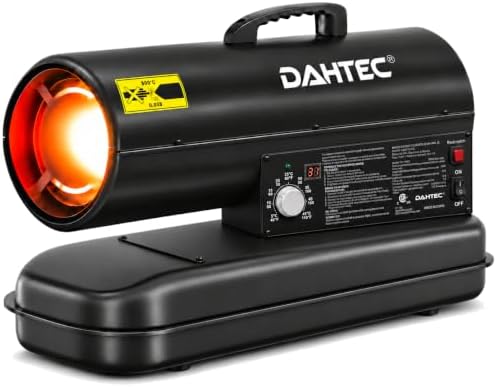
On paper, We researched the DAHTEC 75 as a kerosene and diesel forced air torpedo heater built for garages, workshops, barns and construction sites, and our pick reflects what the listing and owner feedback consistently describe. The 75,000 BTU output is rated for large, well ventilated spaces up to 1,750 square feet, which suits a big two or three car garage rather than a small shed.
Sturdy steel construction and a portable frame point to a workhorse unit made for cold weather job sites.
What matters most to us is the control package. A built in thermostat adjusts from 40 to 110 F so the heater can hold a target temperature and cut unnecessary fuel use, while overheat protection, an indicator light and LED troubleshooting codes simplify operation for everyday users. The five gallon tank is listed at up to nine hours of runtime at roughly 0.57 gallons per hour, though that figure depends on insulation, ventilation and ambient temperature.
It is CSA certified to run on K1 kerosene, filtered diesel #1 and #2, fuel oil #1 and #2, and Jet A or JP8, with K1 recommended for cleaner operation and longer product life.
The trade off is that this is a combustion heater, so it needs a well ventilated space and strict adherence to the approved fuel list in the manual. A sealed, finished room or a buyer who wants zero fumes and no fuel handling should pick a different type of heater. Anyone heating an open or drafty work space who will follow the fuel guidance should find the DAHTEC 75 fits the job.
5. CAMMOO 85,000 BTU Portable Forced Air Kerosene Diesel Heater
Produces warm air in as little as 5 seconds and includes wheels for mobility

CAMMOO 85 is a forced-air kerosene and diesel heater built for big, cold workrooms. In a garage, that means an 85,000 BTU output the listing says can heat up to 2,200 square feet, which suits a double bay or a large workshop rather than a single-car space.
It rolls on wheels and measures about 30 inches long, so it can sit out of the way and be pushed toward the bench when you need warmth. The 5-gallon tank is sized for longer sessions, so you are not refilling constantly during a project.
What we think matters most for garage use is how the fuel and flame are handled. A 100% copper nozzle atomizes the fuel into a fine mist, and continuous-spark ignition is meant to give faster, more consistent starts with less sputtering. Flame-sensing control cuts the fuel supply if ignition fails, which helps limit unburned fuel spray and pooling during startup.
The thermostat lets you set a temperature between 40°F and 110°F and cycles the unit automatically, and overheat protection shuts it down at 176°F. ETL certification and V-0 flame-retardant materials add a layer of backup, and the roll-welded steel tank is built for sealing.
The trade-off is fuel flexibility and weight. The listing recommends 1-K kerosene, and No. 1 or No. 2 diesel needs extra care, so you are tied to a fuel routine and ventilation plan in an enclosed garage. At 32.2 pounds with a 5-gallon tank, it is not something you carry up stairs. Buyers who want a smaller, lighter unit for a one-car garage should look elsewhere.
6. BILT HARD 135,000 BTU Portable Kerosene Diesel Heater
Delivers 135,000 BTUs to heat 3,200 square feet with adjustable thermostat

At first glance, We researched the BILT HARD 135 as a torpedo-style forced-air heater aimed at large garages, workshops, barns and construction sites rather than small rooms. Its listing rates it at 135,000 BTUs and says it heats up to 3,200 square feet for up to 8 hours, which places it in the range of a big shop, a utility building or a farm function area.
The steel construction is described as rugged enough to operate reliably in winter conditions, and typical uses named in the product data include patios, factories, utility and outbuildings, and farming functions.
What matters most in the listing is fuel flexibility and control. The heater is CSA certified for multi-fuel use with kerosene, filtered diesel #1 and #2, fuel oil #1 and #2, and jet A fuel (JP8), though the data strongly recommends K1 kerosene for the best performance, cleaner burns and longer life.
The thermostat adjusts by knob from 40°F to 110°F, and the heater starts once the set temperature is above the ambient temperature. Self-diagnostics, an indicator lamp and cord wrap are included, and the manufacturer backs it with a one-year warranty and free exchange for quality problems within that period.
The trade-off follows from the dimensions: at 49 pounds and about 33 inches long, this is a heavy unit to reposition around a garage or carry between spaces. Also, despite the multi-fuel support, the listing still points owners back to kerosene for the best results. Anyone who needs to move a heater frequently, or heat a smaller or tighter space, should pick a lighter, smaller model instead.
7. VEVOR Kerosene Forced Air Heater 215000 BTU Portable Diesel Space Heater
Provides 215,000 BTUs for up to 44,496 cubic feet with wheels and handle

Forced air torpedo heater VEVOR Kerosene Forced Wheels is built for large, open workspaces rather than a finished room. The listing rates it for areas up to 44,496 cubic feet, which puts it in the range of workshops, barns, farm buildings and construction sites. For a garage that is detached, drafty or used as a working shop, that kind of output and airflow is the point.
It is not a gentle background heater, it is a unit meant to raise the temperature of a big volume quickly while people are working.
The thermostat knob and room temperature display let you set a target between 40 and 110 degrees Fahrenheit, and the heater stops when the room passes that setting. Overheat protection shuts the unit down at a stated threshold, and it auto-shuts off when fuel runs low. The 13.2 gallon tank burns at about 1.5 gallons per hour, which the listing puts at up to 7.5 hours on a full tank.
Dual fuel filters are there to cut smoke and odor, and the unit accepts kerosene or diesel, though only one at a time, with 1-K kerosene recommended. Wheels and a handle help move it around a garage floor.
The trade-off is size and weight. At roughly 50 pounds and over 40 inches long, it takes up floor space and is awkward to store in a small garage. Anyone heating a tight, well-sealed single car garage should look at a smaller radiant or convection unit instead.
8. BILT HARD 215,000 BTU Forced Air Kerosene Diesel Heater with Wheels
Heats up to 10,750 square feet with 215,000 BTUs and includes wheels

Jobsites, construction sites and garages are the target of the BILT HARD 215, a forced air kerosene and diesel heater. The listing rates it at 215,000 BTU with a 13.2 gallon fuel capacity and says it can heat up to 10,750 square feet. That makes it a fit for a large or open garage where the door comes up often and cold air moves through.
The fan forced design pushes heat across a wide area, and the adjustable heat angle lets you aim the stream where you need it rather than straight down the middle of the floor.
CSA certification for multi fuel use is the detail that matters most here, because it covers 2-K kerosene plus filtered diesel number 1 and number 2, with 1-K kerosene named as the manufacturer’s recommended fuel for cleaner burning and longer service life. The steel body carries an anti-rust powder coating for cold winter use, and the support frame helps keep it stable.
Movable wheels and a pull handle let you shift it around a garage, and assembly is described as taking only a few minutes. Overheat protection, a thermostat, a digital display, a drain plug and cord wrap are all included.
The real limit is that this is a big, hot, fan driven unit, so it is not suited to a small enclosed garage or a space where fumes and noise would be a problem. Buyers with a tight single bay should choose a smaller vented or radiant heater instead.
9. SPECRAFT 80K BTU Kerosene/Diesel Radiant Heater, 4-Gal Tank
Radiant design reduces noise while providing 80,000 BTUs for 2,000 sq ft

SPECRAFT 80K BTU Kerosene/Diesel is a radiant heater built for garages, workshops, warehouses, barns and jobsites, with a claimed reach of up to 2,000 square feet. Radiant heat warms people and objects rather than blowing hot air around, which suits a garage where you are often standing in one spot at a bench or under a vehicle.
The 35 pound body sits on wheels with a push handle, so it can follow you between work areas. A garage that is unheated most of the year is the kind of room this unit is aimed at.
The listing states 80,000 BTU of output and a 4 gallon, 14 litre tank that supports extended running with fewer refuels. Combustion efficiency is quoted at 95 percent or higher, and the radiant design is said to keep airflow and operating noise lower than a forced air unit.
Tip-over protection cuts the heater off if it is knocked over, flame-out protection stops it if the flame is lost, and post-purge cooling protects internal parts. An adjustable thermostat holds the temperature you set, a fuel gauge shows the level, and the multi-fuel design accepts kerosene and is compatible with diesel and fuel oil.
The trade-off is that radiant heat is directional, so it warms what it faces more than the whole room, and a 35 pound wheeled unit still takes up floor space in a crowded garage. Multi-fuel compatibility also means you need to follow the maker’s guidance on which fuels to run. A buyer who wants fast, room-wide warm air in a drafty bay should look at a forced air model instead.
10. ROVSUN 70K Kerosene Heater, Forced Air Heater, Portable Diesel Space Heater
Compact 70,000 BTU heater with carry handle and LED display for small spaces

ROVSUN 70K Kerosene Heater is a forced air unit that pushes heated air out through a fan rather than radiating it, which makes it a fit for single and two car garages, workshops, pole barns and small jobsites. Its 182 CFM outlet airstream is meant to move warmth through open or poorly insulated spaces, the kind of drafty garage where still air never really warms up.
The body is heavy gauge iron and steel, and a built-in top carry handle means no wheel assembly is needed. You grab it and move it between garage, barn, shed and site.
The listing quotes 70,000 BTU at near 100 percent efficiency, with an adjustable thermostat dial from 40 to 110 degrees Fahrenheit that stops heating once the room rises above your setting and restarts as it cools. A bright LED display shows live status. The 5 gallon tank uses about 0.57 gallons per hour under normal conditions, which works out to roughly nine hours of continuous heat on one fill, and the unit plugs into a standard grounded 115V outlet at 2.5A.
It runs on 1-K kerosene, which is recommended, or #1 and #2 diesel, JP8 jet fuel or #1 and #2 fuel oil, one fuel at a time. A Cad Cell photocell shuts the heater down if the flame fails.
The catch is that forced air heat comes with fan noise and moving air, and the unit needs a grounded outlet, so cord placement in a garage matters. Anyone heating a small, sealed space who wants silent radiant warmth should consider a radiant model instead.
How We Picked
Our picks for this guide come from the product details supplied for each heater and from what buyers say in their customer reviews. We did not rely on advertising claims or promotional copy.
Comparing the product details meant looking at heat output, fuel type, tank size, run time, ignition method, safety features and build materials. We also weighed the size and shape of each unit, since a garage often has limited floor space.
Owner feedback showed clear patterns in both praise and complaints. Buyers often highlight strong heat output, easy setup and reliable starting, while recurring complaints mention fuel smell, noise and uneven heating. We used those repeated points to shape the list and to flag the trade-offs buyers should expect.
Ordering the picks was set so different needs and budgets are covered. Smaller, simpler models sit alongside larger forced air units, and we grouped them by how much space they suit and what buyers typically spend.
Frequently Asked Questions
How Much Does a Kerosene Heater for Garage Use Cost to Run, and What Decides It?
Running a kerosene heater for garage use comes down to fuel burn rate, the price you pay per gallon or litre of kerosene, and how many hours you run it. Our research compared published burn rates across heater sizes, because a unit that burns more fuel per hour costs more to operate no matter how efficient it looks on paper.
Heat output settings matter too, since most heaters let you run low or high, and low settings stretch a tank further.
The space itself changes the math. A large, poorly insulated garage loses heat fast, so the heater cycles on high more often and burns more fuel. We also looked at tank size, because a bigger tank means fewer refills but not lower cost per hour.
Can I Leave a Kerosene Heater for Garage Running Overnight or Unattended?
We would not recommend leaving any kerosene heater for garage use running overnight or unattended. Kerosene heaters produce carbon monoxide and need ventilation, and a garage is often closed up tight, which lets fumes build. Product data and safety guidance we reviewed stress that these units are meant for attended, ventilated use, not for sleeping areas or long unattended stretches.
The practical risks in a garage are real. Fuel can spill if the unit is knocked, and a garage holds paints, solvents and other flammables that raise fire risk. Owners report that heaters shut down or smell strongly when oxygen gets low, but that is a warning sign, not a safety guarantee. If you need overnight warmth, look at vented or electric options instead, and always follow the manufacturer’s clearance and ventilation rules.
What Wattage Kerosene Heater for Garage Do I Need for My Space?
Kerosene heaters are rated in BTU per hour, not watts, though you can convert if you are comparing with electric units. As a rough guide, budget around 30 to 50 BTU per hour for every cubic foot of garage space, then adjust up for poor insulation or a cold climate. Our research compared output ratings across models, and matching the rating to your room size matters more than buying the biggest unit.
Measure your garage first. Length times width times height gives cubic feet, and that number tells you the output range to shop for. An oversized kerosene heater for garage use wastes fuel and heats too aggressively, while an undersized one runs flat out and never catches up. Owners in cold regions often report needing the higher end of the range.
How Noisy is a Kerosene Heater for Garage Use?
Most kerosene heaters are quiet compared with power tools, but they are not silent. The main sounds are a soft roar from the burner, a slight tick from the fuel pump on some models, and the whoosh of a fan on forced air units. Our research compared owner feedback on noise, and wick style radiant heaters tend to be quieter than forced air models because they have no blower.
In a garage the noise matters less than in a living space, since you are usually working and making your own sound. Still, if you plan to use the space for detailed work or want to hear a phone call, a quieter radiant unit is the better fit. Owners commonly report the burner hum fades into background noise after a while.
Is a Kerosene Heater for Garage Safe Around Children and Pets?
Safety around children and pets needs real attention with any kerosene heater for garage use. The outer surfaces get hot enough to cause burns, and the unit tips if bumped, which can spill fuel. Our research looked at safety features across models, and the ones worth having are a tip over switch, an automatic shutoff, and a cool touch handle or guard.
A garage is not a playroom, but kids and pets still wander in. Keep the heater behind a barrier or in a corner away from the main walkway, and never let anyone sit close to the front grille. Owners report that pets knock things over more than children do, so a sturdy base and a tip switch matter.
Can I Run a Kerosene Heater for Garage on an Extension Cord or Power Strip?
Many kerosene heaters need electricity only for a fan, a fuel pump or an ignition, so the electrical draw is modest. That does not make any cord safe. Our research compared owner reports and product specs, and the recurring problem is a cord or strip that cannot handle the current, which causes overheating. Use a heavy gauge cord rated for the heater’s amps, and keep it as short as possible.
Power strips are the bigger risk. Most are not rated for a heater running for hours, and daisy chaining them makes it worse. A kerosene heater for garage use should plug directly into a wall outlet where you can, or into a single heavy duty cord with no strip in between. Owners commonly report tripped breakers and warm plugs when they cut corners here.
Final Thoughts
After comparing specs, prices and owner feedback, we rate the VEVOR Kerosene Forced Air as the best kerosene heater for garage use. Its forced air design and heat output suit larger, drafty spaces, and owners commonly report quick warmth. For tighter budgets, the BILT HARD 85 covers smaller garages well. A buyer wanting more heat for a big workshop should consider the BILT HARD 135.
Before ordering, measure your space and check the BTU rating against it. Also confirm the heater’s clearance needs and ventilation requirements, since kerosene heaters produce fumes and need fresh air. Matching output to room size matters more than any single feature.