Buyers often size an instantaneous heater by the old tank it replaces, then find the unit cannot keep up with two hot taps at once. That single miscalculation drives most of the disappointment we see in owner feedback.
Flow rate and temperature rise decide whether a unit suits your climate and fixtures, so we weighed both against real household demand. Matching those figures to your incoming water and usage gives the best instantaneous hot water heater for your home.
Our research focused on safety and durability features across every listing. We compared thermal cutoff and overheat protection, freeze protection for cold installations, scaling and mineral buildup resistance, plus warranty terms and reported element life. Those details separate units that last from ones that fail early.
Top 3 Picks for Best Instantaneous Hot Water Heater


How to Choose the Best Instantaneous Hot Water Heater
Instantaneous units heat water only as it flows, so sizing and installation matter more than brand names. We compared product data, owner feedback and expert research to see what separates a comfortable install from a frustrating one. Flow rate, household size, fuel type and the wiring or gas line available at the site decide most of the outcome. Get those right and the unit performs as expected.
Tank, Tankless, Heat Pump or Point-Of-Use
Storage tanks keep a ready reserve but lose heat while standing. Tankless units heat on demand and suit small homes, cabins and single bathrooms where hot water use is spread out. Heat pumps are efficient but recover slowly, so they fit low-demand households. Point-of-use models sit close to a sink or shower and cut waiting time, which helps in additions or remote bathrooms.
Capacity or Flow Rate Against People and Fixtures
Flow rate, measured in gallons per minute, must cover every hot fixture running at once. A single shower or sink needs little, while two bathrooms plus a kitchen can demand far more. Count the people and fixtures first, then match the unit’s rated flow at your incoming water temperature. Undersizing shows up as cold showers when someone opens a tap elsewhere.
Power, Voltage and the Wiring or Fuel Line It Needs
Electric tankless heaters draw heavy current, often needing 240 volts and a dedicated circuit sized to the unit’s kilowatt rating. Smaller point-of-use models may run on 120 volts but deliver limited flow. Gas units need a properly sized fuel line and venting. Check your panel capacity and existing lines before buying, because upgrade costs can exceed the heater itself.
Quick Comparison: All 10 Picks
Our Picks, Reviewed One by One
Our Top Pick
1. Tankless Water Heater Electric, 3000W Tankless Electric Water Heater 110V
Compact 3000W unit raises water 82-131°F in seconds for kitchen or bathroom sinks

Tankless Water Heater Electric is a small point of use electric unit built for tight spots. Its dimensions of roughly 7.85 inches by 4.31 inches by 4.31 inches suit under sink cabinets, kitchen counters and small bathroom installs. Renters, cabin owners and anyone heating water at a single distant tap are the obvious audience. The listing pitches it as a space-saving wall-mounted answer for spaces where a tank simply will not fit.
The 3000W element is the headline, and the listing says it can raise water temperature by 82 degrees F at 0.3GPM and 131 degrees F at 0.5GPM. A digital display switches between Fahrenheit and Celsius, which helps when dialing in a comfortable setting. Safety features include IPX4 waterproofing, leakage protection, dry-burning protection and automatic power-off in over-temperature and inactive states.
Flow is the real limit here. At 0.3 to 0.5GPM the unit is sized for a single low-flow fixture, not a shower plus a sink at once. Vertical installation is required, and horizontal mounting is not allowed because it can fault the heating elements. Buyers heating a whole house or running multiple outlets together should look at a higher capacity unit instead.
Installation details matter with this one. The listing stresses tightening pipe connectors with Teflon tape to prevent a short circuit fault, so a careful hand or a plumber is worth having. It also carries a 10 year product service term with round the clock customer support. For a single tap in a cabin, garage or back bathroom, the compact footprint and simple connections make sense. Anyone expecting full household output from a 110V circuit should size up.
2. Rheem RTEX-06T, 6.5kw Professional Classic 240V Point of Use Thermostatic
Holds selected temperature within 1 degree and is 90% smaller than tank heaters

Rheem RTEX-06T is a point of use thermostatic electric unit rated at 6.5kw on 240V. It is aimed at a single fixture or a small group of fixtures rather than a whole home. The 6 inch by 6 inch by 3 inch body and 4 pound weight make it a natural fit for a vanity cabinet, a workshop sink or a remote bathroom.
Temperature control is the feature that matters most. The listing says water temperature and flow rates are continuously monitored, holding output within 1 degree of the selected setting. That kind of steadiness is useful at a shower or a handwashing sink where swings are annoying. The unit only heats water when in use, which the listing frames as an energy saving.
The 240V requirement is the trade-off. This is not a plug-in unit, so it needs a dedicated circuit and a qualified install, which narrows who can fit it. Households needing hot water at several outlets at once should choose a larger whole home model. For one sink or shower with steady temperature, the thermostatic control is the reason to pick it.
Point of use sizing is where this model earns its place. Because it serves one location, the run of pipe between heater and tap is short, so hot water arrives with less waiting than a central tank allows.
Owners of small units like this commonly report that the biggest factor is matching capacity to the fixture. A low flow shower head or a single sink sits comfortably within its range, while a tub fill or two taps running together will outpace it.
3. Tankless Water Heater Electric 110V, 3000W Instant Electric Water Heater
Ultra-thin ABS housing with LED display fits tight under-sink spots at 110 volts

Shoppers wanting hot water at a single tap will find the Tankless Water Heater Electric a point of use unit built for tight spots. Its 3000W element heats on demand, so a kitchen sink, bathroom basin or washing area gets hot water without a storage tank. The slim ABS body measures roughly 7.86 inches tall and 4.32 inches wide, which suits cabinet interiors and small utility corners.
It runs on 110 volts, making it a fit for ordinary household outlets rather than dedicated high power circuits.
What we found most useful in the listing is the claimed heat rise. The unit can lift water by 82 F at 0.3 GPM and by 131 F at 0.5 GPM, and the flow rate directly changes the outlet temperature, so lower flow gives hotter water.
Safety features include water and electricity isolation, IPX4 waterproofing, leakage protection, dry boil shutoff and automatic power off when the unit overheats or sits idle. Installation needs premade screw holes, a 1/2 inch NPT standard interface and an English manual. The listing also specifies vertical mounting only, since horizontal fitting can trigger an E2 fault in the heating elements.
The main trade-off is output: at 3000W on 110 volts, the unit only serves one low flow outlet at a time, and larger draws cool the water down. Buyers who need to run a shower and a tap together, or who want full house coverage, should look at a higher power whole home model instead.
4. Tankless Water Heater Electric 110V, 3000W Under Sink Instant
Portable mini heater delivers hot water in 3-5 seconds for RVs and camping

Campers, RV owners and renters short on space are the natural audience for the Tankless Water Heater Portable. DOYXC builds it as a mini on demand unit that wall mounts to free up floor and cabinet room. The compact white body suits kitchens, apartments, bathrooms, RVs and camping setups.
A 110 volt supply and 1/2 inch NPT connections keep the hookup simple for a single point of use. We looked at the product data and owner feedback before picking it for small-space hot water, and the size and mounting style are what put it on our list.
Speed is the headline claim. The listing says hot water arrives in 3 to 5 seconds with no preheating, which removes the wait that tank units impose. A variable frequency design adjusts input power to the flow rate and temperature setting, and the listing puts thermal efficiency at up to 99 percent.
Protection covers IPX4 waterproofing, leakage, dry burning and automatic power off when idle. An LCD display shows temperature, and a long press on the power button switches the readout between Celsius and Fahrenheit. Premade screw holes and English instructions round out the install kit.
The limit is capacity. This is a 3000W, 110 volt single outlet heater, and the listing’s own size label reads 110V-3500W, so it cannot supply a whole home or several fixtures at once. Anyone heating a full house should choose a larger whole home unit, while single tap users and travellers get the compact fit they need.
5. Rheem 18kW 240V Tankless
18kW output reaches up to 4.4 GPM with self-modulation and 99.8% efficiency
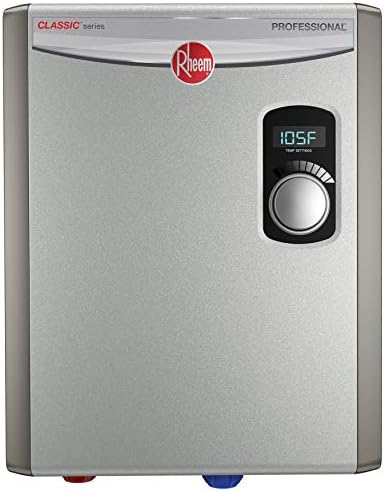
Households running several hot water draws at once get a whole home electric unit in the Rheem 18kW 240V Tankless. Its 18kW rating at 240 volts and flow rate up to 4.4 GPM put it in the range of a full house rather than a single fixture.
Buyers with a spare double pole breaker and room for a dedicated circuit are the ones this model is aimed at. It suits a family bathroom, a laundry, and a kitchen running together, not a cabin or a single sink.
External digital thermostatic control with an LED display is the feature we rate most for daily use, since it reports and holds temperature to plus or minus one degree. Self-modulation is the second, because the unit adjusts power to meet hot water demand instead of cycling hard on and off.
Two copper immersion heating elements are field serviceable, and the bottom 3/4 inch NPT connections simplify installation. A 99.8% energy efficiency class is listed, and the gray cabinet measures 18.5 inches long, 14.5 inches wide, and 3.5 inches deep at 14.78 pounds.
The real limit is electrical: 18kW at 240 volts demands a large dedicated circuit and a panel that can carry it, so many older homes will need an upgrade before this unit can go in. If the service panel is small or the job is a single sink, a lower draw model fits better. Buyers who want point of use hot water at one fixture should look at a small 110 volt unit instead.
6. Tankless Water Heater Electric 110V, 3000W Instant Water Heater Under Sink
Lightweight 3000W wall unit heats water in 3-5 seconds with IPX4 protection

We researched the mini 110 volt Tankless Water Heater Electric as a single-fixture solution, and our comparison places it among compact on-demand units for tight spaces. Its 3000W element and small white body suit renters, apartment dwellers, and RV or camping setups where a full panel circuit is not available.
The wall mounted design frees up cabinet space under the sink, and the unit is sized for one tap at a time, typically a kitchen or bathroom sink, rather than a whole house.
In our review of the listing, the flow and temperature figures matter most: the unit raises water by 82 degrees F at 0.3 GPM and up to 131 degrees F at 0.5 GPM within 3 to 5 seconds, which sets honest expectations for output. Safety functions matter at a sink, and this one lists IPX4 waterproofing, leakage protection, dry burning protection, and automatic power off in over temperature and inactive states.
Premade fixing screw holes, an English manual, and a 1/2 inch NPT standard interface make the install straightforward, and a 24 month warranty is included. The body measures 7.87 inches high, 4.33 inches long, and 4.33 inches wide.
The trade-off is output: 3000W at 110 volts supports only low flow, so it cannot feed a shower and a sink together or keep up with a high flow tap. Buyers who need whole home capacity or multiple simultaneous draws should pick a higher power 240 volt model instead.
7. Tankless Small Water Heater Electric 120V 29.2Amp, ThermoMate 3500W
Hardwired 3500W unit with cast aluminum element and 1°F temperature steps

Single sinks, not whole houses, are the target of the point of use electric Tankless Small Water Heater. Its size and 120V draw suit renters or homeowners who want hot water at one under counter or over sink faucet without running long pipe runs. Hair salons, bar counters and hotel reception desks are the kinds of spots the listing names, because the unit fits in tight places where a tank cannot go.
Anyone planning to heat a shower or feed two fixtures at once should look at a larger model instead.
A 3500W element draws 29.2A on 120V and must be hardwired, with no plug option. The self modulating power adjusts to inlet flow and temperature changes, which helps prevent overheating when demand shifts. A cast aluminum heating element sits outside the water line, and the SUS 304 stainless steel tube is meant to cut scale and mineral buildup.
The touch panel and digital display let you set temperature from 86F to 131F in 1 degree increments, and the unit is ETL certified with 1/2 inch NPT fittings.
The hardwiring requirement is the real limit here. You need a 32A double pole breaker and 10AWG wire minimum, so this is not a plug in project for a weekend. Flow tops out around 0.66GPM, which is fine for a sink but far too low for a shower or a bathtub. Buyers who want to serve a bathroom shower or two fixtures should choose a higher output 240V unit instead.
8. Westinghouse 14kW Tankless Water Heater Electric 240V, Wifi
WiFi and voice-controlled 14kW heater delivers 3.4 GPM across two points

Westinghouse 14kW Tankless Water is a whole home style electric unit aimed at apartments, single family homes, cabins and office restrooms. At 240V and 14kW it is sized to feed two points of use, so a bathroom shower plus a kitchen sink is within its stated range. The compact wall mountable body measures about 12.59 by 9.56 by 3.28 inches, which helps in a utility closet or on a garage wall.
It suits a household that wants on demand hot water without a storage tank taking up floor space.
The listing states hot water in about 3 seconds with 98 percent thermal efficiency, and a 3.4GPM flow when inlet is 62F and outlet is set to 105F. Minimum start up flow is 0.53GPM, so very low trickle demands may not trigger heating. WiFi compatibility with Alexa and Google Home lets you adjust temperature and monitor usage by voice or app, and a temperature memory function restores your last setting.
Four layer protection covers leakage, overheat, dry fire and over voltage, with an IPX4 rating and a separated water and electricity pathway. A removable inlet filter and rotor can be pulled out by hand for cleaning.
Installation demands a dedicated 60A double pole breaker and 6AWG wire at 240V, so this is a licensed electrician job for most homes. Output is capped at two fixtures, and a large family running several showers at once will likely feel the limit. Homes with three or more simultaneous hot water draws should step up to a bigger capacity unit.
9. ThermoMate CZ422LP, Propane Tankless Water Heater Indoor, Up to 5 GPM
Propane unit supplies up to 5 GPM for two showers with 98% thermal efficiency

ThermoMate CZ422LP is a propane-fired indoor tankless unit aimed at households that want on-demand hot water for more than one tap at a time. A busy family bathroom, a kitchen plus shower running together, or a small multi-point setup all fit the intent here. The compact 21 by 13 by 7 inch cabinet frees up the floor space a tank would normally take, which suits tight utility closets and basements.
Installation is indoor only, so the venting and gas supply need to be planned for that location.
Listing figures put output at up to 5 GPM and 102,000 BTU, enough for two showers at once with a stable 105 degrees at a 65 degree inlet. An oxygen-free copper heat exchanger and a 0.81 UEF point to efficiency claims of up to 98 percent thermal transfer.
Eight protections cover boil-dry, freeze, flame-out, overheating, over-temperature, pipe blockage, high-temperature lock and excess air pressure, and the unit carries CSA certification. A DC high-speed fan rated at 360Pa and 3000 RPM is built to resist backdraft in high winds, while the 3.5 inch LED display shows temperature from 90 to 140 degrees plus flow, fan and flame status and error codes.
Standard 3/4 inch NPT water connections, a 1/2 inch NPT gas inlet and a 3 inch vent simplify the plumbing side.
One limit follows from the design: the 105 degree figure is quoted at a 65 degree inlet, so cold-climate incoming water will reduce the flow you can draw at a given temperature. Buyers in very cold regions or with high simultaneous demand should look at a larger unit or a storage-assisted setup instead.
How We Picked
We base our selections on the specifications manufacturers provide in product listings and on the feedback buyers share in reviews, not on promotional material. After examining technical data and owner experiences throughout the category, we matched each unit’s stated capabilities against what users actually report after extended use.
The specifications we evaluated cover power output and voltage, flow rate at a given temperature rise, minimum flow required for activation, dimensions and weight, wiring and breaker needs, venting requirements, and the available controls.
Positive reviews tend to focus on consistent hot water, small footprint, and easy installation for capable do-it-yourselfers. Negative feedback repeats as well: undersized units unable to meet demand, difficult wiring, and poor post-sale support.
The lineup addresses varied needs and price points. Entry-level choices fit single fixtures and cramped spaces, midrange units serve small households, and larger models meet heavier demand. Budget models appear next to premium builds, letting shoppers align output and features with their particular installation.
Frequently Asked Questions
What Size Instantaneous Hot Water Heater Do We Need for Our Household?
Sizing an instantaneous hot water heater starts with the number of fixtures that may run at once, not the number of people in the house. Our research team compared manufacturer sizing charts and owner feedback, and the pattern is consistent: one bathroom plus a kitchen suits a smaller unit, while two bathrooms running together call for a larger one.
Flow rate and temperature rise matter more than any single number on the box. In cold climates the incoming water is colder, so the same unit delivers less hot water than it would in a warm region.
We suggest listing every shower, tap and appliance that could be on at the same time, then matching that combined demand to the unit’s flow rating at your typical incoming water temperature.
Is an Instantaneous Hot Water Heater Better Than a Tank Model?
Tank versus tankless comes down to how your household uses hot water. An instantaneous hot water heater heats on demand, so it never sits with a cylinder of water cooling between uses, and it frees up floor or cupboard space. Our comparison of product data and owner feedback found that households with steady, spread out demand tend to be happiest with tankless.
Homes that draw several hot taps at once, or fill a large bath, often prefer the buffer a tank provides.
There are practical trade-offs to weigh. Instantaneous units need adequate power or gas supply and proper venting, and some owners report a delay before hot water reaches a distant tap. Tank models are simpler to retrofit and deliver hot water immediately from stored volume. We looked at recovery speed, standby behaviour and installation demands rather than marketing claims.
What Does Installing an Instantaneous Hot Water Heater Require in Terms of Voltage, Breaker and Space?
Electrical instantaneous hot water heaters draw a lot of current, so the supply is the first thing to check. Our research compared installation requirements across models, and electric units typically need a dedicated circuit with a correctly rated breaker, often at higher voltage than a standard socket provides.
The unit’s data plate states the required amperage, and the cable and breaker must match it. Gas models instead need a suitable flue or vent and a gas line sized for the burner.
Space is usually modest because there is no tank, but clearance for air, access and pipework still counts. We advise checking the manufacturer’s minimum clearances and confirming your consumer unit has spare capacity before buying. Owners frequently mention that the electrical work, not the unit itself, was the bigger part of the job.
How Long Does an Instantaneous Hot Water Heater Last?
Lifespan depends heavily on water quality and how well the unit is maintained. Our team reviewed manufacturer guidance and owner feedback, and the common theme is that scale buildup is the main enemy of an instantaneous hot water heater. In hard water areas, mineral deposits coat the heating element and reduce efficiency, which shortens service life.
Units in soft water areas with regular flushing tend to last longer, though we do not quote specific year figures because they vary so much by conditions.
Installation quality also plays a part. A unit that is correctly sized, properly vented and fed by a clean supply avoids the stress that leads to early failure. We suggest checking the warranty terms, since many manufacturers tie coverage to documented maintenance.
What Upkeep Does an Instantaneous Hot Water Heater Need, Such as Flushing?
Flushing is the core maintenance task for an instantaneous hot water heater, especially in hard water areas. Our research found that descaling the heat exchanger removes the mineral buildup that otherwise reduces flow and efficiency. Manufacturers typically describe a flush procedure using a descaling solution, and some units have service ports to make it easier. The right interval depends on your water hardness, so check local water reports and the manual rather than guessing.
Beyond flushing, owners should check the inlet filter for debris and confirm the venting or airflow is clear on gas models. We compared maintenance schedules across product data and found the recommended intervals vary widely, so follow the specific manual for your unit. Annual inspection by a qualified technician is a sensible baseline for safety and performance.
Will an Instantaneous Hot Water Heater Run Out of Hot Water?
An instantaneous hot water heater does not store hot water, so it cannot run out in the way a tank does. Instead, it heats water as it flows, which means supply is limited by the unit’s flow rate and heating capacity. Our comparison of product data and owner feedback shows that a correctly sized unit keeps delivering hot water indefinitely as long as demand stays within its rating. Open one tap too many and the temperature drops rather than the supply stopping.
The practical risk is temperature fluctuation when several fixtures run at once, particularly in winter when incoming water is colder. Owners commonly report that a unit sized for peak demand handles simultaneous use well, while an undersized one struggles.
Final Thoughts
For most homes, our pick for the best instantaneous hot water heater is the Tankless Water Heater Electric, which balances capacity, price and owner satisfaction in the data we compared. Buyers who want a proven brand name should consider the Rheem RTEX-06T, a compact model that suits single-point use like a sink or small apartment.
Portable buyers have a clear option in the Tankless Water Heater Portable, which fits camping and remote setups where a fixed unit will not work. Our picks come from product data, owner feedback and expert research, not from any hands-on trials.
One last piece of advice: match the unit’s power rating and flow rate to your actual use before buying. Oversized units waste money, and undersized ones disappoint.