A whole house drawing hot water at once behaves very differently from a single shower running on a quiet morning. Tankless electric units size themselves around that gap, so the load a household puts on the unit decides almost everything.
Most units hang in a utility closet or garage and feed showers, sinks and appliances through short, busy draw periods. Recovery speed and circuit capacity matter more than tank size ever did. Our research points to the best residential tankless water heater as one matched to the home’s real demand.
Kilowatt rating, amperage draw, flow rate at temperature rise and the number of circuits available are the specs we weighted most.
Top 3 Picks for Best Residential Tankless Water Heater


How to Choose the Best Residential Tankless Water Heater
Getting the choice right comes down to matching the unit to your household, not chasing the biggest number on the box. We looked at product data, owner feedback and expert research to compare types, flow rates and power needs for residential tankless water heaters. Our picks focus on what actually fits a home: available power, fuel type, fixture count and how people really use hot water.
Tank, Tankless, Heat Pump or Point-Of-Use
Each type suits a different household. Storage tanks and heat pump models work well for homes with steady demand and space for a tank, while heat pumps need warm air around them to run efficiently. Tankless units free up floor space and heat water on demand, which suits smaller homes and busy families.
Capacity and Flow Rate Against People and Fixtures
Flow rate decides whether two showers can run at once. Electric tankless models are often sized by kilowatts and by how many fixtures they can serve, while gas units are rated in gallons per minute. Match the rating to your peak use: count showers, taps and appliances that might run together. Oversizing wastes money and may strain your electrical panel, so size to real demand.
Power, Voltage and the Wiring or Fuel Line It Needs
Electric tankless heaters draw heavy current, and many need 240 volts with dedicated circuits and thick cable, sometimes more than one breaker. Check your panel capacity before buying, because upgrades add cost. Gas models need a properly sized fuel line and venting, and non-condensing units have specific installation rules. Confirm what your home can supply before you commit.
Quick Comparison: All 10 Picks
In-Depth Reviews
Our Top Pick
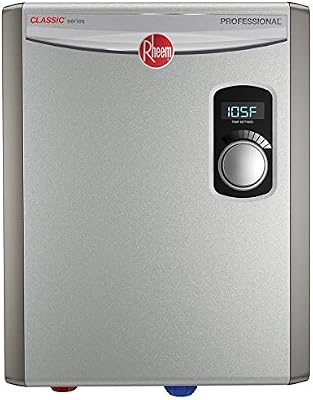
1. Rheem 11kW Multi Fixture
Fits tight spaces at 90% smaller than tanks while heating only on demand

Rheem 11kW Multi Fixture is an electric tankless unit built for households that want on-demand hot water at more than one tap without giving up a closet or utility corner to a storage tank. The listing sizes it for multiple fixture applications, so it suits a small home, a cabin or a guest suite where a shower and a sink may run around the same time.
Because it heats only when a hot tap opens, it avoids the standby losses that come with keeping a tank warm all day. The compact housing is listed as 90% smaller than a traditional tank heater, which matters in tight residential mechanical spaces.
What we look at first for this use case is the electrical demand, and the listing is clear about it. The 11kW model calls for 240V single-phase power, one 50-amp double-pole breaker, a set of #8 AWG copper conductors with ground, and a recommended minimum 100-amp household service panel.
Output is rated up to 2.68 GPM, and the digital thermostatic control adjusts in 1-degree steps from 80F to 140F. The 99.8% energy efficiency class and limited lifetime warranty round out the spec sheet. These are the numbers a homeowner or installer needs to confirm before buying.
The real limit is electrical capacity, not the heater itself. A 50-amp circuit and a 100-amp service panel recommendation mean older homes with smaller service may need an upgrade before this unit can go in, and 2.68 GPM will not keep up with several hot taps running at once. Buyers with a light electrical panel or a large household should look at a higher-capacity model or a gas unit instead.
2. Rheem 240V Heating Chamber
Field-serviceable copper immersion elements and self-modulating power for steady two-fixture output

We researched this unit as a compact electric tankless heater for a single bathroom or small apartment where floor space is scarce. The Rheem 240V Heating Chamber, model RTEX-13, is rated up to 3.17 GPM, which our comparison of the product data suggests fits a shower and a sink used one after the other rather than together.
Its gray housing measures roughly 12.63 inches long and 8.25 inches wide, so it can tuck into a utility closet or the back of a cabinet. For a renter or a homeowner upgrading from a tank, that footprint is the main draw, and owner feedback commonly mentions the space savings.
The features our research picked out as mattering most are the controls and the serviceability. An external adjustable digital thermostatic control with LED display holds temperature to about 1 degree, and the self-modulating power control trims draw to match demand. Two copper immersion heating elements are field serviceable, and the unit ships with half-inch NPT adapters and side half-inch compression connections for a straightforward install.
The listing also cites 99.8% energy efficiency, a 54-amp draw and a 1.5 GPM water-saver shower head. Those details tell us this is a unit built for easy maintenance and precise temperature.
The trade-off is capacity. At 3.17 GPM this heater is sized for one fixture at a time, so a household running a shower and a washing machine together will feel the drop. Its 54-amp draw also needs a dedicated circuit, which not every older panel can spare. Buyers with heavy simultaneous demand should step up to a larger unit or a gas model.
3. Rheem 18kW 240V Tankless
Steps up to 18kW with self-modulation that adjusts power to match hot water demand
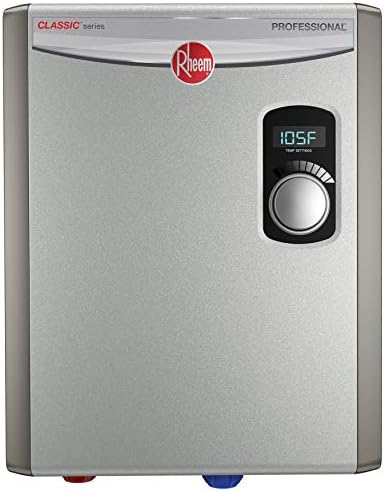
On paper, We researched this as the largest of the three electric units in our comparison, an 18kW 240V tankless model built for a whole-home or multi-bathroom setup with steady hot water demand. The 18kW rating pushes flow to as much as 4.4 GPM, enough to feed a shower and a second fixture at the same time in many homes.
Its gray housing measures about 18.5 inches long and 14.5 inches wide, so it needs more wall space than the smaller models we compared. For a family house replacing a tank, this is the size in our research that comes closest to matching old tank output.
The listing leans on control and durability, and those are the features our team weighed most. Self-modulation adjusts power to meet hot water demand rather than running flat out, and the external digital thermostatic control with LED display holds temperature to about 1 degree. Two copper immersion heating elements are field serviceable, and bottom three-quarter inch NPT connections simplify plumbing.
The 99.8% energy efficiency class and threaded fittings for easy replacement are worth noting for anyone planning a swap. Owner feedback commonly points to these as the details that make a high-draw install practical.
The catch that follows from the product data is the electrical service. An 18kW unit draws heavily and needs a large dedicated circuit and panel capacity, which many older homes simply do not have without an upgrade. It also costs more to install than the smaller models. Buyers with limited panel space or a single bathroom should pick the 11kW or 13kW version instead.
4. SNDOAS Tankless Water Heater Natural Gas, Up to 4.23 GPM 853,00 BTU
Gas on-demand unit with anti-freeze protection and oxygen-free copper exchanger for cold climates
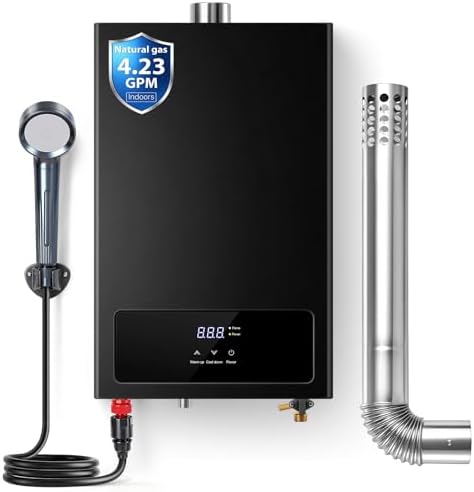
SNDOAS Tankless Water Heater is a natural gas unit built for whole house use and indoor wall mounting in well ventilated areas like kitchens or bathrooms. The listing rates it at up to 4.23 GPM, which is enough for multiple showers and appliances running at the same time, so it suits larger households that are tired of waiting for a tank to recover.
Because it burns natural gas, it needs a licensed technician for installation with 1/2 inch NPT fittings, and the exhaust pipe is included in the box.
What matters most for a gas unit indoors is safety and steady temperature, and the listing covers both. It lists overheat, dry burn and exhaust blockage protection, plus a fan that prevents CO leakage, and a built in anti-freeze device that resists temperatures down to 23°F. The oxygen free copper heat exchanger is there for heat transfer and corrosion resistance, and the smart LED display shows real time temperature and usage while holding water within plus or minus 1°F of the set point.
A standard 120V outlet powers it, and the panel also reports error codes and gas and water consumption.
The trade off is venting and gas supply. This is an indoor natural gas appliance that needs a well ventilated spot and professional installation, so it is not a drop in replacement for an electric unit and it will not suit a home without gas service. Buyers who want a simple plug in electric model, or who cannot run a vent, should look at an electric option instead.
5. Westinghouse 14kW Tankless Water Heater Electric 240V, Wifi
WiFi and voice control with temperature memory set it apart from plain electric models

Westinghouse 14kW Tankless Water is an electric 240V unit that mounts on a wall and takes up very little room, at roughly 12.6 inches high and 3.3 inches deep. The listing positions it for apartments, single family homes, cabins and office restrooms, and rates it for 2 points of use. Anyone without gas service who wants hot water in a small to mid sized home is the obvious buyer here.
The electrical requirements are the first thing to check. It needs a dedicated 60A double pole breaker and 6 AWG wire at 240V, with 1/2 inch NPT connections. The listing claims hot water in about 3 seconds at 98% thermal efficiency, with a minimum start up flow of 0.53 GPM and a max of 3.4 GPM when the inlet is 62°F and the outlet is set to 105°F, which covers 2 fixtures.
WiFi and voice control through Alexa and Google Home let you adjust temperature and monitor usage, and a temperature memory function restores your last setting. It is ETL certified with 4 layer protection and an IPX4 rating, and the separated water and electricity pathway plus a removable inlet filter help limit scale and corrosion.
The limit is capacity and wiring. At 3.4 GPM and 2 points of use, this will not keep up with a large household running several fixtures at once, and the 60A circuit is a real installation cost. Homes with gas available or bigger hot water demands should pick a gas unit or a larger electric model.
6. ThermoMate CZ422LP, Propane Tankless Water Heater Indoor, Up to 5 GPM
Propane model holding a stable 105°F for two simultaneous showers with eight safety protections

ThermoMate CZ422LP is a propane indoor unit aimed at whole house and multi point use, and the listing says it can run two showers at the same time while holding a stable 105°F based on a 65°F inlet. That flow, up to 5 GPM and 102,000 BTU, makes it a fit for busy family homes that want on demand hot water without a storage tank.
It measures about 21 inches high and 7 inches deep, so it frees up floor space compared with a conventional tank.
The safety and efficiency claims are the core of the listing. It is CSA certified and lists 8 protections, including boil dry, freeze, flame out, overheating, over temperature, pipe blockage, high temperature lock and excessive air pressure, and 4 ceramic heating cores trigger frost protection automatically. The oxygen free copper heat exchanger is rated for up to 98% thermal efficiency with a UEF of 0.81.
A 3.5 inch LED display handles temperature from 90 to 140°F and shows flow, fan and flame status with error codes, and a DC high speed fan is built to resist backdraft and flameouts in high winds. Connections are 3/4 inch NPT water, 1/2 inch NPT gas and a 3 inch vent, with a 120V cord.
The catch is that this is a propane appliance with a vent connection, so it needs gas supply, proper venting and a qualified installer, and it will not work in a home set up for electric only. Buyers who want a plug in electric model or who cannot vent should choose something else.
7. Rheem RTG Series 7.0 GPM Natural Gas Tankless Water Heater Indoor
LeakGuard detection plus 7 GPM output covers two to three showers at once

At first glance, We researched the Rheem RTG Series 7.0 as an indoor, wall-mounted natural gas unit for whole-house use, and compared its listing data with owner feedback and expert research on tankless sizing. The product data rates it at 7.0 GPM at a 35°F temperature rise, which the manufacturer says supports two to three simultaneous showers, making it a fit for larger families and multi-bathroom homes with two or three water points running at once.
We picked it as a candidate replacement for aging tank heaters, since the space-saving wall-mount design frees up floor space in a utility closet or garage.
Features the listing states that matter most come down to output, efficiency and safety. Output is 160,000 BTU per hour, and the 0.82 Uniform Energy Factor is claimed to save up to 34 percent on energy costs versus a 50-gallon electric tank heater. The digital LED temperature control panel allows precision adjustments of ±1°F for consistent hot water temperature.
Safety coverage includes built-in freeze protection, flame failure protection and a multi-point safety system, plus LeakGuard leak detection and prevention for internal leaks both large and small. Installation is indoor with a direct vent system, and the unit is CSA certified.
The trade-off is that this non-condensing design depends on proper venting and gas line work, so professional installation is the realistic path, and the listed labor warranty runs only one year. Households with very cold incoming groundwater or more than three simultaneous hot water draws should pick a higher-capacity or condensing model instead.
8. Rinnai RE199iN Non-Condensing Natural Gas Tankless Water Heater
Top 9.8 GPM output with a 15-year heat exchanger warranty for whole-house demand

We researched this Rinnai model as an indoor, wall-mounted gas tankless unit built for whole-house hot water in larger homes. The listing rates it at 9.8 GPM and 199,000 BTU, which points to supporting several fixtures at once, such as showers, laundry and the dishwasher, and it is sized for big households with heavy morning demand.
Because it heats water only when needed, standby energy loss is lower than with a traditional tank. Our comparison of the product data and common owner feedback suggests it suits families who want endless hot water without giving up floor space.
What matters most in the listing is the capacity and the warranty terms. The heat exchanger carries a 15-year limited residential warranty, parts are covered for 5 years and labor for 5 years, as long as the unit is registered within 90 days of installation; otherwise labor defaults to one year.
The LED display reports diagnostic codes and service reminders, which we found useful for routine upkeep. A Controlr module for WiFi is sold separately, and professional installation with proper venting is recommended to ensure safe gas connection, code compliance and full warranty protection.
The trade-off is that this is a non-condensing design, so efficiency depends on climate and incoming water temperature, which is why Rinnai’s sizing guides and groundwater temperature maps matter when choosing. Buyers in cold regions or with limited venting options may be better served by a condensing unit, and anyone who wants app control out of the box should budget for the separate module.
9. Rinnai RE180iN Non-Condensing Natural Gas Tankless Water Heater
Suitcase-sized cabinet delivering up to 8.5 GPM across five fixtures at once

This is an indoor, non-condensing natural gas unit sized for households that need solid hot water output without moving up to the largest model in the line. The listing rates it at 8.5 GPM and 180,000 BTU, and describes it as providing up to 6.9 GPM with five fixtures running at once.
Its cabinet is roughly the size of a small suitcase, so it suits utility closets and tight wall spaces where a tank would not fit. That makes it a reasonable match for mid-size homes and renovations with limited room.
In our research, the features the listing states that matter most are the redesigned internal layout, which is meant to speed installation and improve service access, and the LED screen that shows service reminders and error codes. The warranty terms are worth comparing closely: a 15-year heat exchanger guarantee, 5-year parts and 1-year labor for residential use, with labor extending to 5 years if the product is registered within 90 days of installation.
WiFi control runs through the optional Controlr module, which is not included, and Rinnai recommends a qualified technician for installation rather than a DIY job.
The main trade-off is capacity. At 8.5 GPM and 180,000 BTU, this unit sits below the larger Rinnai model, so homes with several simultaneous hot water draws or very cold groundwater may find it stretched. Buyers who want maximum flow or built-in smart control should pick something else, while smaller households will find the size and output well matched.
10. ThermoMate CZ422NG, Natural Gas Tankless Water Heater Indoor
DC high-speed fan withstands hurricane-force winds while the LED shows flow and flame status
Natural gas tankless unit ThermoMate Natural is built for indoor installation, sized for whole-house use in smaller homes and multi-point setups. The listing positions it for running two showers at once while holding a stable 105°F, which suits households where the bathrooms and kitchen draw hot water at the same time.
Compact dimensions of roughly 21 by 13 by 7 inches let it fit where a tank unit never would, and the 3/4 inch NPT water connections and 1/2 inch gas inlet match common residential plumbing. For a buyer replacing an old tank in a tight utility closet, the footprint is the practical draw.
Output tops out at 5 GPM and 102,000 BTU, so the unit is rated for on-demand supply rather than heavy simultaneous demand from several fixtures. The oxygen-free copper heat exchanger is listed at up to 98 percent thermal efficiency with a 0.81 UEF, and the smart flow sensor and control chip adjust operation to the draw. Safety coverage is broad for a gas appliance: CSA certification plus boil-dry, freeze, flame-out, overheat, timeout, pipe blockage and high-temperature lock protections.
The limit is capacity. At 5 GPM and 102,000 BTU, this unit will not keep up with a large household running several hot fixtures at once, and the 0.81 UEF sits below the top efficiency tier for condensing models. Buyers with bigger homes or heavier simultaneous demand should look at a higher-output unit instead.
How We Picked
Our picks come from the product details manufacturers publish and from what buyers say in customer reviews, not from advertising. We researched specifications, compared owner feedback and drew on expert research to build the list. No product earned a place because of a marketing claim alone.
For this kind of product, we compared power output and voltage, fuel type and venting needs, flow capacity for multi fixture use, the heating chamber design, and the controls each unit offers.
Owner feedback showed clear patterns. Buyers often praise steady hot water, compact sizing and straightforward installation, while recurring complaints mention flow limits at cold inlet temperatures, ignition or control faults and the cost of professional fitting.
Ordering the picks was about coverage, not ranking. We arranged the list so different fuels, capacities and budgets are represented, letting a buyer match a heater to household size and available power or gas supply. Each entry earns its spot through data and owner experience rather than position alone.
Frequently Asked Questions
What Size Residential Tankless Water Heater Do We Need for Our Household?
Sizing a residential tankless water heater comes down to flow rate, not tank gallons. Add up the fixtures you might run at once, such as a shower, a sink and a washing machine, and match that combined flow to the unit’s maximum flow rate at the temperature rise your incoming water needs.
Cold climates need a higher temperature rise, which lowers the usable flow. Our research shows most families do well by listing their busiest hour of hot water use before comparing models.
Count bedrooms and bathrooms as a rough starting point, then check the flow ratings on the fixtures themselves. Two full bathrooms running together can push demand past what a smaller unit delivers. We compared manufacturer flow charts and owner feedback, and the common mistake is buying on household size alone.
Is a Tankless Water Heater Better Than a Tank for a Residential Home?
Tankless and tank models solve different problems, so the right pick depends on how your home uses hot water. A residential tankless water heater heats water on demand, so it never runs a stored tank cold and it frees up floor space. Tank units keep a reserve ready, which suits homes that draw hot water in several places at once. We compared the trade-offs owners report most often before recommending either type.
Homes with spread-out bathrooms and steady demand often suit tankless, while large households with simultaneous draws sometimes prefer a tank. Installation matters too: tankless units usually need gas capacity, venting and electrical work that a tank swap does not. We weighed upfront work against long-term convenience using product data, not guesswork. Decide based on your peak demand, fuel type and available space, not on marketing claims.
What Does Installing a Residential Tankless Water Heater Require for Voltage, Breaker and Space?
Electric residential tankless water heater models draw a lot of power, so the electrical panel usually needs dedicated circuits and higher-amperage breakers. Many whole-home electric units need more than one breaker, and some homes need a panel upgrade to handle the load. Gas models instead need adequate gas line capacity and proper venting. We checked installation guides across models to map what each type demands before you buy.
Space needs are modest, but clearances are not zero. Units mount on a wall and still require clearance for venting, air intake and service access, and gas models need a suitable flue route. Our research found that the hidden costs sit in electrical or gas upgrades, not the unit itself.
How Long Does a Residential Tankless Water Heater Last Compared with a Tank Unit?
Tankless units generally outlast storage tanks because there is no tank to rust through. Manufacturer data and owner feedback point to longer service life for tankless, though hard water and skipped maintenance shorten it. A residential tankless water heater lives or dies on scale buildup, so the water quality in your area matters as much as the brand. We compared expected lifespans from product documentation rather than promises.
Tank units typically need replacement sooner, which is one reason buyers switch. That longer life only holds if the unit is flushed and descaled on schedule, especially in hard water regions. Our research suggests the upfront cost gap narrows over time, but only for owners who keep up with maintenance. Factor in local water hardness and your willingness to service the unit before assuming the longer lifespan applies to you.
How Often Should a Tankless Water Heater Be Flushed, and Can We Do It Ourselves?
Flushing removes mineral scale from the heat exchanger, and hard water areas need it more often than soft water areas. Most manufacturers recommend annual flushing, with some suggesting more frequent service where water is very hard. A residential tankless water heater that is never flushed loses efficiency and can fail early. We reviewed maintenance schedules across models and owner reports to set realistic expectations.
Many owners flush their own units using a pump, hoses and a descaling solution, following the manufacturer’s instructions. The job takes basic care with valves and power, but gas line or vent work should stay with a professional. Our research shows DIY flushing is common and manageable for careful homeowners. Keep a log of each flush, because warranty terms often depend on documented maintenance.
Why Does Our Tankless Water Heater Run Out of Hot Water or Deliver Inconsistent Temperature?
Running out of hot water with a tankless unit usually means demand exceeded the unit’s flow capacity at the current temperature rise. Cold incoming water in winter lowers usable flow, so the same shower that worked in summer can overwhelm the heater. A residential tankless water heater also struggles when several fixtures run at once. We compared flow ratings against common household draws to explain the pattern.
Inconsistent temperature often traces to scale buildup, a flow sensor issue or a minimum activation flow that small draws do not meet. Some units need a certain flow before the burner or element fires, which causes cold bursts at low demand. Our research into owner feedback shows these complaints usually point to sizing or maintenance, not a defective unit. Check your peak simultaneous demand and flush schedule before assuming the heater is broken.
Final Thoughts
Our research team compared the product data and owner feedback to name the Rheem 11kW Multi Fixture our best residential tankless water heater pick. Its multi fixture design suits households that run several hot water points at once. The Rheem 240V Heating Chamber is a simpler choice for smaller homes with lighter demand.
For larger households with higher flow needs, the Rheem 18kW 240V Tankless offers more capacity. Buyers on a tighter budget may prefer the SNDOAS Tankless Water Heater. Each one fits a different size of home and hot water habit.
Check your electrical panel and peak flow demand before buying. Matching capacity to real household use matters more than headline wattage.