Big panels always beat small ones, or so the myth goes. Output depends on surface area, flow rate and sun exposure together, not size alone. A well matched small collector can outperform a badly sited large one.
Homeowners with above ground pools often buy a collector too small for the water volume. The pool gains little heat and the pump works harder for nothing. Matching collector area to pool size avoids that, and our best rated solar pool heater picks reflect it.
Collector surface area, flow rate compatibility, mounting type and material durability matter most here. We compared heat output claims, pressure drop, warranty terms and how each unit connects to common pool pumps and filtration setups.
Top 3 Picks for Best Rated Solar Pool Heater


How to Choose the Best Rated Solar Pool Heater
A good choice for a solar pool heater depends on how well the unit matches your pool’s volume, your climate, and the way you run the pump. We compared product data, owner feedback and expert research to see which designs hold up in real conditions. Fit, heat output and safety controls matter more than marketing claims, so we focused our picks on those.
Heat Type and the Pool It Suits
Ceramic fan heaters warm the air around them quickly and suit small above ground pools used in mild weather. Oil filled units radiate steady heat and work well for pools that need gentle, even warming over longer sessions. Infrared heaters direct warmth at people rather than water, so they fit open patios and uncovered pools.
Wattage and Pool Size
Matching wattage to water volume is where most buyers go wrong. Small pools of a few hundred gallons usually run on lower wattage units, while larger above ground pools need more output to hold temperature. A single household circuit can only carry so much, so check the heater’s draw against the circuit before you commit. Oversized units trip breakers, undersized ones never reach a useful temperature.
Cut-Offs, Thermostat and Timer
Safety cut-offs protect the heater when water flow stops or the unit overheats, which matters on solar setups where pump timing varies. A thermostat lets you set a target temperature instead of guessing, and owners commonly report steadier results with one. Timers save energy by running the heater only when the pump runs. We weighed these controls heavily because they decide how safe and hands off the heater is.
Quick Comparison
Full Reviews of Each Pick
Our Top Pick
1. Highest Performing Design – DIY Solar Pool Heater Kit
Ships with all mounting hardware plus a one-piece molded header for 15-20 year life

Highest Performing Design is a do it yourself solar pool heating kit built around four panels measuring four by ten feet with a 1.5 inch inner diameter header. It suits a homeowner with a reasonable stretch of roof or rack space who wants to add heat to an existing pump and filtration setup without hiring an installer.
The kit is aimed at someone who is comfortable with basic plumbing connections and wants a complete package of mounting hardware and tie down straps included. In our research, kits like this tend to appeal to pool owners who prefer a straightforward above ground or rooftop install.
According to the listing, the manifold is molded directly around the absorber tubes, which removes flow barriers and lets water move freely into each tube. That open flow path is described as the key to capturing more heat from the sun, and the over-molded header is meant to keep that movement effective.
The panels are made in the US with high grade materials and specialized UV stabilizers, and the single piece header is built to reduce manufacturing variances. A 15 to 20 year life expectancy is stated for the panel construction, and the warranty runs 5 years limited with a 10 year limited option.
The main trade off is scale. Four large panels need real roof or rack space, and the kit is designed to tie into your existing pump rather than replace it, so the heater only performs as well as the flow your system can supply. Buyers with a small roof footprint or a weak pump should look at a smaller panel count or a different heating approach.
2. Industrial Grade Solar Pool Heater DIY Kit – Superior High-Wind
Strapless flush mounting certified for storm winds with patented clamps instead of hoses

Industrial Grade Solar Pool is a two panel DIY kit covering 52 square feet, with each panel measuring four by 6.5 feet. It is aimed at pool owners in exposed or storm prone locations, since the mounting system is the centerpiece of the design. The kit suits a buyer who wants a low maintenance rooftop setup and is willing to work with PVC pipe connections.
Our research suggests this kind of panel count fits smaller pools or a partial roof area.
The listing states that a specialized square header and open flow design maximize flow and virtually eliminate backpressure, while low head loss riser tubes protect against clogging and high head pressures. Headers and risers are fused into one solid piece through a patented process, which removes seams and welds that can crack with age and stress.
The strapless flush mounting system is certified to withstand violent storm winds and works on virtually any roof type, and patented panel clamps replace rubber hoses and metal clamps that need regular rooftop maintenance. A 12 year limited warranty plus a bonus lifetime limited warranty is listed.
The trade off is coverage. At 52 square feet, two panels deliver less heating area than a larger kit, so this suits a small pool or a supplemental setup rather than a big one. Owners heating a large pool, or anyone wanting maximum collector area in one purchase, should pick a kit with more panels.
3. Swimming Pool Heater for Above Ground and Inground Pool 12'*14'*48"
Dual-mode heat pump heats 41-104°F or cools, running at 38 dB with auto-defrost

A heat pump like the Swimming Pool Heater suits above ground pools up to around 5000 gallons, and it is the kind of equipment a pool owner turns to when they want to extend the swimming season rather than just take the chill off. The dual mode design means it can warm water between 41 and 104 degrees Fahrenheit or cool it between 41 and 83 degrees, so it covers both ends of the comfort range.
For a household that swims regularly and wants consistent water temperature through cooler months, this is the sort of unit that fits the job.
What matters most in the listing is the thermal performance. The precision thermostat holds temperature within plus or minus 2 degrees Fahrenheit, which is a tighter margin than many pool owners expect from a heat pump. The 5.5 COP figure is the headline efficiency number, and the listing says it cuts energy use by 70 percent compared with conventional electric heating while saving 40 percent over natural gas alternatives.
Installation is also simplified by the included 1.25 inch hose adapters and 1.5 inch conversion kits, with the brand stating setup takes under 10 minutes. A 3 year warranty and lifetime technical support round out the package.
The main trade-off is that this is a substantial piece of equipment at 72 pounds, and it is built around above ground pools, so inground owners with larger volumes may find the 5000 gallon ceiling limiting. Anyone heating a very large pool or wanting a simple passive solution should look at a different type of heater instead.
4. GoFloats V2 Inflatable Solar Pool Heaters for Affordable Pool Heating and Insulation
Three inflatable 5×5 rings lie flat to trap sun energy and insulate overnight

We researched inflatable solar rings as a category and compared the GoFloats V2 Inflatable Solar against similar covers using the product data and owner feedback. This is a set of three floating rings that trap the sun’s energy to heat pool water during the day and hold insulation overnight, and it suits budget conscious owners who already run a gas or electric heater and want to reduce how hard it works.
The three pack format gives a buyer a starter set out of the box, and the flat lying design keeps a backyard pool looking tidy. For a small to medium pool, our research shows these work as a practical add on rather than a standalone heating system.
The listing states that the upgraded design inflates faster and lays perfectly flat every time, which matters because a ring that sits proud of the water catches wind and drifts. Each heater measures 5 feet by 5 feet and covers 25 square feet of surface, and the brand recommends covering at least 80 percent of the pool for the best results.
To estimate how many rings that takes, the guidance is to divide the pool surface area by 30. The thick outer perimeter is described as minimising overlap and increasing coverage, and the solid blue colour gives a clean, modern look.
The real limit is coverage math. A single pack of three covers only 75 square feet, so most pools will need several packs to reach the recommended 80 percent, and these rings supplement a heater rather than replace one. Owners with large pools or no existing heater should pick a heat pump instead.
5. Gen2 Sol+Guard GeoBubble Solar Pool Cover – Graphene Enhanced 16
Graphene-reinforced clear blanket heats water up to 14 F while blocking 98% evaporation

Gen2 Sol+Guard GeoBubble Solar is a clear solar blanket for inground and above ground pools, sold in a 16 by 40 foot rectangle that trims with household scissors. It suits pool owners who want to keep heat in overnight and cut evaporation without wrestling a heavy cover on and off each day.
The graphene enhanced film is aimed at people who have had ordinary bubbles split and leak at the weak points. It works with chlorine and saltwater pools and is cold crack rated to -13 F.
Graphene nanoplatelets reinforce the polymer from within, and lab testing showed 51% higher puncture resistance and 24% higher tear resistance than a 20 mil Sol+Guard cover while using 20% less polymer. At 360 g per square meter versus 460 g, it is over 20% lighter and more flexible, so it folds and rolls with less effort.
The crystal clear film passes about 80% of the sun’s energy into the water, and in a 2025 test of two identical pools it ran nearly 2 F warmer on average than a thicker 20 mil cover. It blocks over 98% of evaporation, about 8,500 gallons a year on an average pool, and reduces heating demand by up to 70% and chemical use by up to 40%.
The main limit is that it arrives folded with no reel included, so you need to supply your own way to roll it up, and trimming is required to fit odd shapes. Buyers who want a cover that comes ready to wind onto a reel should look at a kit that includes one.
6. Solar Sun Rings 60-Inch UV Resistant Solar Pool Heater Above
Encapsulated magnets link 60-inch UV-resistant vinyl rings into a seamless floating cover

Solar Sun Rings UV is a nine-pack of floating 60-inch rings in a sunburst finish, made for above ground and inground pools and spas. We researched this product as an alternative to a full sheet cover for owners who want something they can place and remove by hand without a reel, and who value a design that separates if someone falls in.
Each ring is lightweight, so repositioning them around the water takes little effort. The set also works as a thermal blanket at night, holding heat and limiting water and chemical loss.
What matters most in the listing is how the rings collect and keep warmth. Two layers of UV resistant vinyl absorb sunlight and convert it to heat, adding free warmth to the pool or spa through the day. Encapsulated magnets connect the rings into a floating cover for more uniform heating across the surface.
The safety design lets rings easily separate to prevent entrapment during accidental falls, and a redesigned inner grid with drainage grommets helps stop them sinking. Placement and removal are simple, though the listing warns not to store the rings in direct sunlight because they can burn items stored beneath them.
The trade-off is coverage, since nine rings will not blanket a large pool and you may need several packs to cover the surface evenly. The sunlight storage warning also means you need a shaded spot to keep them when they are out of the water. Owners with big pools who want full surface coverage in one piece should choose a cut to fit blanket instead.
7. INTEX Solar Pool Water Heater Mat for Above Ground Swimming Pools
Eleven-square-foot mat lifts water 5 to 9 degrees and folds for winter storage

Above ground pool owners looking for a simple way to take the chill off often end up considering a solar mat like the INTEX Solar Pool Water. It is a flat, UV stabilized PVC mat that sits in the sun and warms the water as it passes through, and it is built to pair with INTEX filter pumps up to 2,000 GPH.
The listing positions it for above ground pools up to 8,000 gallons, so it fits the smaller backyard setups where a full roof panel system would be overkill.
What matters most on this mat is the surface area and the plumbing fit. The listing states an 11 square foot surface and a flat size of 47.25 by 47.25 inches, and it says the mat can raise pool water by roughly 5 to 9 degrees depending on the weather.
Compatibility is spelled out clearly, with support for filter pumps up to 1/3 HP or a flow rate under 2,000 GPH. The box includes a 1.25 inch hose attachment point, a bypass valve, and adaptors for a 1.50 inch hose connection, which covers the common hose sizes on these pools.
The limit is scale. A single mat with 11 square feet of surface will not transform a large pool, and the 5 to 9 degree gain depends on weather, so cool or cloudy stretches will show less. Anyone heating a pool well beyond the stated 8,000 gallon suitability, or wanting a bigger temperature lift, should look at a larger panel system instead.
For a small above ground pool with an INTEX pump, this mat is a sensible, low effort starting point.
8. Highest Performing Design – Universal Solar Pool Heater Panel Replacement
Swaps in for any round 2.0-inch header panel using rubber hoses and clamps
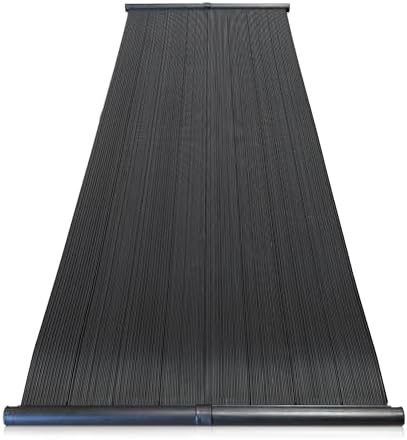
Pool owners replacing a worn out panel often need something that drops into existing plumbing, and the Highest Performing Design Universal is built for exactly that job. It is a 4 by 12 foot solar absorber panel with a round 2.0 inch inner diameter header manifold, designed to replace any panel that attaches with rubber hoses and hose clamps.
The listing pitches it at buyers who want both strong heating performance and long lasting durability, and it suits roof mounted arrays on in ground or larger above ground pools where a proper panel bank is already in place.
The absorber design is the core of the listing. It combines the best of loose tube and flat plate designs while omitting their flaws, according to the manufacturer, and the header is molded directly around the absorber tubes to remove flow barriers so water exits freely into each tube. Flexible zip joints sit every 6 inches across the surface and let the panel move along the joint as temperatures shift, which the listing says reduces stress between sections.
The catch is fit. This panel only works if your existing system uses rubber hoses and clamps on a round 2.0 inch header, so anyone with a different manifold size or a clamped pipe setup needs a different part. The 4 by 12 foot size also means roof space and mounting have to be worked out before ordering.
Buyers replacing a single failed panel in a compatible array should pick this one, while first time installers may want a complete kit instead.
9. Goplus 2.5FT X 10FT/ 20FT Solar Pool Heater for Above
Roll-up PE collectors handle -1°F to 194°F and heat up to 3408 gallons

Goplus x / Solar is a panel style collector kit rather than a blanket that floats on the water. The package holds two collector panels that connect together into a single array measuring 10 feet long and 2.5 feet wide. That size suits smaller above ground pools and inground pools where a rooftop or inclined frame install makes sense.
The listing says the array can heat up to 3408 gallons, so buyers should match it to their water volume before ordering. It is aimed at people who want an active solar loop with a pump pushing water through the panels.
Construction is built-to-last PE, and the listing states it keeps working from -20C up to 90C while withstanding rooftop conditions. The tube on web design is meant to expose as much water surface to the sun as possible and convert that into heat. No electricity or gas connection is needed, so the system runs on solar energy alone. A roll-up design lets the collectors be carried to the ground, an inclined frame or a roof.
The main limit is scale. Two panels at 2.5 by 10 feet cover a modest collector area, and the 3408 gallon figure is a ceiling, not a guarantee for every pool. Buyers with large pools or long swim seasons will likely want more collector area or a different approach.
The three month warranty is also short next to what many pool owners expect from gear that sits outside year round. Anyone heating a big inground pool should pick something else.
10. Gen2 Sol+Guard GeoBubble Solar Pool Cover – Graphene Enhanced 16
Round graphene blanket is over 20% lighter than a 20 mil cover and trims with scissors
GeoBubble 10′ from Sol+Guard Gen2 is a floating solar blanket for a 10 foot round pool, not a pump driven collector. Clear film lets sun energy pass into the water while the bubble cells trap warmth near the surface. It suits inground and above ground pools and works with chlorine and saltwater.
Owners who pull a cover on and off every day are the target here, since the listing stresses easier rolling, folding and lifting. The 10 foot round size trims with household scissors to fit.
Graphene nanoplatelets reinforce the polymer from within, and lab testing cited in the listing showed 51% higher puncture resistance and 24% higher tear resistance than a 20 mil Sol+Guard cover while using 20% less polymer. At 360 grams per square meter versus 460 for a 20 mil cover, it is over 20% lighter and less prone to fold marks.
The listing says it heats water up to 14 F and passes about 80% of the sun’s energy into the water. Evaporation blocking is over 98%, roughly 8,500 gallons a year on an average pool, and heating demand drops by up to 70%. Patented GeoBubble cells are 50% thicker at the weak point, and the cover carries an 8 year limited warranty.
No reel is included, and the cover arrives folded, so buyers need their own way to store and handle it. A blanket like this also depends on being deployed consistently, and it will not replace a collector array for serious heating. Pools larger than 10 feet round, or owners who want pump driven heat, should pick something else.
How We Picked
Each selection is based on the specifications provided for every heater alongside feedback from customer reviews. Advertising statements and promotional text play no part in our process.
For this category, we weighed the specifications that count most for pool owners. These include heater type, materials and build quality, coverage or sizing, installation requirements and any published performance numbers. We also assessed how each design suits varying pool configurations and climates.
Reviews from owners completed the remaining portion of the analysis. We recorded the recurring compliments, including simpler installation, improved heat retention or more solid construction. We likewise noted the complaints that kept appearing, such as fit problems, durability worries or warming that fell short of expectations.
Arranging the list served to address varied needs and price points rather than crown a single winner. We sorted the selections so that someone with a small above ground pool, a bigger inground pool or a limited budget can each locate a reasonable choice.
Frequently Asked Questions
What Makes a Solar Pool Heater Rated, and Why Does the Rating Matter to a Buyer?
A rated solar pool heater carries a manufacturer rating for flow rate, pressure and heat output under set conditions. We look at those ratings first because a pool system pushes a lot of water, and an unrated collector may not hold up. Ratings also let you compare collectors fairly instead of guessing from panel size alone. For a rated solar pool heater, the numbers should match your pump, your roof space and your climate.
We compare rated output against the pool volume and the collector area needed for your location. A high rating on paper still means little if the panel cannot take your filter pressure or fit your mounting surface. Owner feedback often shows that undersized collectors run constantly without warming the water much. Buyers should check the rating plate and the spec sheet before anything else.
What Decides the Running Cost of a Rated Solar Pool Heater?
The running cost of a rated solar pool heater comes mostly from the pump that moves water through the collectors. Solar panels themselves use no fuel, so the electricity bill reflects pump hours and pump efficiency. A larger collector array can add flow resistance, which may push the pump to work harder. We check the rated pressure drop and flow figures to see how much strain a collector adds.
Climate and usage also shape the running cost. Cloudy days and cooler nights mean the pump runs longer to reach the same water temperature. Owners who cover the pool at night commonly report the heater working less. We compare pump wattage and rated flow so buyers can estimate how many hours the system will realistically run in their area.
Can a Rated Solar Pool Heater Stay on Overnight or Run Unattended?
Most rated solar pool heater systems should not run overnight, because panels lose heat to the cool night air. Water passing through dark collectors after sunset can cool the pool instead of warming it. Controllers with a differential thermostat usually shut the pump off when panel temperature drops below pool temperature. We look for that sensor feature when comparing units.
Unattended operation is fine during the day if the system has freeze protection and a reliable controller. A rated solar pool heater on a roof can freeze in cold snaps, so drain down valves matter. Owners report that automatic controllers reduce the need to watch the system. We suggest checking the rating for freeze tolerance and confirming the controller handles startup and shutdown on its own.
How Much Wattage Does a Rated Solar Pool Heater Need for My Setup?
Solar pool collectors are usually rated in heat output rather than watts, but the pump side is where wattage matters. The pump must deliver enough flow to match the rated flow of the collector array. We compare collector rated flow against pump curves to find a match. A pump that is too small starves the panels, and one that is too large wastes power.
For a rated solar pool heater, the panel area should roughly match the pool surface, and the pump wattage should suit that area. We check the rated pressure drop of the collectors and the pump head at the required flow. Owner feedback shows that matching these figures keeps the system efficient. Buyers should size the pump from the collector rating, not from guesswork.
Is a Rated Solar Pool Heater Noisy, and Where Does the Sound Come From?
The collectors on a rated solar pool heater are silent, since they have no moving parts. Noise comes from the pump and from water moving through the panels and plumbing. Air trapped in the collectors can cause gurgling and hammering sounds. We check reviews for priming issues, because trapped air is a common complaint.
Pump noise depends on the model and how it is mounted. A variable speed pump running at lower flow is usually quieter than a single speed unit. For a rated solar pool heater, we compare rated flow against pump speed to see how hard the pump will work. Owners commonly report that proper priming and secure mounting cut most of the noise.
How Safe is a Rated Solar Pool Heater Around Children and Pets?
Panels on a roof are out of reach, but the plumbing and pump area are where children and pets can get hurt. A rated solar pool heater can send hot water through exposed pipes, and surface temperatures on dark collectors get high. We look for covers, secure mounting and insulated lines when comparing systems. Sharp edges and loose fittings are the risks owners mention most.
Electrical safety matters too, since the pump runs on mains power near water. A rated solar pool heater should be wired with proper grounding and protection. We check whether the controller and pump carry the relevant safety certification. Buyers with pets should keep the equipment pad fenced and check that no cables lie where animals can chew them.
Final Thoughts
After comparing specifications, owner feedback and expert research, our pick for the best rated solar pool heater is Highest Performing Design. Its data shows strong heat output for the size, which suits most above ground pools. For larger setups or longer runs, Industrial Grade Solar Pool offers heavier construction that owners commonly describe as durable.
Budget conscious buyers with small pools may prefer Swimming Pool Heater, which keeps the setup simple. Match the collector area to your pool volume before buying, since undersized panels are the most common reason owners report weak heating.