Propane heaters produce water vapour as they burn, roughly a litre for every hour of running, which is why ventilation matters as much as heat output. Indoor models are built around that trade-off, balancing warmth with safe air flow.
A spare room, a garage conversion or a home office gets used in short bursts, so the heater has to fire up fast, run quietly and shut down cleanly. Matching output to room size is how we narrowed down the best portable indoor propane heater for those routines.
Shoppers first ask whether a unit is safe to run indoors, and our comparison answers that through clearance ratings, low-oxygen shutoff and tip-over protection.
Top 3 Picks for Best Portable Indoor Propane Heater


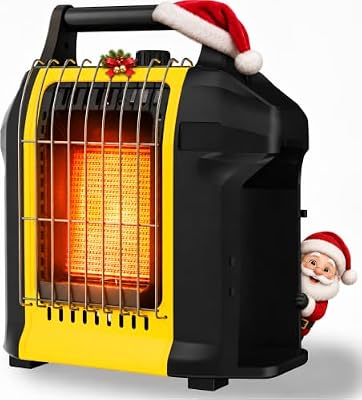
How to Choose the Best Portable Indoor Propane Heater
To pick an indoor propane heater, first match the unit to the room and its occupants. How quickly a space heats up, how evenly warmth distributes, and how much headroom remains on a household circuit all depend on heat type, output, and safety features. Our shortlist came from weighing product data, owner feedback, and expert research.
Heat Type and the Rooms It Suits
Ceramic fan units deliver warm air fast, making them a fit for small rooms needing quick, targeted heat. Infrared models heat people and objects directly, a good match for drafty or partially open areas. Oil-filled heaters give off steady, quiet warmth in bedrooms and living areas. Convection heaters move air gently through a room, providing even background heat in enclosed spaces.
Wattage and Room Size
Output has to fit the space, or the heater runs nonstop without warming it. Lower-output units usually work for small rooms, while bigger or open-plan areas require more heat to keep pace. A standard household circuit has a fixed capacity, so verify the heater’s draw against that circuit before plugging in. Other appliances on the same circuit reduce what’s available for heating.
Safety Cut-Offs, Thermostat and Timer
With indoor propane use, safety features are essential rather than optional. Seek out tip-over shut-off, oxygen depletion sensors, and overheat protection, as these address the chief dangers of portable propane heat. A thermostat keeps the room at a chosen temperature and conserves fuel, and a timer lets you limit run time. These features carried heavy weight in our picks, since owners repeatedly say they matter most day to day.
Quick Comparison
Our Picks, Reviewed One by One
Our Top Pick
1. Mr. Heater 9
Midnight Series offers high-efficiency radiant tiles and a reinforced wire guard for durability

Mr. Heater 9 is a radiant propane unit built for spot heating rather than whole room warmth, and that shapes where it works well. The listing says it is designed and approved for indoor and outdoor use, with indoor use not approved in Canada or Massachusetts, so buyers in those places need to check local rules before relying on it inside.
It suits a garage workspace, a cabin room, a workshop bench or a campsite where one person wants heat aimed at them rather than the whole space. The 225 sq. ft.
What we found most useful in the listed specs is the choice between 4,000 and 9,000 BTU, which lets a buyer run a gentler setting in a smaller room and a stronger one when the cold bites. The high-efficiency radiant tiles are the core of that performance, sending warmth in one direction instead of relying on a fan.
Runtime is stated as up to 5.4 hours on a 1 lb propane tank, and up to 108 hours when connected to a 20 lb cylinder with an optional Buddy hose and fuel filter.
The trade-off is fuel and ventilation. A 1 lb tank gives only a few hours at the low setting, so anyone planning long sessions will need the hose and filter setup for a 20 lb cylinder, and any fuel-burning heater indoors needs a safe space and attention to the manufacturer’s instructions. Buyers who want even, room-wide warmth or who live where indoor use is not approved should look at a different type of heater instead.
2. Mr. Heater 9
Red model includes an emergency low oxygen safety system and two temperature settings

Built around a red steel body and a radiant face, Mr. Heater 9 is the straightforward version of a propane spot heater for a shed, a fishing shelter or a small cabin room. The listing describes it as designed and approved for indoor and outdoor use and rated to heat up to approximately 225 square feet, which fits a single room or a work area rather than an open plan.
It suits a buyer who wants one simple unit with two settings and no electricity needed. The low and high temperature settings are the whole control scheme, so there is nothing to program.
Safety is where the listed features carry the most weight for indoor use. The emergency low oxygen safety system is designed to shut the unit down if oxygen drops, and the construction uses self-extinguishing materials, both of which matter in a closed room. Output is stated at 4,000 or 9,000 BTU per hour, and runtime is listed as 5.4 hours on low and 2.4 hours on high with a 1 lb propane cylinder.
Those figures tell a buyer plainly how often a small tank needs changing, and the 7.1 pound weight keeps it easy to carry.
The limit is that a 1 lb cylinder gives only a couple of hours on high, so this unit is not built for all-night running without a larger fuel supply. The single low oxygen system is a backstop, not a substitute for following the manual and leaving some ventilation. Anyone heating a large room, or wanting a thermostat and timer, should choose a different model.
3. Karveden Portable Propane Heater, 9000 BTU Indoor Outdoor Heater with Tip-Over Protection
Karveden features a three-position knob and built-in anti-tipping protection for worry-free use
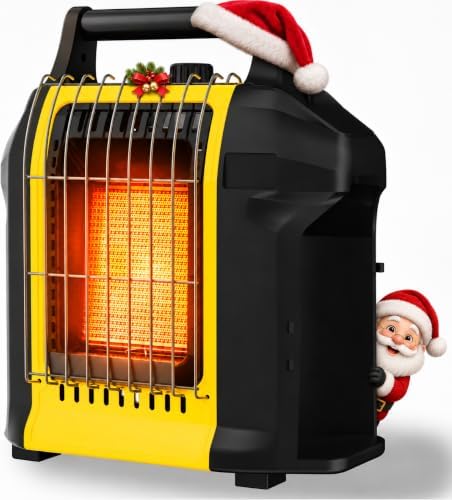
We researched the Karveden Portable Propane Heater as a compact radiant unit intended for small spaces and fast warmth. Its listing describes a lightweight body with an integrated handle and a wide fixed bracket, so it can move between a garage, a workshop, a tent, or a small indoor room.
The rated coverage of up to 225 square feet points to a one-room job rather than an open floor plan, and the cordless design suits campers, RV owners, and patio users.
Radiant output adjusts from 5,000 to 9,000 BTU through a three-position knob with PI ignition, LO, and HI settings, and the listing states a 3-second rapid heat start for warming a small zone quickly. A built-in anti-tipping system shuts off the gas and extinguishes the flame if the unit is tipped or bumped, and it can be relit after an accidental trigger.
It runs on a 1-pound propane cylinder, which the data lists at about 3.5 hours on low and 2.5 hours on high.
The trade-off follows from that fuel and coverage data: a 1-pound tank yields only a few hours, and 225 square feet is a modest ceiling, so a larger room or a long cold night will outlast it. Buyers heating a big space or wanting all-night warmth should pick a higher BTU unit that accepts a 20-pound tank.
4. Mr. Heater 18
Big Buddy delivers up to 18,000 BTU and a high-powered fan to circulate warmth across 450 sq ft
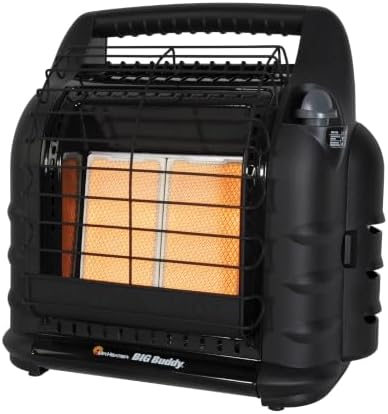
By design, Mr. Heater 18 is a higher output radiant heater aimed at bigger rooms and cold-weather backup. Its 18,000 BTU top setting and 450 square foot rating push it past small-space units, so it suits a large garage, a cabin main room, or a job site shelter. The listing approves it for indoor and outdoor use, though indoor use is not approved in Canada or Massachusetts, so buyers there need to check local rules first.
Three output levels, 4,000, 9,000, and 18,000 BTU, let the user match heat to the space, and a built-in high-powered fan helps move that warmth around the room. Electronic ignition gives a push-button start, which is simpler than a match or piezo setup. It runs on two 1 pound cylinders or a 20 pound tank with an optional Buddy hose and fuel filter, and the listing claims up to 96 hours on low with the 20 pound tank.
That long runtime depends on the hose and filter, which are sold separately, and the 14 pound body is heavier to carry than smaller units. Buyers who want a light, grab-and-go heater for a tent should pick a smaller model instead.
5. DECOKTOOL 9,000 BTU Portable Propane Heater with ODS & Tip-Over Protection
DECOKTOOL 9 heats in just 2 seconds with a radiant PTC ceramic panel and protective front grille

DECOKTOOL 9 is a compact radiant propane heater built for tight spaces and short heating sessions. Its 225 square foot coverage suits garages, patios, yards, camping tents and ice fishing shelters where a full size cabinet heater would be overkill. The carry handle and space-saving body make it easy to move from the truck to the bench and back again. Our research shows buyers who want quick spot warmth rather than whole room heating are the right audience here.
Two output settings let you dial between 4,000 and 9,000 BTU, and the listing puts runtime at roughly 2.5 to 3.5 hours on a standard 1 lb cylinder. A radiant PTC ceramic panel is claimed to deliver noticeable warmth in as little as 2 seconds, which matters when you are working with gloves on.
Safety is covered by an oxygen depletion sensor, a tip-over switch and flame-out protection, plus a front grille that guards against accidental contact with the hot panel. The compact body stores easily between uses.
The clear limit is fuel. A 1 lb cylinder gives you only a few hours of heat, so long sessions mean carrying spares or stepping up to a heater that accepts a 20 lb tank. Anyone planning to heat a garage for a full workday should look at a larger cabinet style unit instead. DECOKTOOL 9 fits the buyer who wants a small, safety loaded heater for short bursts of warmth.
6. Jocoevol Propane Heater Outdoor 18000 BTU Portable Tank Heater Cordless
Jocoevol runs under 30 db and moves on five durable casters, two with brakes for stability

Jocoevol Propane Heater Outdoor is a cabinet-style radiant heater built for larger spaces and longer sessions. Its 450 square foot rating covers garages, workshops, patios and big camping setups that a small tank heater cannot reach. The cabinet shape and caster base point to a unit that stays in one place for hours rather than moving with you, and owners heating a whole bay or a busy patio are the target user.
Our research compared the listing’s three heat modes at 6,000, 12,000 and 18,000 BTU, selected with a gas knob, and the standard 20 lb propane cylinder connection that supports extended runtime in a garage or yard. Three safety layers are stated: low oxygen protection, tip-over protection and flameout protection.
Five casters, two of them braked, keep the unit stable in use and easy to roll away afterward, and noise is listed under 30 db so conversation and reading stay comfortable. Owner feedback commonly points to the casters and the quiet operation as the details that matter day to day.
The trade-off is weight and footprint: at 18 pounds and 23 inches tall, this is not a heater you toss in a backpack, and it needs a 20 lb tank that is not included. Buyers who want something to carry to a hunting blind or a small tent should pick a lighter 1 lb cylinder model instead. Jocoevol Propane Heater Outdoor suits the user who wants serious output in a fixed spot like a garage or patio.
7. DECOKTOOL 18,000 BTU Portable Propane Heater with ODS & Tip-Over Protection
DECOKTOOL 18 offers three heat settings and a radiant PTC ceramic panel for fast warmth
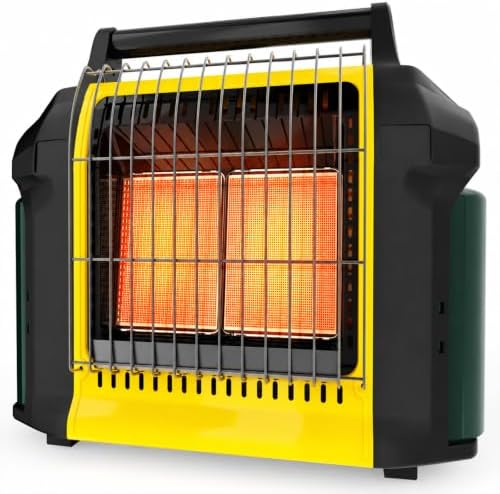
Compact radiant heater DECOKTOOL 18 is built around a PTC ceramic panel, and its size and handle make it easy to move between a garage, a yard or a camping setup. The three heat settings let one unit cover small jobs and larger spaces, with output that reaches up to 18,000 BTU and coverage listed at up to 450 square feet.
Runtime is quoted at roughly 5 to 7 hours, which suits an evening in a workshop or a few hours on a patio. For a buyer who wants warmth that arrives quickly without a long wait, the two second heat up is the headline claim.
Safety features matter most for anyone heating an enclosed or semi enclosed space, and this model lists several. A tip over switch cuts the unit off if it gets knocked, flame out protection stops the gas supply, and an oxygen depletion sensor shuts things down when oxygen runs low.
A protective front grille guards against accidental contact with the hot panel. It runs on standard 1 lb propane cylinders, so there is no cord and no outlet needed, though the tank itself is not included.
The trade off is the small cylinder format. Standard 1 lb tanks keep the unit light and simple to carry, but they limit runtime compared with a larger tank and mean more frequent changes during long sessions. Anyone planning to heat a space for many hours at a stretch, or who wants to avoid swapping cylinders often, should look at a model that accepts a 20 lb tank instead.
8. WELLUCK Propane Heater Indoor Outdoor with ODS & Tip-Over Protection
WELLUCK Grey folds to 15CM thin and runs up to 69 hours on a 20 lb tank
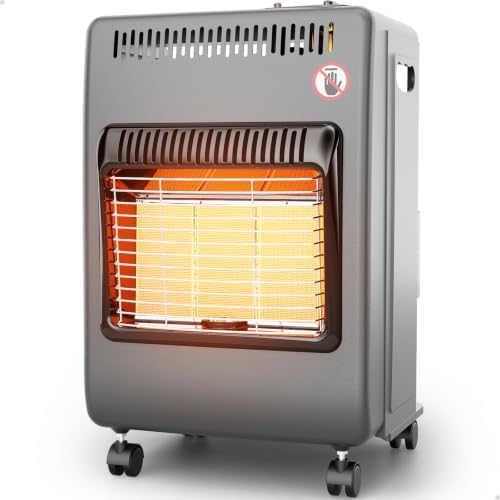
WELLUCK Propane Heater Indoor is a cabinet style unit on four swivel casters, two with locking brakes, so it can be rolled from a garage to a patio and parked where the heat is needed. It folds down to only 15cm thin, which makes it practical to store against a wall, under a table or in a closet between uses.
Buyers heating a workshop, shed, RV or construction site get a unit that moves with the job rather than sitting in one spot. The powder coated finish is listed as corrosion resistant for indoor and outdoor use.
The ignition sequence is the detail we rate highly here. A dedicated ignition setting purges air before lighting, which the listing says prevents dangerous flare ups, and there are three heat settings at 6,000, 12,000 and 18,000 BTU. No electricity is needed, since it connects to a standard 20 lb propane tank with a QCC hose and built in regulator, and runtime reaches up to 69 hours on the low setting.
An oxygen depletion sensor and tip over protection round out the safety package, and a front mesh guard keeps hands off the panel.
The catch is the 20 lb tank requirement. That cylinder delivers the long runtime but adds bulk and weight that the casters have to handle, and the hose must be disconnected before folding, so packing it away is a two step job. A buyer who wants a truly grab and go unit for short trips should consider a smaller cylinder model instead.
9. WELLUCK Propane Heater Indoor Outdoor with ODS & Tip-Over Protection
Black WELLUCK model includes a front protective mesh guard and four swivel casters for mobility

Cabinet-style radiant unit WELLUCK Propane Heater Black is aimed at garages, workshops, sheds and job sites where a power cord is not an option. Its 18,000 BTU top end gives it more muscle than most small radiant heaters, so it can carry a drafty workspace or a porch that never quite warms up.
Buyers who need heat during outages or on construction sites tend to gravitate toward this format because it runs straight off a standard 20 lb tank with the QCC hose and built-in regulator. The cabinet shape also keeps the hot panel behind a front mesh guard, which matters in rooms where people walk past the unit.
What we found most useful in the listing is the ignition sequence. A dedicated IGNITION setting purges air before the burner lights, which is designed to prevent the flare-ups that can happen on a cold start. Three settings let you step down to 6,000 or 12,000 BTU instead of blasting full output, and on low the unit is rated for up to 69 hours on one tank.
Safety hardware includes tip-over shutdown and an oxygen depletion sensor, both of which cut the gas if conditions turn bad. Four casters, two with locking brakes, plus a fold to 15CM thin, make storage against a wall or under a table realistic.
The catch is ventilation. The listing calls for outdoor or well-ventilated indoor use only, so this is not a sealed-bedroom solution, and the 20 lb tank it needs is bulky to haul around. Anyone wanting a heater for a small closed room or a tent should look at a smaller tank-top radiant model instead.
10. Mr. Heater 3
Little Buddy directs warmth at a 45° angle and runs 5.6 hours on a single 1 lb tank
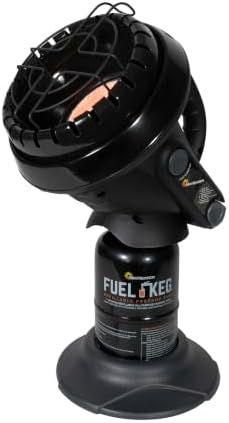
Going by the details, Mr. Heater 3 is a small radiant heater that screws onto a 1 lb propane cylinder and throws heat in one direction rather than trying to warm a whole house. Its 3,800 BTU output is rated for spaces up to 95 sq. ft., which puts it in range for a hunting blind, a job-site trailer, a camping tent or emergency backup heat in a single room.
The 45 degree heating angle lets you tilt the radiant tiles toward where you are sitting, so the warmth lands on people instead of drifting to the ceiling.
Owners commonly report that the directional radiant heat feels faster than the room’s air temperature suggests, because it warms surfaces and bodies directly. The listing puts runtime at up to 5.6 hours on a single 1 lb tank, which is short but predictable, and swapping tanks takes seconds.
No electricity is needed at any point, so a power outage does not affect it. A reinforced wire guard surrounds the hot tiles, and the easy grip handle makes it simple to move without touching metal that has been running. Indoor use is approved, though not in Canada or Massachusetts.
The trade-off is coverage and tank life. Under 4,000 BTU will not hold a large garage or an open workshop once temperatures drop hard, and 5.6 hours means you will be changing cylinders often on longer nights. Buyers heating a big, drafty space should step up to a higher-output cabinet unit or one that accepts a 20 lb tank.
How We Picked
To build this list, we examined the specifications provided for each heater and analyzed feedback left by customers in their reviews. Advertising language and marketing materials played no part in our process.
Within this category, we weighed the features that matter most to shoppers. These include heat output, the safety options each model lists, dimensions and weight as they affect portability, plus the way each unit receives power and handles ventilation.
Patterns emerged clearly from owner reviews. Positive comments frequently mention rapid heating, simple assembly and solid value for smaller areas. Repeated complaints tend to focus on smell, operating noise and safety worries in confined rooms.
The list is arranged to address varied requirements and price points. Certain shoppers need a small model for a compact room, while others require greater output for a bigger area. By combining economical choices with higher-output units, our list offers readers a jumping-off point suited to many different circumstances.
Frequently Asked Questions
What Decides the Running Cost of a Portable Indoor Propane Heater?
Running cost for a portable indoor propane heater comes down to two things. First is the burn rate of the unit, which is usually given in Btu per hour. Second is what you pay for the propane itself, either per pound in a small cylinder or per gallon in a refillable tank. A higher Btu output burns fuel faster, so a unit sized right for the room usually costs less to run than an oversized one cycling on and off.
For our buying guide we compared published burn rates and tank sizes rather than quoting money figures, because fuel prices vary by region and season. Owners commonly report that small cylinders run out quickly under continuous use, so many keep a spare on hand.
Can a Portable Indoor Propane Heater Stay on Overnight or Unattended?
We treat overnight and unattended use as a safety question first. Propane heaters produce carbon monoxide, so any unit used indoors needs a low oxygen shutoff and a tip over switch, and the room needs some ventilation. Manufacturers commonly advise against sleeping with a heater running, and we pass that guidance along rather than encouraging it. A working carbon monoxide alarm in the same room is essential gear for anyone heating indoors with propane.
Our research compared shutoff features across the models in our guide, since those features matter most when attention drifts. Units with an oxygen depletion sensor and an automatic tip over cutoff give you a margin of safety that bare models do not. If you need heat through the night, look at the manufacturer’s instructions for your specific model before you rely on it.
What Wattage or Btu Output Do I Need from a Portable Indoor Propane Heater for the Room I Am Heating?
Portable propane heaters are rated in Btu per hour rather than watts, though the two convert roughly. For a portable indoor propane heater, the usual advice is about 20 Btu per square foot of floor space in a reasonably insulated room, with more output for poor insulation or very cold conditions. A small bedroom needs far less than an open plan living area, so measure the space before you shop.
We compared the published Btu ratings and the square footage each manufacturer claims to heat, then looked at what owners say about real rooms. Owners often report that a unit rated for a larger space heats a small room quickly, which can mean more cycling and more fuel use. Sizing slightly under the maximum is usually the smarter fit for a single room.
How Noisy is a Portable Indoor Propane Heater in a Bedroom or Office?
Noise from a portable indoor propane heater depends on the design. Radiant and convection units with no fan are essentially silent apart from a faint gas hiss, which suits a bedroom or a quiet office. Fan forced models add airflow noise, and that is the part owners mention most often in feedback about sleeping or working near the unit.
We compared the design of each model in our guide and noted which ones use a fan, since that is the main noise source. Owner feedback commonly describes fan models as noticeable in a quiet room but easy to tune out in a living space. For a bedroom, a fanless radiant unit is the calmer choice. For a workshop or a room where background sound already exists, a fan model spreads heat faster and the noise matters less.
What Safety Features Should I Look for in a Portable Indoor Propane Heater Around Children and Pets?
Safety around children and pets starts with heat. The front grille and body of a radiant portable indoor propane heater get very hot, so a guard or a barrier and strict clearance from play areas matter. Look for a tip over shutoff, which cuts the gas if the unit is knocked, and a low oxygen sensor. Both are standard on the models we shortlisted, but check each listing because not every unit includes them.
We compared the safety listings for every heater in our guide and flagged the ones with an oxygen depletion sensor and an automatic shutoff. Owners with pets commonly report that cats and dogs brush against warm surfaces, so keeping the unit out of traffic paths is the practical step. Place it on a stable, level surface away from bedding and curtains.
Can I Run a Portable Indoor Propane Heater from an Extension Cord or Power Strip?
Most portable propane heaters do not plug in at all, because the heat comes from burning propane. Some models add a small electric fan or a spark ignition, and those draw very little power. For a portable indoor propane heater, the cord question usually applies to that fan or ignition circuit, not to the heating itself. Read the listing to see whether your model needs an outlet.
Where a heater does need power, we compared the electrical requirements in the manuals and the advice is the same as for any appliance. Use a heavy gauge extension cord rated for the load, keep it short, and never daisy chain power strips. Owners commonly report tripped circuits when a heater shares a strip with other devices.
Final Thoughts
After comparing product data, owner feedback and expert research, we picked the Mr. Heater 9 as the best portable indoor propane heater for most buyers. It balances a practical heat output with safety features that suit indoor rooms, and owners commonly report it runs reliably. Smaller spaces may favour the Karveden Portable Propane Heater, which covers basic heating needs without extra capacity.
For larger rooms or longer run times, the Mr. Heater 18 offers more output from the same trusted design. Buyers who want the lowest upfront cost can look at the DECOKTOOL 9 instead.
Whatever you choose, match the heater’s output to your room size and check the safety features before buying. A slightly larger unit running gently usually beats a small one working flat out.