A greenhouse without reliable heat loses more than warmth. Seedlings stall, tender plants die overnight, and the money spent on seeds, pots and effort quietly disappears. Cold snaps do not wait for a convenient moment.
Small growers, allotment keepers and backyard gardeners often run a single unheated greenhouse through winter. Without the right unit, damp air and frost damage set in fast. Our guide points you to the best solar powered greenhouse heater for that job.
Each pick is matched to a room, a user or a job. We compared heat output, panel wattage, thermostat control, build quality and how owners report performance in cold weather. Safety features and running costs also shaped our shortlist.
Top 3 Picks for Best Solar Powered Greenhouse Heater


How to Choose the Best Solar Powered Greenhouse Heater
Choosing well starts with the greenhouse itself. Glazing loses heat fast after sunset, so the heater has to recover it without a mains cable. We compared product data and owner feedback on powered greenhouse heater options and picked models by heat type, wattage, circuit load and safety controls. Fit to your structure and panel capacity decides more than headline power.
Heat Type and the Space It Suits
Ceramic fan heaters warm air quickly and move it around, which suits small glasshouses and cold frames. Oil filled units release heat slowly and stay warm after the panel stops feeding them, a good match for steady overnight protection. Infrared warms plants and pots directly rather than the air, useful in open or draughty frames. Convection heaters rely on rising air and work best in taller, well sealed greenhouses.
Wattage and Room Size
Match wattage to volume, not floor area alone, because a tall greenhouse holds more cold air. Small frames of a few square metres usually run on low power, while larger greenhouses need stronger output and often two units. Check the household circuit too, since a single circuit can carry only so many amps. Add the heater to other loads before deciding.
Safety Cut-Offs, Thermostat and Timer
Greenhouses are damp, so look for a tip over cut-off and an overheat shutoff on every unit we cover. A thermostat keeps temperatures steady through cold nights and stops the heater running flat out. Timers help ration stored solar power, running the heater only in the coldest hours. Digital controls on some models make both easier to set.
Quick Comparison
In-Depth Reviews
Our Top Pick
1. Tixorelin Solar Panel Heater Kit, 30W Portable Greenhouse Heater
Compact 30W solar blower moves warm air into greenhouse corners and camping setups
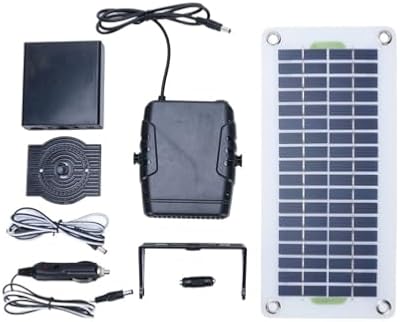
Tixorelin Solar Panel Heater is a compact solar blower heater kit built for small, off grid spots where running a cord is awkward. It suits greenhouse corners, sheds, camping setups, pet shelters and young plant starting spaces that need targeted warm air rather than whole room heat. The kit pairs a 30W monocrystalline panel with an included cell box, so it can be moved between spots and stored without much fuss.
At roughly 1.1 pounds and under a foot long, it fits into tight spaces where a full size heater would not.
Our research on this listing points to the panel and the safety side as the details that matter most. The 30W crystalline silicon panel captures sunlight to help deliver heat while cutting dependence on corded charging, which is the whole point of going solar. Built in heat control helps prevent overheating during operation, supporting steadier warmth as indoor and outdoor conditions shift.
The included cell box supports basic charging and bendable placement, and the blower design pushes warm airflow where you aim it, including pet houses and drying tasks.
The clear limit is scale. A 30W panel and compact blower are made for small, targeted areas, not for holding a full greenhouse at temperature through a hard freeze. Output also depends on sunlight, so grey winter weeks will ask more of the battery box. Growers heating a large or poorly insulated greenhouse should pick something else, and anyone wanting app control or a thermostat range will need a different unit.
2. Lesotc 1500W PTC Smart Greenhouse Heater | WiFi App Control
WiFi app control and 41-95°F thermostat adjust warmth remotely for plant rooms

Our team researched the Lesotc 1500W PTC Smart as a mains powered greenhouse heater built for enclosed indoor growing spaces up to 150 square feet. Plant rooms, home greenhouses and seedling shelves are the natural fit, especially where winter chill and sudden temperature drops threaten vegetables, flowers and tropical plants.
The 1500W PTC heating system is designed to take the edge off cold snaps rather than heat an open garden, and a carry handle plus a small footprint make it easy to reposition between growing areas.
Several listed features matter for a greenhouse owner who needs reliable backup heat. WiFi app control through the Smart Life app on a 2.4GHz network lets you check and adjust settings from your phone, including temperature, mode, timer and oscillation. The 41 to 95F range with monitoring mode tracks surrounding temperature and adjusts operation automatically for more consistent warmth.
Oscillation spreads airflow across multiple rows of plants, fan only mode keeps air moving, and tip over plus overheat protection add a safety layer, with a 112 hour auto off timer supporting planned operation.
The trade-off is that this unit runs on mains power, so it is not a solar heater and will not work off a panel kit alone. It also suits enclosed spaces up to 150 square feet, so a large or drafty greenhouse will overwhelm it. Buyers who want true off grid warmth should look at a panel based kit instead, while anyone heating a bigger structure needs a more powerful unit.
3. Solar Heater for Greenhouse & Chicken Coop,30W Solar Pet House Heater,1Set
Battery box stores daytime solar energy to keep coops and hutches warm overnight

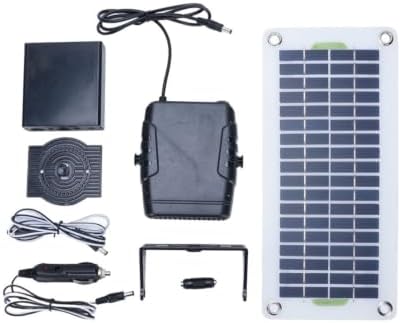
We researched this listing as part of our look at off-grid warming options for small animal shelters and growing spaces. Solar Heater is a complete kit built around a 30W blue solar panel, a compact heating fan, and a battery box, and it suits backyard chicken coops, rabbit hutches, outdoor dog houses, and small greenhouses where running mains power is awkward or impossible.
The idea is simple. The panel gathers daylight, the battery box stores it, and the fan pushes warmth into the shelter after dark.
What matters most here is the panel size. At 43.5 x 20 cm, the 30W panel is the engine of the whole setup, and its output depends entirely on how much direct sun it receives. The included battery box, measuring 8.5 x 7.5 x 2.7 cm, takes three batteries so the fan can keep running through dark nights, and owners commonly report that this storage is what makes the kit useful after sunset.
The heater body itself is small at 12.5 x 12 x 3.8 cm, which lets it slot into cramped coops and sheds without crowding the animals.
The real limit is the sun. On short winter days or in a shaded garden, the panel collects little, and the batteries can only carry what was stored. Owners in cloudy climates should expect patchy warmth rather than steady heat. Anyone heating a large greenhouse or a big coop should look at a mains-powered unit instead.
4. Solar Heater for Chicken Coop, Solar Pet House Heater for Winter
Lightweight plastic heater fits compact shelters and runs off a 30W solar panel

On paper, We researched the Solar Heater Coop as an off-grid warming option for backyard animal shelters, and it pairs a 30W solar panel with a compact heating unit. It is built for chicken coops, small dog houses, garden sheds, and small greenhouses where running a mains connection is not practical. Because the setup is solar by design, placing the panel where it catches daylight matters as much as placing the heater near the animals.
Our comparison of the listing data points to three details that matter most. The blue panel measures 43.5 x 20 cm and collects daylight for the heating system, while the 8.5 x 7.5 x 2.7 cm battery box holds three batteries to help support operation when sunlight is reduced.
The lightweight plastic heater body measures roughly 12.5 x 12 x 3.8 cm, small enough for compact shelters, and overheat protection is built in to help manage heat during operation in a small enclosed space. Owners commonly report that the unit provides supplemental warmth rather than room-level heat.
The trade-off follows from the product data: performance depends on available sunlight, so in a shady run or through a stretch of grey days the stored energy drains and warmth fades. Buyers who need guaranteed heat through a hard freeze should pick a mains-powered heater instead.
5. 60W Solar Powered Space Heater with Dual USB and Battery Compartment
Ultralight 400g build with dual USB ports charges phones while heating off-grid spaces

A compact off-grid heating kit is what this 60W Solar Powered Space amounts to, and it suits growers and smallholders who want warmth in a greenhouse, shed or pet shelter where mains power is not an option. The kit pairs a solar panel with a heater and a battery compartment, so it can run during daylight and hold charge for cloudy spells or night use.
We looked at the listed specs and owner feedback for greenhouse setups, where the appeal is simple installation and no wiring run out to a remote structure. The 400g build and 100cm flexible cable mean it can be hung near plants or repositioned as needed.
Its 60W monocrystalline panel is the core of the design, capturing sunlight to deliver heating away from the grid. The battery compartment accepts three lithium batteries, which are not included, to reserve energy for overcast days or overnight. Dual 5V USB ports let you charge a phone, earbuds or a radio while the unit heats, and the waterproof DC connector plus sealed interfaces are meant to resist dust and moisture in damp greenhouse air.
A preassembled kit means the panel, compartment, heater and cables arrive ready, with no tools or complicated wiring required.
The main trade-off is that the batteries are not supplied, so the reserve for cloudy days or night heating depends on buying three lithium cells yourself. Output also relies on decent sun exposure, which matters in a shaded greenhouse during deep winter. Buyers who need steady, thermostat-controlled heat through a cold snap should look at a mains-powered panel heater instead.
6. TIMEBAL 2026 Chicken Coop Heater, 200W UL Certified Radiant Panel
UL certified radiant panel with remote temperature adjustment and memory after outages
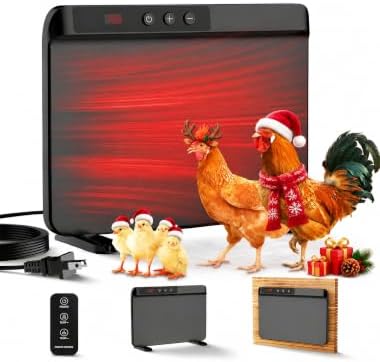
Radiant panel heating is the approach behind the TIMEBAL 2026 Chicken Coop, a mains-powered unit aimed at poultry keepers and small animal owners who need reliable warmth inside a coop through winter. The flat panel design needs no bulbs or tubes to replace, and it simply plugs in to warm chickens, cats, dogs, ducks or other animals.
We compared the listed features against what owners of coops and similar shelters tend to need, namely safe heat, easy control and protection against tipping. Flexible installation options let it be mounted in different positions inside the structure.
A 200W radiant design provides stable, gentle heat without overheating, and the unit is UL certified for zero-clearance installation, which reduces the clearance needed around it. The LED digital display shows the current temperature, and the remote control lets you adjust settings without stepping into a narrow coop, across a range of 122 to 158 degrees Fahrenheit.
Memory function keeps your temperature, mode and power-on state after shutdown or an outage, and the anti-tilt design cuts power if the panel reaches 45 degrees. The heater is also compatible with outlet timers and thermostatic plugs, which are not included.
The catch is that this unit needs mains power, so it will not help in a coop far from an outlet, and the timer and thermostatic plug accessories are sold separately. It also draws 200W continuously when running, which matters if the coop is on a limited circuit. Keepers who want a fully off-grid setup should look at a solar option instead.
7. TSJKPAYL Solar Light & Thermometer Hygrometer Set | 3 Color
Separate wireless thermometer and hygrometer pair with a dimmable solar hanging lamp
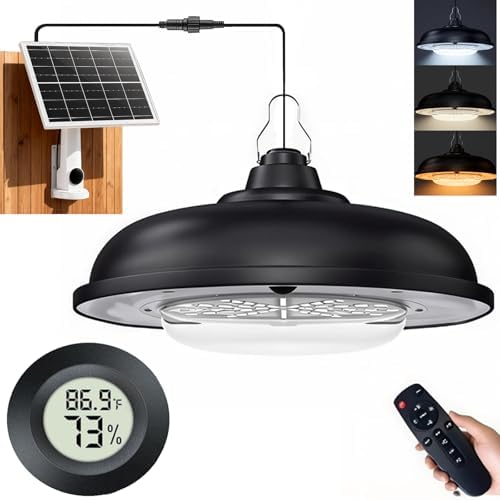
TSJKPAYL Solar Light & Thermometer is a two part kit that pairs a hanging LED solar lamp with a separate wireless thermometer and hygrometer. It suits greenhouse growers who want to read temperature and humidity at plant level without running cables, and it also works in sheds, coops, gazebos and garages.
The split design is the point here, because the sensor can sit on a potting bench or among seedlings while the lamp hangs overhead. For a solar setup in a greenhouse, that separation matters more than raw brightness, since cold spots and damp pockets rarely sit where a lamp is mounted.
Charging happens through the solar panel all day, and the light runs automatically from dusk to dawn for up to 12 hours. Three color modes cover bright white at 6000K for chores and security, warm white at 3000K for a softer glow, and soft amber for night time use that is less disruptive to plants. The monitor shows Fahrenheit and relative humidity on a clear LCD, and the IP65 rating means the housing handles wet greenhouse air and rain.
The main limit is that this is a monitoring and lighting kit, not a heat source, so it tells you when conditions drop but cannot warm the space. Runtime also depends on how much sun the panel gets, which is a real consideration in a shaded or northern greenhouse during winter. Anyone who needs actual heat for cold sensitive plants should pick a powered heater instead, and treat this as the sensor and light layer of a solar greenhouse setup.
8. Lesotc Smart Greenhouse Heater for Plants Vegetable, 1500W WiFi Thermostat
App temperature alerts and 70° airflow cover up to 150 sq. ft. of plants

Plant protection rather than room comfort is the focus of lesotc Smart Greenhouse Heater, a mains powered fan heater. It suits greenhouse, grow tent, garage and flower room growers who want to hold a steady temperature and keep an eye on it from a phone. The 1500W PTC ceramic element is rated for spaces up to 150 square feet, which fits a small to mid sized greenhouse or a shelving run in a grow tent.
For a solar greenhouse setup, the useful role is as the backup heat source that kicks in on cold nights when the sun has done all it can.
The thermostat adjusts from 41 to 113 degrees Fahrenheit, and the built in display shows current conditions so you can match the setting to what your seedlings or vegetables need. WiFi app control lets you check temperature remotely and adjust it, and high and low temperature alerts warn you when conditions move outside your chosen range.
A 70 degree oscillating design spreads warm air across shelves, a 24 hour timer handles colder nighttime periods, and a fan only mode keeps air moving in warmer months.
The obvious trade off is that this heater needs mains power, so it is not a standalone off grid solution and will not run from a solar panel alone. It also draws a serious 1500W when heating, which matters if your greenhouse power comes from a battery bank. Growers with no reliable electricity should look at passive solar options instead, while anyone with power who wants remote monitoring and alerts will find this fits the job.
9. Fanspex 1500W Integrated Digital Thermostat Heater for Greenhouse Garage
Instant PTC heat with a 24-hour timer and remote suits grow tents and garages

At first glance, We researched the Fanspex 1500W Integrated Digital as a compact portable heater for greenhouse and grow tent use, and it suits growers who need targeted warmth in a small space without sacrificing floor area. The listing recommends one unit for a maximum of 120 square feet, which points to small greenhouses, single grow tents, flower rooms and sheltered patios rather than large open structures.
Its space-saving form factor is meant to fit easily inside a tent or greenhouse, and at 4.3 pounds it can be carried wherever the heat is needed.
What matters most in the listing is the 1500 watts of heating power delivered through a built-in PTC heating module, which is stated to provide a large volume of hot air instantly. The integrated digital thermostat allows precise temperature control, and the three modes cover high heat, low heat and fan only.
A 24 hour timer with remote control adds convenience for daily automatic on and off cycles. The design is also described as engineered to distribute warmth evenly through the growing space, which helps prevent the cold spots that can harm plants.
The trade-off is coverage: one heater is recommended for no more than 120 square feet, and the listing states plainly that larger areas need multiple heaters to achieve the desired effect. Anyone heating a full-size greenhouse, an open garage or a bigger workshop should plan for several units or pick a larger model instead. Growers with a single small tent or a modest sheltered space are the ones this compact unit fits best.
10. Greenhouse Heater with Thermostat, 1500W Outdoor Heaters for Patio
Built-in dial or digital thermostat control with three modes for patio and garage use

Greenhouse Heater with Thermostat is a portable electric space heater built for growers who want quick warmth in a greenhouse, grow tent or garage. Its gold finish and medium size suit a bench or floor placement, and the handle and adjustable angle make it easy to aim where cold air gathers.
Campers and patio users also fall within the listing’s intended uses. PTC technology is the headline claim, with warm airflow said to arrive in as little as 2 seconds when temperatures drop. Two control options give buyers flexibility: the built in thermostat dial handles basic operation, while a separate digital thermostat can be connected for automatic control.
The digital unit displays the temperature clearly and simple buttons set the preferred level. Three modes split the output into 25W fan only for ventilation, 750W low heat for gentle warmth and 1500W high heat for stronger heating. Overheat protection adds a safety layer for unattended greenhouse use.
The trade-off is control complexity. The listing requires the dial to be turned to H before a mode is selected, so setup takes a moment of reading rather than plug and play. Growers who want app control or precise programmable schedules should look at a thermostat driven model instead.
Buyers who want fast, simple warmth in a small greenhouse will find this one fits.
What It Costs to Run
Running cost comes down to two things: the wattage and the hours it runs. The table uses the power figures from the listings above, at the highest setting.
| Power | 1 hour | 4 hrs a day | 8 hrs a day |
|---|---|---|---|
| 60 W | 0.06 kWh | 0.24 kWh | 0.48 kWh |
| 200 W | 0.2 kWh | 0.8 kWh | 1.6 kWh |
| 1,500 W | 1.5 kWh | 6 kWh | 12 kWh |
Your bill shows a price per kWh; multiply it by the figure above for the cost. A thermostat or a lower setting cuts the hours at full power, so real use is often below these figures.
How We Picked
Our picks come from the product details supplied for each heater and from what buyers say in customer reviews. We did not rely on advertising claims or promotional copy. Instead, we researched the specifications and cross checked them against owner feedback.
Several product details guided our comparison. We looked at panel wattage and heater output, smart controls and thermostats, build materials, and how each unit is mounted or placed. Power source and backup options mattered too, since solar heating depends on stored energy.
Owner feedback shaped the list as much as the specifications did. Praise often centred on easy setup, steady warmth and reliable thermostats, while complaints tended to mention weak output on cloudy days and unclear instructions. We noted which strengths and faults appeared repeatedly.
Ordering the list was about covering different needs and budgets rather than ranking one winner. Smaller, lower cost units suit small spaces and modest budgets, while higher output models with smart controls serve larger greenhouses.
Frequently Asked Questions
What Decides the Running Cost of a Solar Powered Greenhouse Heater?
With a solar powered greenhouse heater, running cost mostly comes down to how much grid electricity the unit draws when the sun is not charging it. The panel and battery size set how much free energy you collect, while the heater’s wattage and thermostat settings decide how fast that stored energy is used up.
A unit that runs a fan or circulation pump adds a small continuous draw on top of the heating element. In our research we compared panel wattage, battery capacity and rated heater draw across models, because those three numbers tell you how long the unit can run before it needs mains power.
Cold overnight temperatures and cloudy stretches are what push a solar powered greenhouse heater onto the grid, and that is where cost creeps in.
Can a Solar Powered Greenhouse Heater Stay on Overnight or Run Unattended?
Overnight operation depends on the battery, not the panel, because a solar powered greenhouse heater collects nothing after dark. A charged battery bank carries the heater through the night, and the runtime you get is battery capacity divided by the heater’s draw at your set temperature. Models with a thermostat cycle the element on and off, which stretches that runtime compared with a unit that runs flat out.
In our comparison we looked at stated battery capacity and low-temperature draw to judge realistic overnight coverage.
Unattended running is where safety features earn their place. We checked for automatic shutoff, overheat protection and low-battery cutoffs, since those let a solar powered greenhouse heater run without someone watching it. Frost protection modes are useful for unattended winter nights because they hold a minimum temperature rather than heating hard.
What Wattage Solar Powered Greenhouse Heater Do I Need for My Greenhouse?
In plain terms, the right wattage for a solar powered greenhouse heater follows from the volume of your greenhouse and how many degrees of lift you need above outside air. A small hobby house needs far less heat output than a large walk-in structure, and the panel and battery must be sized to feed whatever wattage you pick.
We compared rated heater output against panel wattage in our research, because a powerful heater with a small panel will drain its battery and fall back on the grid. Matching the three together matters more than chasing the biggest number.
Insulation changes the answer too. A well-sealed greenhouse with thermal screens holds heat, so a lower-wattage solar powered greenhouse heater can maintain the same temperature as a bigger unit in a drafty house.
Is a Solar Powered Greenhouse Heater Noisy?
Noise from a solar powered greenhouse heater usually comes from a fan or circulation blower, not the heating element itself. Units that move warm air around run a fan, and that fan is the main sound you will notice, especially in a quiet garden at night. Models without a fan are silent but distribute heat less evenly. In our research we noted which designs use fans and what owners say about noise levels in a greenhouse setting.
For most buyers the sound is modest and easy to live with, but placement helps. Sitting a fan-driven solar powered greenhouse heater on a solid base and away from the glass reduces vibration and reflected noise. Owners commonly report that the fan noise fades into background once plants and staging fill the space.
Is a Solar Powered Greenhouse Heater Safe Around Children and Pets?
Safety around children and pets starts with the heater surface and the electrical parts. A solar powered greenhouse heater with an exposed hot element is a burn risk at pet and child height, so enclosed elements and cool-touch housings are worth checking. We looked at overheat protection and automatic shutoff in our comparison, since those reduce the chance of a unit running dangerously hot. Keeping the heater off the floor and behind a barrier keeps curious hands and paws away.
The panel and wiring deserve attention too. Cables running to a solar powered greenhouse heater should be clipped out of reach, and the panel should be mounted where it cannot be pulled down. Owners commonly report that raising the unit onto a shelf or bench solves most access concerns.
Can I Run a Solar Powered Greenhouse Heater from an Extension Cord or Power Strip?
An extension cord can work for a solar powered greenhouse heater, but the cord’s rating has to match or exceed the heater’s draw. A thin indoor cord on a long run can overheat, so check the amperage rating against the unit’s wattage before plugging in. We compared heater draw figures in our research to see what cord gauge each model needs. A power strip adds another connection point, and strips vary in how much load they safely carry.
Outdoor use raises the bar. A solar powered greenhouse heater in a damp greenhouse needs a cord rated for outdoor conditions and a connection kept off wet ground. Owners commonly report that running a properly rated outdoor cord to a grounded outlet, with the plug sheltered, avoids problems.
Final Thoughts
For most buyers, the Tixorelin Solar Panel Heater is our pick for the best solar powered greenhouse heater. We compared panel output, heating method and owner feedback across the range, and it balances both jobs well. The Lesotc 1500W PTC Smart suits larger greenhouses where faster, smarter heat matters more than panel size.
Budget-conscious growers with small frames may prefer the Solar Heater, which keeps things simple. Our advice is to match the panel wattage to your greenhouse volume and light exposure before anything else. A powerful heater with a weak panel will struggle on cloudy days.