Plush pile and a chill in the air: you set the heater down, and it sinks, tips, or blows hot air at the ceiling. Carpet changes where a heater sits, how stable it feels and how heat spreads.
Renters and homeowners with fully carpeted bedrooms or basements are the typical shoppers, often short on floor space and wary of a unit that scorches fibres or wobbles on deep pile. Our guide points you to the best space heater for carpeted room setups.
Stability, base clearance, tip-over protection and heat direction matter most on carpet. We compared footprint and base design, safety switches, cord placement and how each unit moves warm air at floor level, using product data and owner feedback to pick suitable models.
Top 3 Picks for Best Space Heater for Carpeted Room


How to Choose the Best Space Heater for Carpeted Room
A carpeted room changes the brief for a space heater. Thick pile traps dust and blocks airflow at floor level, and hot surfaces sitting close to fibres raise scorch and tip-over concerns. We compared heat types, wattage figures, safety features and owner feedback in product data to find what suits carpeted floors, from low-pile bedrooms to dens with rugs over underlay.
Heat Type and the Rooms It Suits
Ceramic fan heaters warm a room fast and push air across the carpet, which suits bedrooms and small living rooms used in short bursts. Oil-filled units radiate steady, silent heat and stay warm after switch-off, a good fit for carpeted rooms where people sit for hours. Infrared heaters warm objects and people directly rather than the air, useful in draughty carpeted spaces.
Wattage, Room Size and Circuit Limits
Most portable heaters draw 1500W at full output, which generally heats a room of roughly 150 to 300 square feet depending on insulation and ceiling height. A standard household circuit usually carries 15 amps, about 1800W, so one 1500W heater leaves little headroom for other appliances on the same circuit. In carpeted rooms, check where the cord runs and keep the heater off extension leads shared with other gear.
Safety Cut-Offs, Thermostat and Timer
For carpet, tip-over and overheat cut-offs matter most, since a unit knocked onto pile can scorch fibres within seconds. A adjustable thermostat holds the room at a set temperature instead of cycling at full blast, and a timer lets you warm a carpeted bedroom before sleep without leaving it running.
Quick Comparison: All 10 Picks
Our Picks, Reviewed One by One
Our Top Pick
1. DREO Space Heaters for Indoor Use with Thermostat
Covers 270 square feet with 70° oscillation and runs at a library-quiet 34dB

DREO Space Heaters is a ceramic tower heater built for warming larger carpeted rooms such as bedrooms, basements and living rooms. Its 1500W PTC element and 270 square foot coverage suit a carpeted floor where warm air needs to spread across a soft, insulating surface. The slim 16 inch body and 4.6 pound weight make it easy to shift between rooms without dragging it over thick pile.
For a carpeted space, the flat 6ft cord lies neatly along the floor rather than looping up where a foot could catch it.
Safety is the headline here. The listing states V0 flame retardant materials, tip over protection, overheat shutoff, a 12 hour timer and a 24 hour automatic power off. On carpet, where a unit sits low and close to fibers, that tip over cut off and flame retardant housing matter more than they would on bare floor.
Quiet operation is rated at 34dB, and the oblique airflow fan wheel is described as 12 percent quieter than traditional electric heaters. The 70 degree trackball oscillation is rated for over 750,000 cycles and boosts coverage by 20 percent. A precise temperature sensor drives the ECO mode, which shifts between 1000W and 1500W to hold the set temperature.
The main limit is height. At 15.8 inches tall and 5.9 inches wide, this is a low tower, so heat rises from near floor level and a large carpeted room may feel uneven at the far edges despite the wide oscillation. Buyers who want a taller unit that throws warmth higher, or who need a model with a visible tip over indicator, should compare other options.
2. WINHL Space Heaters for Indoor Use with Thermostat
Three power levels from 700W to 1500W handle winter heating and summer ventilation

WINHL Space Heaters is a compact ceramic heater aimed at offices, bedrooms and larger carpeted rooms. At 2.23 pounds it is light enough to lift with one hand and set down on a carpeted floor without worrying about the base sinking or tipping. The 17 inch height and 5.51 inch width give it a narrow footprint that fits beside a desk or bed.
For carpeted rooms, that low weight and small base make it simple to reposition as the warm zone shifts through the day.
The listing states three power levels at 700W, 1000W and 1500W, which gives a carpeted room a gentler low setting for keeping the chill off rather than blasting heat. A built in thermostat reads room temperature and adjusts output on its own, and the remote control lets you change settings from across the room.
Safety features include tip over protection, overheat auto shutoff, V0 flame retardant materials, a 12 hour timer and a 24 hour automatic power off. The 70 degree oscillation spreads warmth across the floor area, and the 6ft flat cord stays tidy against carpet.
The trade-off is that the 700W low setting and the 2.23 pound build point to a lighter duty machine, so a very large carpeted room will take longer to warm than the coverage claims suggest. Anyone heating a big open basement or a room with high ceilings should look at a heavier, higher output unit instead.
3. GiveBest Space Heater, Portable Space Heaters for Indoor Use
Built-in carry handle moves this 10-inch mini heater where you need warmth

GiveBest Space Heater is a small ceramic fan heater built for desks, offices and bedrooms rather than whole-home warmth. Its 2.2 pound body and built-in carry handle make it easy to shift from one spot to another, which suits a carpeted room where you want heat close to where you sit.
The listing rates it for spaces up to 200 square feet, so it fits a small to medium carpeted bedroom or a home office corner. A cool air fan mode means it can also move air in summer, and the automatic thermostat cycles the unit on and off to hold your preset temperature without manual adjustment.
Safety features matter most on carpet, where a tipped unit can press hot grilles against fibers. The listing states V0 flame retardant materials, overheat shutoff, and a tip-over system that cuts power with a loud beep if the heater is knocked over. Quiet operation is another plus for carpeted bedrooms, since the ceramic element and high speed fan are described as quieter than most conversation levels.
A six foot lead cord gives some slack for placing it away from walkways, and the 1500W and 750W modes plus thermostat control let you match output to the room.
The trade-off is reach and control depth. This is a compact 200 square foot heater with a simple thermostat, no remote, no timer and no precision temperature steps, so a large carpeted room or one with deep pile and cold windows will stay uneven. Buyers who want scheduled heat, app-style control or faster warm-up across a bigger floor should look at a larger or more feature-rich unit instead.
4. DREO Space Heater, Portable Electric Heaters for Indoor Use with Remote
Brushless DC motor and winglet fan cut noise to 34dB for undisturbed sleep

Bedrooms, offices and home rooms where quiet counts are the target of the DREO Space Heater, a portable ceramic unit. At 3.5 pounds with a carry handle, it moves easily around a carpeted room, and the listing rates the 1500W PTC system for spaces up to 200 square feet.
The heat funnel design is said to push warm air farther than traditional heaters, which helps in a carpeted bedroom where you want warmth to spread past the bed and desk rather than pool in one spot. A remote and a 12 hour timer make it practical for overnight use.
Temperature control is the headline here. The NTC chipset allows settings from 41 to 95 degrees in one degree steps, which is far more precise than a basic dial and useful in a carpeted room that heats unevenly. Quietness is the other big claim, with a brushless DC motor and winglet fan listed at 34dB, roughly library level, so it should not disturb sleep or calls.
Safety includes a tilt-detection sensor for tip-over protection, V0 flame retardant materials, overheat protection and a safety plug, all relevant when the unit sits on soft carpet. Modes cover power heat, ECO and fan only, plus mute, child lock and memory.
The limit is scale. This is still a 200 square foot class heater, so a long carpeted living room or an open plan space will not warm evenly no matter the mode. Anyone heating a big carpeted area, or wanting a low-profile unit that tucks under furniture, should choose a larger heater instead.
5. DREO Space Heater, Portable Electric Heaters for Indoor Use with Thermostat
Gold 10-inch tower pairs 34dB quietness with five heating and fan modes

Measuring about 10 inches tall and weighing just over 3 pounds, the compact portable electric DREO Space Heater 2026 can sit on a nightstand, desk or floor without crowding the room. For a carpeted room, that small footprint matters because the unit can be placed on a hard surface or a low stand rather than sinking into pile or blocking walkways.
We think it suits renters, home office users and anyone heating a bedroom or small living area where floor space is already taken up by rugs and furniture. The gold finish is a cosmetic detail, but the size and weight are what make it easy to move from room to room.
According to the listing, the Hyperamics 1500W PTC system with a heat funnel design is meant to push warm air farther than traditional heaters, and the NTC chipset lets you set a target from 41 to 95 degrees Fahrenheit in 1 degree steps. The brushless DC motor and winglet fan keep noise at a claimed 34dB, which is relevant in a carpeted bedroom where you want heat without a loud fan drowning out sleep or conversation.
Safety features include a tilt-detection sensor, V0 flame retardant materials, overheat protection and a safety plug. A 12-hour timer, remote, mute, child lock and ECO mode round out the controls.
The trade-off is that this is still a small personal heater, so it warms the space around it rather than a whole large room, and the 12-month default warranty is shorter than some buyers expect unless they register the product. Anyone heating an open-plan area or a room with high ceilings should look at a larger or radiant option instead.
6. DREO Space Heater 1500W, 60 Adjustable Tilt, Portable Heater for Office
Manually tilts 0° to 60° so warmth reaches from head to toe on a desk

Portable and black, DREO Space Heater 1500W is a desk or floor heater built around a manually adjustable tilt, and that tilt is the detail that matters most in a carpeted room. The unit can be angled from flat to 60 degrees so warmth can be aimed at your feet, legs or torso instead of blowing straight across the floor into thick pile.
We see it fitting home office workers, students and anyone who sits at a desk for long stretches in a carpeted bedroom or study. At about 10 inches tall and 3.5 pounds, it is light enough to reposition as the day moves on.
The listing states the 1500W Hyperamics system delivers heat in roughly two seconds and produces more heated air than traditional heaters, while the NTC chipset holds a setpoint between 41 and 95 degrees Fahrenheit in 1 degree increments. Eight safety protections are listed, including tip-over protection, V0 flame retardant materials, overheat protection and a safety plug, all ETL certified.
A brushless DC motor and winglet fan bring noise down to a claimed 34dB, and three modes plus a remote keep operation simple. For carpet, the raised tilt position helps keep the hot outlet above the fibers rather than buried in them.
The catch is that the tilt is manual, so you set the angle by hand rather than with the remote, and the heater is still a point-of-use unit rather than a whole-room solution. Buyers who want to heat a large carpeted basement or a room shared by several people should choose a bigger, higher-output model.
7. Dr Infrared Heater DR-968
Infrared quartz and PTC dual heating warms up to 1000 square feet at 39dB
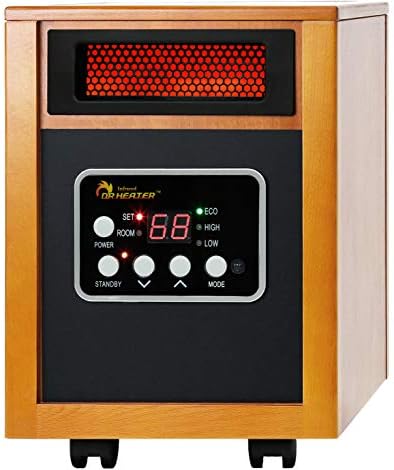
Dr Infrared Heater DR-968 is a portable electric heater with a wood-look cabinet, sized for living rooms, bedrooms and home offices where the unit will sit in plain view. Carpeted rooms benefit from its mix of radiant warmth and moving air, since the blower pushes heat out across the floor rather than letting it pool in one spot.
The cabinet style and furniture-grade build suit buyers who want a heater that looks like a side table instead of a plastic box. A 19-pound unit on carpet is stable, and the cool-touch cabinet matters when kids or pets brush past it.
Output is rated at 1500 watts and up to 5,200 BTU, with the brand claiming coverage up to 1000 sq. ft. and up to 60 percent more heat than single-PTC heaters at the same power. Dual infrared quartz and PTC heating combines direct radiant warmth with circulated air, and the high-velocity low-noise blower is listed at 39 dB.
Safety features include tip-over protection, overheat protection, automatic shutoff, a full metal housing and UL certification, and the unit is made without PTFE. An electronic thermostat spans 50F to 85F, with a 12-hour timer and infrared remote for adjustments from a seat.
The trade-off is size and weight: at 17 inches high and 19 pounds, it takes up real floor space and is awkward to carry between rooms, and the wood cabinet styling will not suit every decor. Buyers who want a tiny personal heater for a desk or nightstand should pick something else. Those heating a carpeted living room or bedroom who want quiet, furniture-like presence will find the DR-968 fits.
8. Space Heater, WINHL Portable Electric Heaters for Indoor Use,70 Oscillation
Compact 9.9-inch tower oscillates 70° to sweep warmth across a desk or sofa

Space Heater by WINHL is a compact PTC ceramic tower built for supplemental heat in personal spaces, not whole-room coverage. On carpet, its small footprint and 3.2-pound weight make it easy to set on a nightstand, desk or counter without blocking the floor, and the tower shape keeps the hot grille up away from plush pile.
It suits a buyer who wants quick warmth within a few feet of where they sit, such as a home office corner or bedside. The listing is clear that it is supplemental heat for small rooms, not a replacement for central heating.
A 1500W PTC ceramic element is listed to start blowing warm air within seconds, and the 70-degree auto oscillation sweeps heat side to side so a desk, sofa or bed gets even coverage instead of one hot stream. Controls include a remote, a thermostat and a 12-hour timer, and ECO mode cycles the heater on and off to hold the set temperature rather than running nonstop.
Safety covers overheat protection and a tip-over shutoff, which matters on carpet where kids and pets move around, and the unit is ETL listed. The brand says to plug it directly into a 15A wall outlet and never use an extension cord.
The limit is reach: at roughly 5.9 inches deep and 9.9 inches tall, it is built for personal spaces within a few feet, so a large carpeted room will not get even warmth from it. Buyers heating a whole living room should choose a larger unit. This one fits desk, nightstand and small-room use.
9. DREO Space Heater, Portable Electric Heaters for Indoor Use with Thermostat
ECO mode auto-adjusts heat to hold your set temperature and trim energy bills
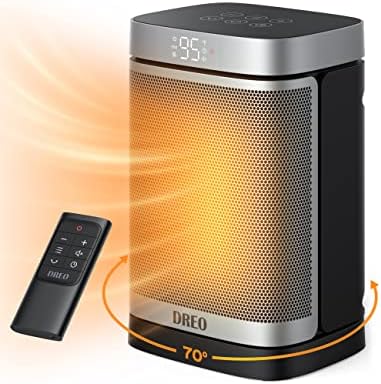
Carpeted rooms where cold air pools low and a small footprint matters suit the DREO Space Heater ECO, a compact ceramic unit built to sit on the floor by your feet. Its 1500W PTC element and Hyperamics technology are rated to reach the set temperature quickly, so it works for a bedroom, office or basement corner rather than a whole open plan space. Owners looking for a personal warm zone near a sofa or desk are the natural fit here.
The listing states a 70 degree oscillation sweep that spreads warmth across a wider arc, plus a digital thermostat adjustable from 41 to 95 degrees Fahrenheit in one degree steps. ECO mode changes the heat level on its own to hold your target temperature, and the 12 hour timer lets it shut off on schedule.
Safety on carpet matters, and the Shield360 system adds tip-over and overheat protection, an enhanced safety plug and UL94 V-0 flame-retardant materials. A brushless DC motor and nine aerodynamic blades keep noise as low as 37.5 dB.
The trade-off is reach. A 1500W floor unit with a 70 degree sweep warms the area around it well but will not carry a large carpeted room on its own, and the low placement means furniture can block the airflow. Buyers heating an open living space should look at a larger or taller model instead.
10. DREO Quiet Space Heater, 1500W Portable Heaters for Indoor Use with Remote
Eight safety protections including child lock and tip-over shutoff at 34dB

We researched the DREO Quiet Space Heater as a 1500W portable ceramic heater for indoor use, and the room it suits best is a carpeted bedroom, where soft floors make fan noise more noticeable. Its low profile and silver finish fit an office, guest room or bedroom, and the Hyperamics PTC system is listed as reaching up to 200 percent farther than traditional heaters, which matters when the unit sits low and warm air has to travel across the floor.
The features that matter most in the listing are the brushless DC motor and winglet fan design, which bring noise down to as low as 34dB, and the adjustable thermostat, which spans 41 to 95 degrees Fahrenheit in one degree increments. We compared the 70 degree oscillation, the 12-hour timer and the remote, and we picked out the safety package: a child lock, tip-over protection, V0 flame-retardant material, overheat protection and a safety plug, all ETL certified.
Owner feedback commonly mentions the quiet operation and the precise thermostat as the reasons they keep it in a bedroom.
The trade-off is that a quiet, low-profile heater still depends on being close to the person using it, so a large carpeted room with open doorways will feel uneven. Anyone who needs to heat a big space fast should pick a stronger, more directional heater instead.
What It Costs to Run
The power figure on the listing tells you most of what you need to know about running cost. The table uses the power figures from the listings above, at the highest setting.
| Power | 1 hour | 4 hrs a day | 8 hrs a day |
|---|---|---|---|
| 1,500 W | 1.5 kWh | 6 kWh | 12 kWh |
Your bill shows a price per kWh; multiply it by the figure above for the cost. A thermostat or a lower setting cuts the hours at full power, so real use is often below these figures.
How We Picked
To choose heaters for rooms with carpet, we relied on specifications and on feedback written by owners in reviews, advertising played no part.
In this category, we assessed heating output and number of heat settings, safety functions such as tip-over and overheat protection, thermostat design, operating noise, physical size and power cord length. We also considered controls, portability and the effort required to move each unit over carpet.
Recurring themes in owner reviews guided the selection. Positive comments frequently mention quick warmth, quiet running and straightforward controls. Repeated criticisms include loud fans, thermostats that deviate from the chosen temperature and units that switch on and off more often than anticipated.
The list was arranged to address varied needs and price points, not to crown a single best product. Compact, cheaper options appear next to bigger 1500W models and quieter units, letting a shopper pair a heater with room dimensions, noise preferences and budget.
Frequently Asked Questions
What Decides the Running Cost of a Space Heater for Carpeted Room Use?
What we found in our research is that running cost comes down to three things: the heater’s wattage, how long it runs, and your local electricity rate. A space heater for carpeted room use is often a smaller, lower wattage unit, so it can cost less per hour than a big whole room model.
Owners often report that the thermostat setting matters more than the headline wattage, because a heater that cycles on and off uses less power than one left running flat out.
Our comparison of product data showed that models with adjustable thermostats and timers give you more control over the hours the heater actually runs. That control is the real lever on cost.
Can a Space Heater for Carpeted Room Be Left on Overnight or Unattended?
Safety data from manufacturers and fire safety experts we reviewed is consistent: heaters should not be left running unattended, and that includes overnight while you sleep. A space heater for carpeted room use carries an extra risk because soft carpet fibres can block the base or intake if the unit tips or sits too low.
Look for a model with an automatic tip over switch and an overheat shutoff, and place it on a hard, flat surface rather than directly on deep pile.
Owners commonly report using timers so the heater runs for a set period and then shuts off, which is a middle ground rather than true unattended operation. Our advice is to treat any heater as something you switch off when you leave the room or go to bed.
What Wattage Space Heater for Carpeted Room Do We Need?
Room size is the main guide. A common rule from heating research is roughly 10 watts per square foot of floor area, so a 150 square foot carpeted bedroom points to about 1500 watts. Most portable space heaters top out at 1500 watts, which suits a single room. Larger open plan carpeted spaces may need more than one unit rather than a bigger single heater.
Our comparison of product data showed that many heaters offer high and low settings, often around 1500 and 750 watts, so you can match output to the room. Insulation and ceiling height shift the number, and a carpeted floor feels warmer underfoot, which can make a lower setting comfortable. Check the circuit the heater will share, because 1500 watts draws close to the limit of a standard household outlet.
How Noisy is a Space Heater for Carpeted Room?
Noise depends on the type. Radiant and oil filled heaters are usually silent because they have no fan, while fan forced models produce a steady whir. Our research into owner feedback found that people using a space heater in a carpeted bedroom often prefer the quiet types for sleep and for watching TV. Ceramic fan heaters move air well but are the louder option.
Carpet itself absorbs some sound, so a carpeted room tends to feel quieter than a hard floor room with the same heater. Fan noise is still noticeable in a small space, though. If quiet matters, look at the product data for a fanless design, and expect the thermostat click to be the only sound you hear.
Is a Space Heater for Carpeted Room Safe Around Children and Pets?
On paper, Safety features matter most here. We looked for cool touch housings, tip over switches, overheat protection and grilles that fingers and paws cannot reach through. A space heater on carpeted floor sits low, right at the level of crawling children and pets, so a sturdy base and a tip over cutoff are essential. Keep a clear zone around the unit and never let a cord trail across the carpet where someone can trip.
Our product data review showed that models with a cool exterior and automatic shutoff are the safer pick for homes with kids or animals. Owners often report that pets brush against heaters, so a unit that switches off when knocked is worth having. Supervision is still the main safeguard, and a heater should never be used as a drying rack for blankets or pet bedding.
Can We Plug a Space Heater for Carpeted Room into an Extension Cord or Power Strip?
Manufacturer guidance we reviewed is clear that heaters should be plugged directly into a wall outlet. A space heater draws high current, and a standard extension cord or power strip can overheat at that load. If a cord is unavoidable, it needs a heavy gauge rating that matches the heater’s wattage, and it should be short and fully unwound. Never run a cord under carpet, because heat builds up and you cannot see damage.
Our research into owner reports found that most problems trace back to overloaded strips or daisy chained cords. For a carpeted room, the cord also crosses a soft surface where it can be crushed or tripped over. The safest setup is a dedicated wall outlet near the heater, with the cord kept clear of foot traffic.
Final Thoughts
Our research team compared models for heat output, safety features and how they sit on carpet. We picked DREO Space Heaters as the best space heater for carpeted room overall, with stable bases and tip-over protection that owners commonly mention. WINHL Space Heaters suit buyers who want a low-profile unit that tucks against a wall.
GiveBest Space Heater is a sensible budget choice for small rooms where simple controls matter more than extras. Each pick reflects product data and owner feedback, not lab tests.
Whatever you choose, check the base and cord placement before buying. A wide, stable footprint and a tip-over switch matter more on soft flooring than raw wattage alone.